Popular Age Quiz is Front for Marketing and Advertising

How many of you have taken that widely circulated quiz to determine your “real” age?  You know, the one that gives you a “health” age as opposed to your chronological age?

It turns that the “quiz”  is a veiled attempt to extract health-related information from you that all sorts of marketers can use.

As the superb story in today’s Times points out, people reveal information in the course of doing the quiz that they almost certainly would not routinely disclose.

So if  you do the quiz and  then get an email about Boniva three weeks later, you’ll know why.

First Ever On-Line Town Hall Meeting Held By a US President: Thursday, March 26, 11:30 AM, EDT

I am naturally skeptical of anything billed as “new” or “improved.” Chalk that up to a childhood when a “new” and “improved” Tide detergent came out every month or so.

Check it out at 11:30 AM EDT.

Anatomy of a Scare: Stellar Reporting About the Alleged Autism/Vaccination Connection

Sharon Begley’s piece in the February 21st issue of Newsweek, Anatomy of a Scare, is a must read.

I am not sure I have ever seen a more complete and authoritative analysis of how one controversy over a medical issue played out in the mass media.

Someday I Might Tell You This Story


duvanich

Someday, if I can get past the emotions and bittersweet memories,  I am going to tell you why this man — my 6th grade teacher in West Covina, California —  probably taught me as much about patience, compassion, and decency as anyone I have known in my life.  I have even thought about writing a book about him. And I may.

Someday.

Please, Please Tell Me No One Will Watch This!


I have always tried to be realistic when it comes to the weird topics that attract large audiences.  Some topics that are easy to dismiss as disgusting and sensational really do speak to some of our most basic fears and anxieties. In all their sleaziness, they can connect to basic aspects of what it means to be a human being.

Stories of violence, infidelity, and disaster have grabbed our attention since antiquity, and I have always thought it futile to deny these fascinations or to suggest that we pay less attention.  We are going to pay attention.

Having said that, this morning I read about an upcoming broadcast that will almost certainly set some unofficial record for pathetic pandering and shameless sensationalism. We are talking about nonsense of the highest order.

Will anyone watch this? Of course. And that fact alone gives me a feeling someplace between the discomfort of indigestion and a minor traffic accident. 


Soccer Destroying America?

If this essay is a tongue-in-cheek humor piece, I send it along with sincere compliments  to the author for so deliciously and humorously impersonating idiocy at its most astounding.

If the guy is serious, then I send it along as idiocy at its most astounding.

What do you think?

I honestly can’t tell.

P.S. I just re-read it, and — if I had to bet the college fund ( or what’s left of it) — I’d say the author could not be serious and that this is a humor piece.

Give Silence a Try

This advice from James Fallows, about using silence as an interview technique, was directed at journalists. But it is something documentary filmmakers should also think about.

Learning when to be quiet  is sometimes more important, and more of a challenge, than learning what to say.

Who Remembers Kodak Colorama in Grand Central Station?

kodak

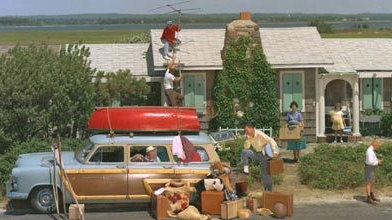
In retrospect, for all the occasional attractiveness of the giant photographs, the 40 year tenure of the  Kodak colorama was really a blight on the  Grand Central Station’s elegant architecture. 

I still miss it, though.  I loved so many of the pictures, even though the vision of American society  they depicted was as cloying and sentimental as you can imagine.

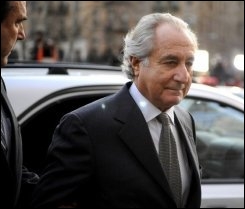
Bernard Madoff is Sorry; Or At Least The Person Who Wrote His Statement is Sorry

 madoff3

This is the statement that Bernard Madoff made in court today, as he pled guilty. 

Which leads me to ask the same question I have been asking for years:  is it too much to ask that a high profile public apology for criminal acts of this magnitude be written by the person who is actually apologizing?  For years “repentant” offenders have simply mouthed the handiwork of attorneys and public relations experts whose “rhetoric of deep regret” is as phony and unmistakable as a $2 bill.

I am not saying that Madoff  had nothing to do with this statement, but it is packed  with the kind of morally empty boilerplate that really is no apology at all.

I have a half-serious  idea:  When someone pleads guilty and wants to apologize for his or her crimes,  he or she should be be handed some paper and a pen by the judge and asked to spend an hour writing a hand-written apology.

Of course this doesn’t even slightly guarantee sincerity.  But isn’t it about time we end this charade of supposedly remorseful people reading statements actually written by other people?

What happens to genuine contrition in a world where crafting apologies has become an occupation?

Andrew Sullivan, Mensch

A blog post today by Andrew Sullivan on his “Daily Dish”  is a perfect example of why, while I don’t share his conservative politics,  I have so much respect for the rigor and honesty with which he grapples with ideas.  Andrew doesn’t issue pronouncements. He shares   an ongoing, flexible,  and painfully honest internal debate about what he thinks is right. 

Most of all, he does this with profound humility and attention to the moral and ethical implications of his thinking.  He actually asks whether public policies are civil, are ethical,  are compassionate.

Quaint, huh?

It feels strange to express my admiration for someone with whom I so frequently disagree. I suppose I am more and more frustrated with the incivility of those bloviators who seem so willfully apathetic about the human and emotional dimensions of public policy. Andrew rarely loses track of those things.

There, I said it.

Welcome to Google’s Weird World of INTEREST-BASED Advertising

Check out this important article in Wired. While Google still offers a variety of privacy settings, this effort to use a person’s search history to target ads is more than a little worrisome.

Supporting Actors? Character Actors? How About Just Actors? Pt.#2

pamela-h

In March, 2008, I posted a short piece about character actors.  Then, as now, I was uneasy about terms like “character” or “supporting”  that even unintentionally diminish the contribution that these performer can make to a film. 

I was thinking about this recently as I listened to Florian Henckel von Donnersmarck’s  director’s commentary on the DVD of his masterpiece The Lives of Others (Das Leben der Anderen).  (Yes, I respect the term ” masterpiece.”   No,  I don’t use it promiscuously.)  When I first watched the film, I didn’t know the work of many of the actors with small parts.  But I could tell that something unusual was happening, that each of them was contributing something profound and well beyond what is usually expected from someone with three or four lines. 

That is why it was so fascinating to hear von Donnersmarck  talk about how he cast these roles. Apparently, the parade of actors with small parts in that film was a veritable treasure trove of great German actors. Von Donnersmarck told of apologetic call after call that he made to  these highly respected actors, apologizing for offering them a small part and simultaneously trying to convince them that their role would be central.  His argument was that these are among the most important casting decisions made by a director.

I couldn’t agree more.

So here is my second, admittedly selective,  listing of actors  with small roles who  I think were arguably indispensable to the films in which they appeared. In some cases, they are actors who have played major roles in their home countries but generally smaller roles in films that are widely distributed in the United States.

Louis Guss

Frank Sivero

Ned Glass

Patricia Hitchcock

Margo Winkler

Gene Jones

Bert Freed

Michael K. Williams

Volkmar Kleinart

Sophie Okonedo

Irfan Khan
Sheila (Recorded Live in 1962 by The Beatles)

Sweet little Sheila

You’ll know her if you see her

Blue eyes and a crazy smile


Her cheeks are rosy

She loves and she shows me

Hey this little girl is fine.


Never knew a girl like

a little Sheila

Her very name drives me insane


Sweet little girl

that’s my pretty Sheila

Hey, this little girl is mine.


Me and Sheila go for a ride

I’m telling you I’m

feeling funny inside:


Then little Sheila

whispers in my ear

I’m telling you girl

I love you Sheila dear


Sheila says she loves me

She says she never leaves me

True love could never die

I’ll be really happy


just me and her together


True love could never die.

I’ll be really happy


just me and her together


Hey

this little girl is fine


Hey

this little girl is fine . . .

Who Wants to Take a Stroll Around Manhattan at Night, circa 1948?

The  great film noir,  Naked City,   directed by Jules Dassin,  would have been just as mesmerizing without this self-conscious two-minute introduction by producer Mark Hellinger telling you just how cool the film is. 

But with its aerial shots of the city and images of Manhattan at night,  even the intro has its own voice and charms — a tough-talking producer talking about a tough city and preparing you for a tough movie.

See the film. Since you can’t take a stroll around Manhattan in 1948, this is a pretty good consolation prize.

It’s infinitely hokier than Double Indemnity or Sunset Boulevard, and close to silly with its pseudo-documentary style. But still hypnotic.

Barry Manilow and the War Against Juvenile Delinquency

The recent bankruptcy of Muzak, originator of so-called elevator music,  was a reminder of all the ways that music — rather than being appreciated for intrinsic, transcendent beauty — has been used for propaganda and social control.

I will confess, though, that this is a pretty hilarious example of music being used to keep people in line. 

After all, he  is music and he writes the songs.