Where Did Goodness Go? It’s In The Past, Dummy, Always In the Past.

Have you ever thought about how media and culture represent the concepts of “past” and “present?”

The past is always better. It is when things were less complicated, when people were more civil, and when music wasn’t as loud.

The present is when things are going to “hell in a handbasket.” It is when we have lost track of fundamental values and when we have become more crude and more thoughtless.

Most of all,  the present is precisely when we have to return to the values that we honored until the present. They were the core of our goodness, the essence of our humanity, until — well — until today.

Why do we do this?

I don’t know, but as I look around at this turbulent and unforgiving world, I can only remember the “peace and decency” that was pervasive just moments ago when I started to write this.

Sometimes I think that, as pleasurable as it is to be nostalgic, there are few places where we more brazenly reveal our ignorance:

Do people really want to go back to that idyllic past — the one without polio vaccine, the one with segregation, the one where you weren’t inconvenienced by nuisances like seat belts, the one where anybody could freely make and distribute food without worrying about safety standards set by the FDA, the one where lynching was so pervasive that people sent lynching postcards back home to brag about being a witness,  the one before medicare was established when my grandmother with heart disease could luxuriate in the serenity of knowing that the government was staying out of healthcare.

Those were special times, weren’t they?

No Jugular Here

Just one more thing about Mark Sanford.

By his own admission, he betrayed the trust of almost anyone who meant anything to him.

His acts crossed the line from private behavior to public performance in office, rendering him unsuitable to be Governor of South Carolina.

But I simply can’t revel in this misfortune. I recognize that some people  — good journalists — do have to be immersed in all the sleaze to serve the public’s need to know. I don’t.

Now we have the letters between Sanford and his paramour. And most of what I see — beneath the contemptible conduct — is an incredibly frail and flawed human being.

I just can’t work up the glee and sarcasm that is flooding the news this morning.

I think this is the guy to whom I’ll give the final  word.

He that is without sin among you, let him first cast a stone.

– John 8:7

Perhaps My Favorite Blog Comment Ever!

Obviously, I won’t identify her.

But one of my friends (I’m telling you, she is such a witty  smart a__ that she has probably already thought of a good line satirizing my having called her a friend in this sentence! ) sent me the following reaction to my piece on the sleazy Governor of South Carolina.

I will treasure it:

“Agree with you wholeheartedly – save this, I may never say it again.”

Believe me, I will save it.  And I am already plotting my response.

From the Appalachian Trail to Buenos Aires: An Easy Case of Private Behavior Affecting Perfomance in Public Office

MSNBC_6.24

“Oh what a tangled web we weave, When first we practice to deceive”

Sir Walter Scott

In the years I have been teaching, my students and I have closely monitored the evolution of the distinction between public and private. Slowly, and not always clearly, we have watched society change from a place where a private life could be conducted away from media scrutiny to a society in which virtually no private space seems to exist.

We have also watched as the public gradually came to accept that their national leaders would come with all manner of personal flaws that would not necessarily disqualify them from public office. It is almost hard to remember a time when some marijuana use could potentially derail a campaign for national office.  I remember.

Infidelity, though, still seems to occupy a somewhat ambiguous place in political culture. To be sure, we have in the last two decades knowingly elected a president who had committed adultery. There might have been many who argued that adultery revealed something important about character. But those people were outnumbered by a majority who listened to the  the taped conversation between Bill Clinton and Jennifer Flowers before the election and decided that it would not affect their vote.

Today, though, in South Carolina, we witnessed a bizarre episode that will almost certain reopen the discussion of when it might be entirely appropriate for the public to consider private behavior when evaluating public performance.

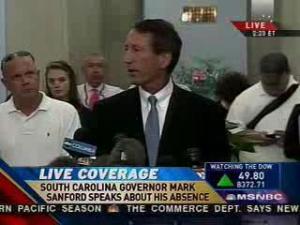
Governor Mark Sanford, after close to a week in which virtually no one knew his whereabouts, admitted — in what the New York Times called a “rambling” press conference — that contrary to previous reports placing him on the Appalachian Trail for some R&R,  he had actually been in Argentina conducting an extra-marital affair.

Public or private?

I see this as an easy example of an episode in which private behavior clearly affected public performance; a case in which that behavior might rise to level of negligence and dereliction of duty. And I am not thinking primarily about the sex.

Governor Sanford disappeared. His wife told reporters during his absence that she didn’t know where he was. At some point, she announced that he was hiking on the Appalachian Trail.  While she actually may have known more, the fact remains that the people of South Carolina didn’t. Their Governor was hiding.

Bad. Very bad.

And even if he had simply been ballroom dancing, he was would not have been available to his constituents  if there had been some “God forbid” moment. The fact that he had disappeared into an ongoing extramarital affair simply reveals a little more of what went into his cost/benefit analysis when  he contemplated flying the coop.

I will always have a weakness for human frailty.  I won’t even bother to say that I don’t expect perfect leaders because no one is perfect, especially those who claim to be. Just because Sanford is an outsized character in a news saga does not mean he is not also a human being who hurts and hopes and struggles.

But this crosses a line. You can be a Governor. And you can disappear.  But you can’t be a Governor and disappear.

Easy call. He has to go. Private acts, in this case, lead directly to professional neglect.

Later Comment: Just yesterday in my class Journalism and Society, we were discussing how honesty, even about difficult topics, usually trumps deception.  Read the statement that Governor Sanford’s staff released in the midst of his disappearance.

“Gov. Sanford is taking some time away from the office this week to recharge after the stimulus battle and the legislative session, and to work on a couple of projects that have fallen by the wayside. We are not going to discuss the specifics of his travel arrangements or his security arrangements.”

I don’t know about you, but I find this kind of weasily  lie drafted by a junior  flack to be a greater sin than adultery.

Projects that have “fallen by the wayside?” Right. And even their decision to lie and put him on the Appalachian trail was calculated political claptrap. The Appalachian Trail comes close but does not  run through South Carolina. So the lie put him in the glory of nature, kept him “fictionally” very close to South Carolina,  but allowed them to “honestly” say he was “out of state.”
“Tweets of Terror:” Check Out Andrew Sullivan’s Ongoing Iran Coverage

Iran violence

Have any of you checked out the incredible coverage of the events in Iran on Andrew Sullivan’s Daily Dish?

Andrew has reminded his readers again and again that much of the video and twitter-traffic cannot be fully verified and sourced.  But even taken with that major grain of salt,  the images and words spilling out of Iran in digital form are simply mesmerizing (and terrifying).

I can’t recommend Daily Dish strongly enough for a taste of journalism in the era  of “links.”  Is it fully authoritative? No. But Andrew himself has been absolutely clear about these  limitations. No one can be absolutely certain of the origin of much of the horrifying video, he continually reminds us, but it is a major source of raw material that will eventually be part of a larger, more coherent story.

Please check out the Daily Dish and look at some of the video.  Even if one discounts half of these images as fraudulent (unlikely), the remaining half tell a story of fearless resistance to authoritarian power.  And, sadly,  of an astoundingly brutal response by that power.

The flood of video and text from Iran —  as well as the brilliant way that Sullivan is collating and editing and commenting on it — is an extraordinary example  of  digital age journalism  reaching maturity.

After looking at much of the video, I had a surprizing reaction: I really hope a few specific videos are   fraudulent. If they are genuine,  the brutality is almost unbearable.

The Arguments About Blogs and Twitters and Tweets Are Interesting, But Irrelevant; They Have Come of Age

twitter-bird-wallpaper

Something extremely important is happening at this very moment and it is worth taking a look.

Despite all the past debate about the blogosphere — sometimes heated — among conventional journalists, bloggers, and plain old twitterers , the New York Times is putting together some extraordinary breaking coverage of the events in Iran using just these types of “questionable” sources.

These  include Flickr, Twitter,  social networks, instant messaging, You Tube, and numerous blogs. The Times coverage appears in the Lede blog on the home page of the Internet edition.

I have always listened when Bill Keller, Times Managing Editor, and other journalists have offered their sometimes biting critique of the blogosphere:  Who are these bloggers? What are their sources? How can they be trusted?  These are fair questions.

But forget those  arguments for a second and look at the Times itself. The fact is that, when events like those in Iran occurred,   experienced journalists immediately  looked to all these fragmented sources and knew just what to do with them.  They collated them, questioned them, linked to them, accepted some,  rejected others,  and tried to fit them into  a larger puzzle.  It worked.

One big kvetch of conventional journalists has been that the blogosphere has no fact-checkers and editors.  But the complaint has essentially fizzled. The Times proved a basic point:

They are still the editors!

No one forced them to quote from the blogs and the tweets of students caught in the midst of demonstrations.  They did it carefully,  and with the clear belief that “the amateurs” helped fill-in the details of the complex story they were covering.

And what do you know? The amateurs didn’t overrun quality journalism. They didn’t replace it. They became an indispensable part of the mix.

In the end, all these new-fangled news sources from the street turned out to be  not all that different from the old stodgy, official sources: You look at them, judge their validity, decide when they can be embedded in a larger story, and either use them or not use them. Of course, you have to be cautious, very cautious, but  —  in the end — you are still the editor.

“Bernie Made Us Money Because, Well, Bernie Was Bernie!” PBS’s Frontline Takes On the Madoff Scam

america-depression

You can only watch a  cash register so many times on the evening news before you realize how difficult it is to cover a complex, systemic issue like economics.   Economic upheaval —  and the resulting unemployment, hunger, and human suffering —  is first visible (or invisible)  in very “unsexy” computer bytes and programming code that record everything from credit default swaps to out-and-out Madoff-style thievery.

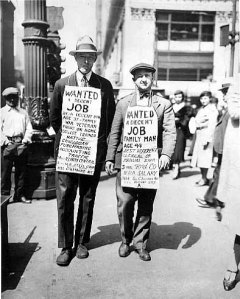
The other day someone in one of my classes remarked that, at least in the depression, there were countless visuals of suffering and a group of extraordinary photographers to record them. Those early 20th century images remain eloquent testimony of the suffering wrought by speculators and other assorted financial crooks.

Today, though,   white-collar crime is more complex and more quiet.  It is a stealth enterprise in which one corrupt accountant  can press the send button on his or her computer,  and send hundreds of phony profit statements reporting non-existent  earnings to victims of the latest Ponzi scheme.

Well today it was all a little less baffling.

The PBS documentary series “Frontline” has produced an extraordinary 90 minute documentary that clearly explains how so many smart people lost so much money in Bernard Madoff’s  scheme. The mechanics of the theft are fascinating.

But even more fascinating is the depiction of how people, happy with more and more profits,  created a distorted picture of the world  for themselves in which it was impossible to see even Madoff’s most ludicrous and bizarre behavior as anything unusual.  Bernie was making them money , and it was oh so easy to imagine a world in which it all made sense. The documentary tells the stories of one shrewd person after another who, though capable of due diligence in every aspect of their lives,  made room for Bernie’s peculiar practices simply because the money was good. 

If Bernie the multibillion-dollar money manager happened to use one only one anonymous accountant  whose office was in a strip mall, there had to be a reason. And who knew the reason? Bernie. Because Bernie was, after all,  Bernie.

What an incredibly important lesson:   At just the right moment, not two weeks or two months later when with hindsight everything becomes clear, we are capable of convincing ourselves of ridiculously implausible realities simply because the money is good.

I can’t recommend this documentary strongly  enough. By the way, much of it is the reporting work of Frontline correspondent Martin Smith.

Check it out. You can watch it for free online.

Switch to Decaf. Switch Now.

I am going to sound like a broken record soon, but there are sometimes when I simply can’t stop myself .

I thought my  Chicago Tribune piece about maniacal cable news would make me feel better, calm me down a little, but it didn’t work.

Now it’s  the shouters who often speak for me  — my  “loudmouths,” if you will  — who are about to push me off the deep end.

Is there any chance,   any chance at all,  that hot air machines like Ed Schultz, Chrtis Matthews or Keith Olberman have any idea how deranged even their  most persusave and courageous views can sound when they are shouted in a hyperventilating, salivating frenzy. 

I wish I could think of a more nuanced way to put it,  guys, but you have to switch  to decaf.  Your  indignation, however justified, will emerge in the clarity and elegance of your argument  and not with the accelerartion of your heart rate. 

You look ridiculous. Bulging neck veins don’t make you more authoritative, they bring on heart attacks.

Here’s how sick of the nuttiness I am, how much I want the “debate by dynamite” to stop. I am going to quote from Richard Nixon’s first innaugural address.  That’s right. Richard Nixon. Paragon of quiet, honest, reasoned argument.

I won’t suggest that Nixon followed his own advice,  nor that he even wrote the following passage. But he did say it,  and it keeps coming to mind as I watch the shoutocracy of cable  news act as if they are mainlining Red Bull.

“To lower our voices would be a simple thing …..  We cannot learn from one another until we stop shouting at one another–until we speak quietly enough so that our words can be heard as well as our voices.”

Richard Nixon,  January 20, 1969 

Twenty Years Later; New Pictures of “Tank Man”

Tank Man

Just when one photo becomes iconic —  indeed, one of the most recognized images of the last several decades —  some new ones of the same event surface.