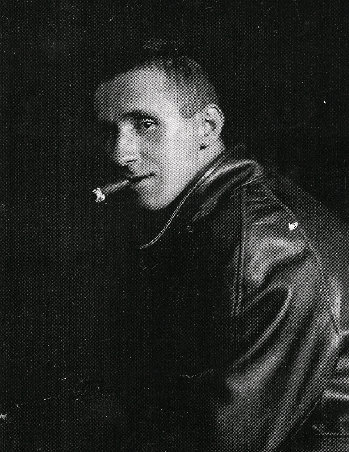
No Joke: Maybe the Coolest Dude in the 20th Century. Hint: This Picture Taken in 1929. Brilliant. Politically Progressive. Playwright. Master Satirist and Theatrical Visionary. And the Owner of One Incredible Leather Jacket.
3
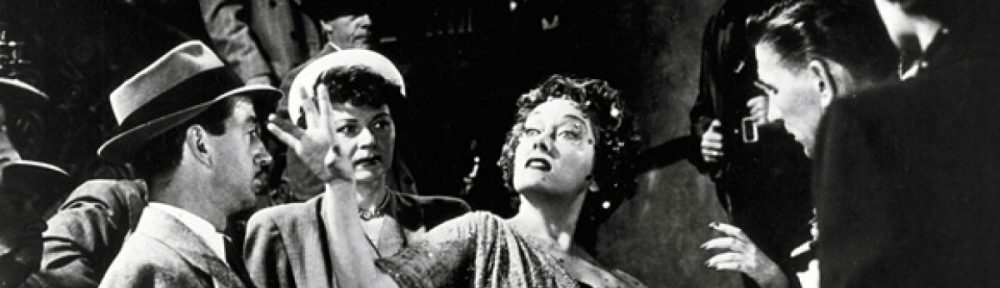

Ok, so I’m sitting here alone in the dark scaring myself crazy for the umpteenth time watching Hitchcock’s masterpiece Psycho.
It reminded me of a Saturday night in the early 1960s when my parents left my sister and I home for the evening — I think we were 11 and 12 — and one of the television networks actually broadcast the film. We were terrified and our parents came home to us whimpering and cowering in the corner of the living room.
The reason I stopped the film for a moment, though, is that yet again I am marvelling at the musical score by the extraodinary Bernard Herrmann.
Have a film and a musical score ever fit together so well, with such extraordinary and terrifying results? In fact, have a director and composer ever been so indispensable to each other?
Don’t laugh, but it just might be a little too dark and little too late and a little too rainy here on the east coast to turn it back on. Janet Leigh is about to be stopped by THE POLICEMAN and, if you’ve never seen the film and never seen THE POLICEMAN’S sun glasses, get some friends to keep you company and do so immediately.
Or maybe I could fast-forward past THE POLICEMAN. Let me go get a Mallomar while I decide. In fact, I think that unfinished barbecued chicken leg is still in the fridge.

No shock here. The virtually unbroken string of bad biopics apparently continues with Amelia. I will see it out of almost unqualified admiration for director Mira Nair, but nothing in the many reviews I have seen suggests that the film transcends standard, tired biopic conventions.
Gus Van Sant’s “Milk” probably came the closest to reviving the whole genre. In fact, Van Sant may have fully succeeded (your call). But there are, I think, some good reasons that biopic screenplays usually stink up the house:
– including every obligatory “sacred” historic moment, regardless of how well they fit into a coherent story or how true they might be
– the over-investment in making sure the actors look and sound like the people they are playing. I have always felt that physical resemblance only works when the effort put into makeup, however precise, is exceeded by the even greater performance of a brilliant actor. It makes perfect sense that the two best “look-alike” performances I have ever seen were by actors who are consensus members of the pantheon — Bruno Ganz in Der Untergang and Sean Penn in Milk. )
– the unavoidable hagiography
– the drive to be so exhaustively complete that the story sinks from the weight of its self-conscious authority
– a director or actor so obsessed with an historical personality that he or she confuses the character in the film and the actual person being depicted. (Kevin Spacey and Bobby Darin?) Rare but spooky.
The baffling thing here is that a great filmmaker like Mira Nair took on Amelia.
Mira Nair. The Mira Nair who made Monsoon Wedding and The Namesake. The brilliant, luminous Mira Nair.
We need to remember that authenticity and accuracy are historical, not dramaturgical, concepts.
The very best films about lives don’t take on the heavy and weighted obligation of completeness. They pick an episode in a life and, through the unfolding of events and character during that episode, reveal aspects of a complex life. Capote, Henry and June, and Downfall (Der Untergang) are three good, random examples. These films also succeed by embedding the main character in a world of comparably interesting , and maybe even more interesting, characters.
I’ll leave you with one admittedly unconventional recommendation and one worry.
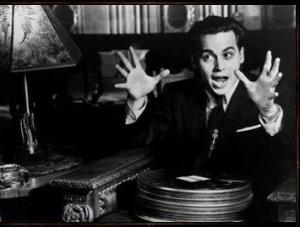
Recommendation: My favorite biopic really isn’t a biopic at all. But with its crazy sensibility, hilarity, cast of grotesque characters, and overwhelming quirkiness, Tim Burton’s Ed Wood is my favorite “life-story” of them all.
Worry: Spielberg, as you may know, is doing Lincoln. I believe Liam Neeson got the part. My fear is that Lincoln’s complex, even anguished , life could be buried beneath “Private Ryan” schmaltz, expensive costumes, overwrought John Williams music, the flood of signature close-ups of Lincoln’s face, and the quest for accuracy. None of these equal compelling drama and conflict. In fact, all this nonsense often hides a lack of compelling narrative.
We’ll see.
The energy of punk with the soul of Appalachia. I have never heard anything like this.
They found him. He was at home the whole time.
Let’s cut to the chase. I was a difficult little kid. But I am absolutely sure that my Mom would agree I never did anything like this.
I mean, how do you calculate the appropriate length of time to ground a kid when the offense is nothing less than scaring millions of people and mobilizing legions of rescuers? Life grounding without parole? Trying a juvenile “hider-in-a-box” as an adult?
And how much, if any, blame do you assign to the parents?
I don’t know, I don’t care, and I am finished with this topic
What a day.

One occupational reality of someone who grapples with trauma and its media and cultural representations is that a moment of terror — I mean MY terror — is (after the worst of the shock wears off) a chance to learn about, not only myself, but about what makes terror.
I don’t want to imply that I come quickly to clinical distance. I am fully capable of feeling terror and trauma. I feel it right now and have felt it for the last hour and a half. But I long ago gave up the idea that any amount of intellectual understanding would immunize me from these or any feelings.
Please take a look at the news bulletin above that I received about an hour and a half ago from CNN. I am still shaking.
Perhaps you help me explore what variables came together — everything from the larger social context to the nature of the story to my own shtick (which of course you don’t know very well) — to give me (and now I read thousands of others) almost unbearably terrifying feelings.
The worst is over, but I am still shaky.
As of 5:25 EST, this was where the story stood.

I have always been a collector of memories. And, as many of you already know, the digital age has made memory-collecting a very different and exciting enterprise. People are easier to find. Old photos easier to scan and share. Google “Street-View” even lets you see what a given address looks like today.
This morning I woke up thinking of Vincent Avenue Elementary School in Covina, California. I was a 6th grader there and had a teacher — John Duvanich — who was an extraordinary influence on my life.
Anyway, I checked and found out that Vincent School is no more but that it now houses a wonderful entity called The Vincent Children’s Center, with special education programs for pre-schoolers. Is that great or what?

The school was originally one of many built in the 1950s to handle the mob of baby boomers. When we all stopped booming, the school closed and then reopened to provide special education services.
When I attended, virtually no special education services were provided. The Individuals With Disabilities Education Act of 2005, with its origins in an earlier 1975 law, had not yet mandated equal treatment for the disabled. The law made The Vincent Children’s Center possible.
Given all available digital tools, this took me 10 minutes to find out.
Nice. Real nice.
Now I have to go back and visit Room 16.
Room 16. Magic.

This will be an interesting couple of weeks for the producers of ground beef.
Michael Moss has produced a masterful piece of investigative reporting in today’s Sunday New York Times entitled “The Burger That Shattered Her Life.”
If someone had told me that a meat-grinding expose was coming, I would have assumed that, since no inspection process is perfect, problems would inevitably be discovered and reported.
But I never would have expected revelations about the content of ground beef that seem drawn from Upton Sinclair’s nightmarish early 20th century muckraking classic ” The Jungle.”
I mean, we are talking about a serious “yuck-factor.”
Moss’s story is a brilliant combination of the poignant story of an individual victim embedded in a larger story about the shoddy and secretive system that was responsible for her sickness and paralysis. The story closely follows the specific lot of tainted meat that harmed the young woman from the various factories that produced it to her dinner table. It is not a pleasant journey.
This is what a great reporter can do.
I may be dating myself , but the “Sheila Rule” is a little known principle that has guided record producers since the mid-1950s.
The rule states that, when all else fails for a recording artist or producer, record any song with a title including the name Sheila. It will be successful solely because Sheilas are inherently and magically charming .
Here is something interesting. Tommy Roe had an early 60s mega-hit with the song Pretty Sheila. But several years before, in 1957 I think, he recorded a stripped-down , garage-version of the same song for Judd records that I just found after searching for quite a while. Notice how Judd Records mispelled the name Sheila as Shelia.
Enjoy and all hail the “Sheila Rule.”
Ok, I confess. Sheila was my first love. I was 11.
Last night, David Letterman opened his late night television with a startling account a blackmail plot. Apparently, the alleged blackmailer had information that Letterman had had sexual relations with some members of his staff and was demanding a payment of $2 million to keep silent.
I in no way want to minimize the extent to which sexual relations in the workplace have the potential, given the power of the employer to hire ands fire, to be exploitative and oppressive. It has happened in many cases and on occasion led to litigation.
However, this serious issue is not what I wanted to mention.
It is Letterman’s performance.
The video below, in which Letterman tells the whole story to his audience, is one of the most surreal things I have ever seen. Watch how long the audience takes to figure out that Letterman is not doing a comedy monologue. It seems as if, through humor, he is 1) easing his own way through a disclosure that must have been excruciating to make and 2) providing the audience with just enough levity to help them sit through a story that, if told without any irony or self-mockery, could really have been a horrifying experience.
I also find it interesting to watch because, in addition to everything else Letterman is trying to accomplish, it is clear he is also trying to walk the line between humor and horror in a way that protects what is, more than anything else, a valuable comedy franchise/brand.
Again, I point this out as a case study in high-stakes communication and rhetoric with full awareness that I am not addressing the serious questions about sexual harassment that may or may not have been at play in this case.
How does a comedian make a a painful confession in a way that minimizes the erosion of his reputation as a comedian?
This is how.
 MEDIA AND MAYHEM