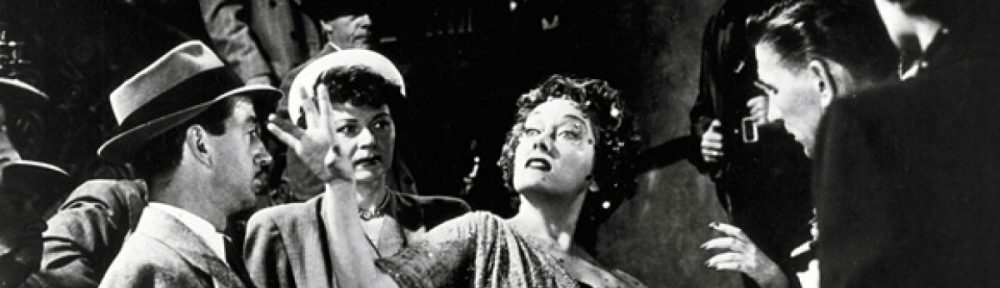
Whoopee! Criterion Collection Now Available for Viewing on Netflix.


Netflix has added much of the Criterion catalogue to the films they make available for instant viewing/streaming. This means that, if you are a Netflix member, much of the 20th century film canon (with an admittedly Western European bias)  is there for you to enjoy.

I would never argue that this is the best way to appreciate a great film. A DVD played on a decent sized monitor will almost always trump your laptop. (In an era when,sadly,  seeing a film on a large screen is almost too much to ask for!)  But if you’d like to check off some classics you somehow missed, this is worth checking out.

I just quickly glanced at the Netflix “instant-viewing” list and saw G.W. Pabst’s Pandora’s Box, Vittorio De Sica’s The Bicycle Thief,  Carol Reed’s The Third Man, Marcel Carne’s Les Enfants du Paradis, and an incredible treat that I first saw thanks to my colleague Mick Hurbis-Cherrier, Henri-George Clouzot’s Le Corbeau.

I almost forgot to mention that this collection includes Wim Wenders’s Paris, Texas, a haunting meditation on  rootlessness and loss with a beautiful, spare screenplay by playwright Sam Shepard.

And many more.

Enjoy.

A New Law: The Appearance of Any New Technology Will Eventually Be Followed By Some Egregious Misuse of That Technology By An Entity That Might Include, But Not Be Limited To, The Lower Merion School District.


I was about to begin this with the standard “if this turns out to be true.”

But the Lower Merion School District has in fact admitted that they were able to surreptitiously activate the webcams on school-issued laptops and watch students at home.

I’ll probably get angry in a few minutes, but right now I’m just sitting here stunned and speechless at a privacy violation that would seem to set a new standard of odiousness. 

I’ll say this for the Lower Merion School District: At least they did us the favor of violating privacy with such heavy-handedness and lack of sophistication that no one will be able to sanely argue that their actions were in some gray or uncertain realm. This was surveillance at its best and most sinister, straight out of  Orwell.   

And they’re being sued.

Let This Be a Warning to Film Grad Students Who Excuse Absences By Saying They Have To Be “On Location”

It is going to be harder and harder to “go on location.”

Boy, 11, Left Alone

Sometimes, when I glance at just a few words in a headline, I can just feel the inevitable sadness to follow.

Like this.

J.D. Salinger Explains Why He Resisted a “Catcher in the Rye” Film

I have always been glad that he never sold the film rights.

Paul Dano: Mark My Words

If you have seen There Will Be Blood, there is no way you could have forgotten Paul Dano’s brilliant performance as Eli Sunday. This was creepiness as high art. Whether his acting went over the top is certainly a fair question, yet this very well have been a film in which his lapse into hyper-lunacy was an absolutely integral part of the narrative.

A performance this unusual and  idiosyncratic by a newcomer has had me wondering: Does he have range? Can he do “super-subtle?” Or even regular old subtle? What else does he have?

Watch Paul. If he can also be playful and versatile, and if he takes his craft seriously, he very well might contend for a spot in the male pantheon with Penn and Depp.

By all means, if you somehow missed There Will Be Blood, see it. Daniel Day-Lewis is also remarkable, and it was great to see him in a role that needed every bit of his bombast.

This is What Happens to Someone Who Mocks Winter. I Will Never Speak Ill of the Joys of Frostbite and Ice Again.


Yes. Cold is fun. You get hot chocolate. Who needs the Napali Coast anyway?

A Doc Film Appropriate for a Blizzard


Actually, I briefly considered trying to be mildly amusing about this, but decided to show some unexpected good taste.

You probably have heard that we are in the midst of a  blizzard here in New Jersey and New York. As I wrote to my students today canceling class in Hunter College’s Department of Film and Media Studies, I somehow remembered to recommend a superb and weather-appropriate documentary that is now available for free streaming on the PBS video site.

Check out the The Donner Party,  a film by Ric Burns.

The story of this ill-fated, 1846 journey to California in the midst of a brutal winter is riveting. As a kid growing up in Southern California, it was a story told many times, as if the desperate attempt to make it to California was somehow confirmation of that state’s status as a mythical golden land.

Andy Borowitz Announces New Social Media “Killer App”


Andy is consistently hilarious. And virtually every news bulletin of his makes some larger, more profound, point. No one deflates pretense and arrogance and bloviation with more style and humor.

Today, though, he discovers a social networking technology so brilliant that it  could soon mean the end for Facebook and MySpace.

Tiger’s Collapse. And Now His Resurrection?


On December 14th, I shared some thoughts about what might happen to the Tiger Woods brand/franchise in light of his personal travails. I  really had no idea how it would all unfold given the enormity of the Woods brand and the incredible symbolic power of his personality.  Another way of saying this is that  few personalities touched by scandal have had as far to fall.

Well, he fell.  And then fell some more.

As each sponsor either fired him outright or more subtly distanced themselves, it became clear that the whole brand had been anchored by his perceived reliability, toughness, persistence, and solidity.  To use one overused phrase: Tiger was someone you could take to the bank.  To use one even more overused: When the going gets tough, Tiger gets going.

OK, I’ll stop.

The point is that his transgressions were not peripheral to his mythology. They were a direct contradiction of the whole structure of the franchise.  And many of the sponsors capitalizing on  his identity couldn’t run for cover fast enough.

But here is the main point I want to make: Everything we know about the social and economic functions of celebrity suggests that his resurrection  is at hand. Again and again — especially when  the potential financial rewards for so many parties are so enormous — our culture enables even the most tarnished brand to be revived. Apologies are given, forgiveness is sought, and the fallen idol slowly begins the ascent back to the top. We  love the drama of  atonement.

In class, I sometimes state it in the form of a “law:”

The speed with which a public figure falls from grace is only exceeded by the speed with which he or she seeks forgiveness and  is allowed  to return to prominence.

We’ll see.

Great Songs/Themes in Films #2: Narciso Yepes – Romance from ‘Jeux Interdits’ (1952)


The little girl on the record label, the character Paulette in René Clément‘s masterpiece Jeux Interdits (Forbidden Games) , is the actress Brigitte Fossey.  Now 64 years old, she has had a lengthy and productive career in French cinema.

The theme song from the film, which would be haunting in any context, is a shattering musical backdrop for this film about the impact of World War II on a French peasant family. The composer and performer was Narciso Yepes, an acclaimed classical guitarist from Spain. You very well may have heard the theme without knowing its origin. I have noticed that it is a standard part of the street/subway guitarist’s repertoire.

I won’t spoil the ending of the film,  but I don’t know anyone who has watched the film’s final few minutes who hasn’t experienced either run of the mill sadness or complete despair.

Did Objectivity Kill the News? Some Thoughts from Chris Hedges


I am a big fan of the writer Chris Hedges, especially his stunning and disturbing book War is a Force That Gives Us Meaning.  Hedges has been a reporter for both the New York Times and the Christian Science Monitor.

Chris has written a short provocative essay about the negative consequences of objectivity in journalism. I strongly recommend it. 

I am still playing around with it and, because Hedges is not one for understatement, I suspect that I might come out with a slightly more moderate take on the issue.

But, as usual, he has challenged a taken for granted orthodoxy with passion and insight.  What,  he asks, is so great about slavish attention to objectivity if we use it almost ritualistically to avoid, and not face, complexity and nuance. What  about the cases in which fairness might not be justified, when a journalist’s best judgement is that only one, and one side alone, holds up?

I always need time to digest Hedges, but I never need  time to be provoked.