“We will not walk in fear, one of another”

October 25, 2008


A lot of my political side – especially the passion and anger that I feel about issues and candidates — never makes it on to this blog. And I thought I would explain.

I am not without strongly held political beliefs.  Neither am I at all covert about them.  I will often share my basic opinions so students can have some sense of who I am as a political and social being. Feigned neutrality, I have always thought, would be its own form of dishonesty.

But anyone who has taken my classes (or who ever will in the future) knows of my special concern for the feelings and attitudes of students who I either suspect or know might disagree with me. As much as anything, I want my classes to be safe places for the expression of political views from anyplace on the political spectrum, and even for views so marginalized that they might not have even made it on to the mainstream spectrum!  The joy of clashing ideas, especially when marked by both passion and civility – is a special thrill of teaching at a university. If we can’t do it in a university, where can we do it?

Having said that, I did start this blog especially for my students at Hunter College.  Media Studies is a rapidly evolving field and is being defined and redefined in public discourse every single day. The main purpose of my blog — Media and Mayhem — is to share this ongoing change with students as it unfolds. Last week, for example, a historic moment occurred in the evolution of the Internet: More people saw Tina Fey’s impressions of Governor Palin on-line than saw them when they were originally broadcast on NBC.

I suppose I mention all this because we now face the last ten days of a long, hard-fought campaign for the presidency. And because I support one of the candidates, Senator Obama, I wanted to make absolutely sure that all of you who are Hunter students feel absolutely free to either publicly or privately express views that might be to the contrary. You are welcome to raise them in class, to come see me, or to be in touch via email.  Some of you already have, and this touches me very deeply.

Keep it coming. And if in the next week I blurt out something in my excitement or enthusiasm – or in my anger and frustration – know that your contrary expression of  excitement or anger will be even more welcome, and will be met with civility and respect.

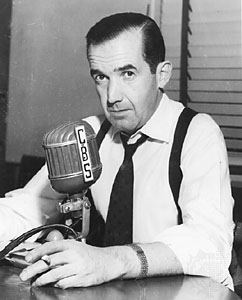
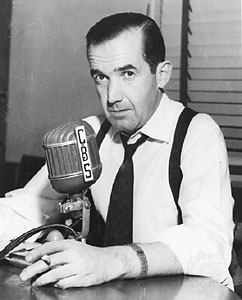
We are living through an extraordinarily historic election, taking place amidst economic chaos and wars on several fronts. Now is not the time to be shy, silent or reticent, whether you support Senator McCain, Senator Obama, Ralph Nader, Ron Paul, or any one of a number of other candidates.  As Edward R. Murrow once said in a broadcast that many of my students have seen:

 “We will not walk in fear, one of another, we will not be driven by fear into an age of unreason. If we dig deep into our history and our doctrine, we will remember we are not descended from fearful men. Not from men who feared to write, to speak, to associate, and to defend causes that were, for the moment, unpopular…. There is no way for a citizen of the republic to abdicate his responsibilities. As a nation we have come into our full inheritance at a tender age. We proclaim ourselves as indeed we are, the defenders of freedom where ever it still exists in the world. But we cannot defend freedom abroad by deserting it at home.”


Andrew Malcolm of The LA Times May Need to Do Some Deep Breathing Exercises

April 17, 2008


Andrew Malcolm does a really fine blog on politics for the Los Angeles Times. It is called “Top of the Ticket,” and I recommend it. 


But I need someone to do a reality check for me.


In the last hour Malcolm posted what is either a pretty nifty prank or an astoundingly dumb column suggesting that today in Pennsylvania Barack Obama gave Hilary Clinton the finger during a speech.  Now I think Malcolm may be joking as a way of satirizing last night’s nit-picking, issue-free debate.  I have seen Obama scratch his cheek this way countless times.


But what do you think?


I think that if he is serious, and that if he really believes he sees Obama flipping the bird, Malcolm may truly be coming undone. And the LA Times may have posted the single strangest column thus far in the election season. Am I hopelessly old-fashioned or am I right to think that it is beyond weird for the LA Times to use any of their space for nuttiness like this?


Check out Malcolm’s post and the Youtube video below. Somebody please tell me if you think Malcolm is joking or if you think he did give the middle finger.


The Piety Test

April 13, 2008

Are any of you watching tonight’s “Compassion Forum” live from Messiah College in Pennsylvania? One after the other, Senators Clinton and Obama are answering questions about religion, faith, and compassion.


I’ll share something that I rarely talk about: My religious beliefs are central to who I am, especially what Jews call Tikkun Olam, or “repairing the world” through selflessness, good works and charity.  No big surprise that I don’t always act in according to those principles, but I do try.


So why does a “Compassion Forum” give me the willies? Why do I find myself interested in the questions being asked of each candidate and the answers being given, yet still profoundly uneasy about the whole thing?


I had the privilege of growing up with a close friend whose father was the sage and compassionate leader of a major Protestant denomination. Not the typical friend of a Jewish kid from Southern California, but – hey — how often do you get a best friend with whom you can simultaneously act out adolescent nuttiness and contemplate profound matters of faith.


What I am leading to was a view of church-state relations I learned from my friend  that has been basic to who I am: The temptation to mix and confuse the unique roles of government and religion, especially in fearful and uncertain times, is understandably great. This impulse makes perfect sense given that religion offers beliefs and ideas that can enrich so many areas of human endeavor, especially the political realm where, shall we say, truth seems to be a pretty slippery concept.


But I also learned that the separation of the two realms protects both: Government in a democracy needs to protect the free expression of diverse and even unpopular takes on religious faith. Religion needs the freedom to proclaim ideas and beliefs without having to answer to government institutions that seem pretty inept when it comes to the realm of the spiritual.


So again: The sight I am watching of two presidential candidates being grilled about their beliefs, however fascinating, is not something with which I will ever be comfortable. It simply has too much of the feel of a public test, in which each candidate’s views will be judged for adequate piety and purity; in which the candidates can easily slip into a “faith-competition.”

I’m watching. And listening raptly. And wishing they never felt this necessary.  


A Thunderbolt from William Faulkner

March 23, 2008

My friend and colleague Mick Hurbis-Cherrier sent me this extraordinary and completely unexpected example of a speech of transcendent eloquence.  It was a timely and embarrassing reminder of how instinctively I still sometimes think of speeches as something that politicians do.  Thanks, Mick. 

Steve, I can’t thank you enough for the compendium of moving speeches you’ve posted here.  It reminds us that there was, and still is, nobility among our political leaders, and therefore in the voters and supporters who gave them these platforms to begin with.  These speeches also remind us of how much work there is to be done in confronting  racism and sexism (which has also reared its ugly head in this primary) despair and cynicism. 

In any case, I too was moved by Obama’s speech like I have never been moved by a political speech since before I was able to vote: honest, personal, complex, important and dead on.  I’ve heard writers, professors, friends, community leaders, colleagues, etc. talk like this, but never someone who was seeking a critical mass of votes to win national office.  You see, my political consciousness began with Watergate and late Vietnam (the American embassy in Saigon was evacuated on my 11th birthday, which made it a solemn occasion).  I cast my first presidential vote for Jimmy Carter when he lost to Ronald Reagan.  B. Clinton’s presidency was the only bright spot in an otherwise depressing experience for me as a voter in presidential elections (Reagan x2, Bush x3) and even that ended in a severe disappointment. 

And along with everyone else, I’ve witnessed the near total erosion of eloquence, substance and inspiration in political speech making.  So much have presidential hopefuls learned over these years to be more careful and less substantive with their speeches, that I was beginning to feel that anyone who held profound or complex ideas, and a desire to speak truthfully, was essentially ill equipped to be elected president in this country after so much Reagan and Bush can you blame me for thinking this?  (BTW, I never understood why Regan was dubbed “the great communicator” and I never understood people who said that George W. Bush is a guy they’d like to have a beer with, talk about dull company!)  

Anyway, I wanted to share a speech which “struck this kid like a thunderbolt” when I discovered it browsing the public library shelves as a 13 year-old, which I did a lot (like you, I was a weird kid in some ways).  This speech, which addresses being a writer (artist in general) in a cold war era on the brink of nuclear apocalypse, continues to be inspirational and influential for me, as only something which tags your consciousness at a tender age can be.  It’s not a speech made in my lifetime and it’s not a speech by a political figure, but it shares, with all the speeches you’ve posted, a fervent appeal to our collective humanity which, one hopes, remains a greater force on one’s actions than the specific crises of the day.  It is through our humanity (the recognition of ourselves in others and the recognition of the best we can be in ourselves) that we can move toward progress rather than slide back into bitterness, hatred and revenge (as RFK says in his MLK speech).  

In his speech on race, Obama quoted William Faulkner’s famous line from Requiem for a Nun, “The past isn’t dead and buried. In fact, it isn’t even past,”  (btw. Faulkner’s actual line is: “The past is never dead. It’s not even past.”). This reference reminded me of William Faulkner’s speech upon receiving the Nobel Prize for Literature in 1950, the text of which I am submitting here.  Nikki Giovanni’s fiercely healing poem to Virginia Tech, which you posted, stands as a perfect example of what Faulkner is talking about.

Mick

Acceptance Speech by William Faulkner, Nobel Prize in Literature, December 10, 1950


Eloquence That Struck a Kid Like a Thunderbolt Part #1

March 21, 2008

I have been thinking a lot about political speeches this week. Because, while many of you at the age of nine were doing cool kid stuff, I was often hidden away following politics and watching or listening to speeches. I ate them up. I loved the high drama, the displays of courage, the revelations of cowardice, and the occasional moments of eloquence. Yes, I was a little weird.

(Don’t feel too bad for me. I also loved skateboarding, tree-climbing, Leave it to Beaver, Mighty Mouse, Chef Boyardee, and had a crush on a girl in my 6th grade class that was a killer!)

Seriously, Senator Obama’s speech on race is what got me thinking. I almost choked when I heard him opening up the darkest places where our society’s secret and hidden and subtle racism still festers.  He opened a discussion that — if we join in, regardless of the candidate we support — will mean going toward the ugliness rather than away from it. It will mean examining what James Ellroy, referring not to race but to family trauma, has  called “My Dark Places.” We may or may not be ready. But out of the hurt just might come healing.  

So I thought I would share with you some of the other speeches or examples of improvised public rhetoric that have moved me over the years. They are seared in my memory. And for this go-round, I am limiting myself to speeches by Americans. More to come soon from many places around the world.  

Attorney Joseph Welch Confronts Senator Joseph McCarthy at the Senate “Army-McCarthy Hearings. June 9, 1954 

At the height of Senator McCarthy’s reign of terror, he launched a particularly vicious attack on a young lawyer named Fred Fisher unfairly accused of communist sympathies.  Rising to Fisher’s defense with barely contained rage — surrounded by hundreds or reporters and legislators with in a crowded Senate room — Fisher’s law partner Joseph Welch of the Boston law firm of Hale and Dorr essentially destroyed Senator McCarthy with a thundering statement that included the famous “Have you no sense of decency?” 


“I Have a Dream” Martin Luther King, March on Washington, August 28, 1963   

I include this not as a formality, but because it shook me to my core for a very special and still embarrassing reason: I lived in a completely white community and had never had any personal contact with an African American. None. I was 12 years old. Never even a shake of the hand or a nod in the street. No contact. I didn’t know the world King was describing. In some ways, northern suburbs were as segregated as the deep south. And then the floodgates, then this speech. 

Stump speech by President Lyndon Baines Johnson. Summer, 1964. Downey, California. 

When my Dad took me to see an LBJ campaign rally, I only knew the deadly boring television speeches LBJ gave and the mounting Viet Nam war dead. No one I recall was more awkward and less eloquent on television. What I didn’t know then was that, when the topic was the humiliation of poverty that had marked his youth and haunted him his whole life, and when he was speaking without a script, he was one of the greatest and most inspiring stump speakers ever.  

RFK Announcement of MLK Assassination, April 4, 1968 This is the greatest speech I have ever heard. Period. RFK had nothing less than the task of announcing  MLK’s assassination to a largely African American crowd in Indianapolis. My eyes moisten just typing these words. All I can say is: Please listen to it. In fact, file it away after you have listened to it and have it ready to play any time you have to deal with some grief or loss.  

 Part #2 coming soon


Winning Presents Problems

March 4, 2008

The most skilled and smart politicians I have observed and known generally follow an election result by asking one of two questions: If they won, they want to figure out any tactics or words they used in the campaign that might that cause them problems down the line. “What wounds did I inflict to win that I now have to heal?”If they lost, they want to figure out every opportunity that the loss might have created any new doors that might have been opened when the others closed. “Is there something new I can try?”

So if Hillary wins any combination of primaries and ultimately the nomination, she’ll have to assess the damage done by the negative campaigning that exit polls show many people resented. Hillary will ask: “Who did I alienate and how do I fix that? How do I get Obama supporters?

If Obama wins, he’ll need to come to terms with how and why his strategy did well with white males and African Americans, yet was largely unable to attract older white women, a fairly large demographic group. Barack will ask: “Did sexism drive the votes of some of my supporters and what do I have to do about that? How do I get Clinton supporters?

McCain, now the nominee, has to come to terms with the extent to which his courting of the extreme right might have alienated centrists and how much his courting of the centrists might have alienated conservatives. McCain will ask: How do I move back toward the center without alienating people.

Winning a nomination creates as many problems as it solves.


High Drama and a Strange Nine Year-Old Kid

March 4, 2008

There is nothing more boring than an old guy who starts babbling about the old days.

Gimme just a second for babbling.

I grew up just long enough ago to be able to watch, in between episodes of Leave it to Beaver and Father Knows Best, absolutely vicious and contested televised fights for presidential nominations. Many candidates were not nominated until messy fights on the floors of conventions. You really had to see it to believe it. I’m talking about politics that sometimes resembled the World Wrestling Federation.

I might have only been nine years-old, but I was a truly strange nine year-old, and to this day I remember skipping my Popeye cartoons and being mesmerized as I watched the 1960 Democratic convention on television and seeing Bobby Kennedy running around the floor rounding up votes to seal the deal for his brother John. And I recall the 1964 Democratic convention when a group of heroic African American delegates from Mississippi, the Freedom Democrats led by 20th century civil rights icon Fannie Lou Hamer, fought to be recognized. So what’s my point?

You may be understandably sick of the whole business. No matter who you support, you might be looking at the other candidate and feeling that enough is enough. Fair enough.But let’s not let our fatigue divert our attention from the fact that, with a woman and an African American candidate, we are watching the kind of high political drama that all of us will remember for years. I envy those seeing it for the first time. Watch and learn.The old guy has babbled.


After This Post, I Am Going to See if My Sleeping Daughter is Safe

March 3, 2008

Well, I’ve learned my lesson. If I try to show some restraint, I inevitably allow a festering resentment to continue to – well – fester. So let be more direct and say it for the last time.

The first Clinton “sleeping children” ad crossed a line.  

I detest the use of children in any advertisement or media content to foster or encourage fear. Children face so many less-visible and legitimate threats — everything from reckless drivers to substandard schools to hunger to racism and sexism — that to even give the impression that your opponent is a threat to the safety of sleeping children is ridiculous. Check out Joel Best’s brilliant “Threatened Children for the history of how fear and children have been a volatile and incendiary mix in American culture. 

And that’s what I think was in that ad. If you show children sleeping in a dark, creepy room, you imply – on some level — that someone is coming who will scare them or wake then up or hurt them. Just look at that ad and see the worried face of the mother who checks to see if they are alright. 

I know how flacks defend ads like this: “The ad was not intended to scare anyone but to call attention to the differences in experience between the candidates. Crises do occur and the voters blah blah blah blah blah and another blah. 

Please stop.

If you want to bring kids up, show us how you are going to treasure them and nurture them with sound public policy, not how your presidency will keep creepy people out of their bedrooms.


The Mother of All Fear-Based Political Advertisements

March 1, 2008

Alright, I am ready to get off my ”kids and fear in political advertising” kick, but thought I should end by sharing the famous daisy commercial.

Take a look at the classic  “vote for me or your kids might be in danger” ad.   The almost unbearable irony of watching this now is the realization that the candidate in this ad who in 1964 was promising to keep kids like me safe, President Lyndon Johnson, proceeded to escalate a war in Viet Nam that killed thousands upon thousands of those same kids.  

Truth in advertising: Barack Obama is my candidate. But I know that some of you who see this blog are my students and it is important to me that you feel free to make your own political choices.

But neither did it seem to make much sense to hide my choice.


Obama Strikes Back With His Sleeping Kids

March 1, 2008

Now the Obama campaign has struck back with their own sleeping kids.

Is this a presidential campaign or a remake of “When a Stranger Calls?”

The next commercial will probably have a voice saying: “We’ve traced the call. It’s the next President and it’s coming from inside the house.”


Kids As “The Nuclear Option” in Political Advertising

February 29, 2008

 I just saw a television commercial being used by the Clinton campaign, and wanted to share it. This is not about my own political preferences, but about a moment in the current campaign that should be noted by those interested in politics and media.  

Children have long been a “nuclear weapon” in political campaign advertising.  You can go on and on about how your opponent will muck up the world, accuse them of everything from unpaid debts to adulterating the food supply, but suggest that they might put your kids in jeopardy and you just may start a firestorm. Raising this specter has always been controversial. In fact, in the larger culture – advertisements, news coverage, popular culture – the endangered child has long been familiar and highly charged icon.  

One of the most notorious examples was the so-called daisy commercial created by President Lyndon Johnson’s re-election campaign in 1964. Broadcast only once, the commercial depicted a little girl pulling the buds off a daisy who was about to be annihilated by a nuclear explosion. The implication was that Johnson’s opponent, Barry Goldwater, might recklessly start a nuclear war. The use of the little girl was immensely controversial and the ad was pulled. So check out this ad now being run by the Clinton campaign.

It will be interesting to see what, if any, controversy ensues. I would love to know if children have been “cast” in the recent commercials of any other candidates. And I’d love to know what you think.