Katrina, and Now Gustav: Remembering the “Looters” and Those Who “Found Food”

I just figured out why I can’t go to sleep.

With Hurricane Gustav bearing down on the coast of Louisiana, I have been thinking a lot about Hurricane Katrina and its aftermath. We actually had students at Hunter College in the fall semester of 2005 who were escaping the horror of New Orleans and needed a school to attend for one or two semesters. I often wonder what happened to them.

And sometimes I still flash on the news footage of bodies floating through the streets of New Orleans, human detritus of a social system that can decorate a New York skyline with dramatic skyscrapers but can’t fix a levee.

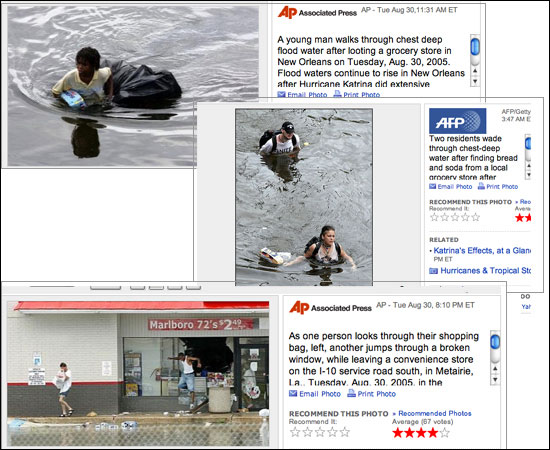
But I will always be haunted by some of the images and captions in the Katrina coverage that revealed some of our most insidious attitudes about race and class.

Do you remember how some people were described by major news organizations as “looters” and others as having “found food.” Do you remember exactly who were called “looters” and who “found food?”

Sometimes our blindness is astounding: We are thrilled to celebrate major victories against racism, sexism, homophobia and other hates. And then, full of self-congratulation for all the progress we have made,  we demonize people struggling to survive and turn others into tenacious heroes.

Shameful.

In Celebration of a System That Allows Both Disgusting Films and a Disgusted Audience

Yesterday’s  Washington Post includes a very thoughtful op-ed piece by Tim Shriver on the controversy surrounding Tropic Thunder. I strongly recommend it.

But first, allow me a quick word on free speech.

I certainly have made my disgust with Tropic Thunder well known. I have never written a blog post that generated  as much attention.

I do, though, want to make clear that I am pretty much an absolutist when it comes to free expression.  Yes, this kind of unrestricted expression can get terribly messy, even hurtful.

It allows people who I think are being cruel to be that cruel and more. It allows people to vote with their pocketbooks and either see or not see anything they want.   And yes, it allows DreamWorks to take the temperature of public attitudes and focus groups and to market the film with any tag-line that they choose, however disgusting I may find it.

As I said in the post below: “I actually appreciate that we live in a country that grants artists the creative freedom to make audiences sick.”

But here is where the rubber meets the road:

This same wonderfully chaotic free market  also gives me the right to do everything permitted under constitutional law — including supporting boycotts, email campaigns, blogs, demonstrations — to extract a price from DreamWorks for saying what it is that I don’t like. If my efforts cause them some problems, I am happy. If those who ridicule the disabled are brought out of the shadows, I am also happy. If I don’t succeed,  I may wish I had done better, I may even be bitter that cruelty prevailed, but that is a price I will gladly pay. I am not restraining  their free speech, nor would I want to. I am exercising mine.

I know this will be a tough pill for me to swallow. But if they still choose to go ahead with the astoundingly hurtful use of the word “retard,”  I will  — along with my pain and anger — still celebrate the system that permits both the making of a dumb film and my disgust with it.

I have spent time in authoritarian dictatorships. I have quickly shoved a camera under a taxi seat so secret police would not discover it at a road block. I have watched that camera slip out from under the seat as the police approached.

And I’ll take the rough and tumble — even the pain — of free expression any day.

Bravo DreamWorks! What Courage It Must Have Taken to Make Fun of “Retards”

Whenever I despair that true courage — the willingness to take on the powerful and the intimidating — is nowhere to be found, I have a couple of weeks like these.

Last month it was the courageous Michael Savage.

Where, after all, can you find a man willing to fearlessly ridicule autistic kids and show the moral fiber it takes to make fun of the defenseless and the disabled? Others may hide behind such gutless concepts as compassion, empathy, and – YUCK!! – love, but at least Mike wasn’t afraid to be proudly and shamelessly cruel.

Now that takes guts.

I think Savage may have inspired the most recent courageous person of the week.

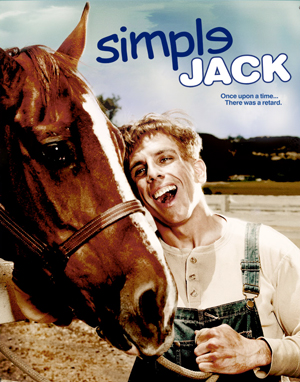
Today we salute the compassion of Stacey Snider, a senior executive at DreamWorks, who has stood firm against those who would criticize “Tropic Thunder,” a film from Ben Stiller that has used its right to free expression to nail those annoying little kids that the film bravely calls “retards.” Check out the tag-line on the poster: “Once upon a time…there was a retard.”


That’s right. While others might have knuckled under and admitted they had done something unspeakably hurtful, Ms. Snider has honored herself and her industry by announcing that she is “proud of the movie. It is hysterically funny. I do think it’s got its heart in the right place.”

And not one to be intimidated by the forces of compassion, she defends the film’s depiction of disabilities by suggesting that “The star-studdedness of it, and the absolute playability of it, trumps it all.”

That’s right: Miss Snider asks us to accept this profound hurt because of the film’s “star-studdedness,” which “trumps it all.” It might be disgusting, but at least it is stars being disgusting.

Just out of curiosity, Ms. Snider, whose concerns and hurts are trumped by all these stars? The hundreds of thousands of children who already get called “retard” at school, on playgrounds, in shopping malls? The kids who get stared at? The parents who struggle to protect and defend those kids from emotional pain?

Here’s what really kills me. Do I think that any production executive or Ben Stiller sat down and thought: How can we make fun of kids with cognitive disabilities? How can we cause their parents unnecessary pain? How can I make sure the word “retard” echoes across the cultural landscape?

Of course not. It is worse than that. Much worse.

Because what this whole shameful episode makes clear is that the entire promotional campaign – the posters, the web sites, the trailers, everything – made it through the entire DreamWorks production and promotion process without anyone, not one person , ever stopping to ask themselves: Sure we can say anything we want. Sure we can use the word “retard.” But do we want to? Should we? Is it right? Is it kind? Who would we hurt?

Nobody asked. Nobody asked.

Nobody gave two seconds thought to the possibility that someone might be hurt; that some kid might come home and ask why another kid called them a “retard” after seeing a movie made by Ms. Snider’s company.

I wish I was pure. But there is not a soul on earth to whom I would confess all the disgusting nonsense I have laughed at. I actually appreciate that we live in a society that grants artists the creative freedom to make an audience sick.

But never, ever — if you claim to have even a minimum of guts or decency — mess with people who cannot speak back.