Covina and West Covina, California: Where I first dropped the dishes.

Covina Orange

I know that one person’s nostlagia  can be another person’s mind-numbing boredom. Sometimes the  things from the past that most touch us, that most bring us to life, are things which no audience — not even an audience of one — is eager to hear about.

So some of us keep a lot of our memories to ourself.  Or we try.

Last week, I had the still shocking experience of learning that one of my graduate students here in NYC grew up in the same southern California suburb I did, and that her family owned the Five Lanterns Chinese Retaurant, in Covina, California, the place I had my first job in 1965.

It's a UPS store now.

It’s a UPS store now.

I was a bus boy in that wonderful Chinese Restaurant, one of only two Chinese Restaurants for miles around in a suburb that — to this day — I recall as one of the least diverse places I have ever seen or visited.

The result is that, in the last week,  I have been overwhelmed with memories  of two  towns, West Covina and Covina, California, from which I had supposedly escaped close to 40 years ago.

Today at the former site of The Five Lanterns Chinese Restaurant: My First Job, 1965, Covina, California

Today at the former site of The Five Lanterns Chinese Restaurant: My First Job, 1965, Covina, California

I may have more to say later: For now, all I am feeling is the flimsiness of concepts  like escaping,  “getting away from it all,” or starting over. They may be occasionally useful in the course of a lifetime, but it seems that I have rarely  been able to truly escape or get away from anything.

Memories, joys, and hurts travel. And travel well.

I dropped an enormous tray of dishes at that restaurant. On a busy weekend night.  And until last week, that tray was gone forever.

It’s back.

A Tike style mug from The Five Lanterns Chinese Restaurant. I broke quite a few of these one night in December, 1965.

A Tike style mug from The Five Lanterns Chinese Restaurant. I broke quite a few of these one night in December, 1965.

Ah, The Joy of Being Terrified by Two Great Actors: Gene Jones and Javier Bardem


A Brilliant Performance

Gene Jones: A Brilliant Performance

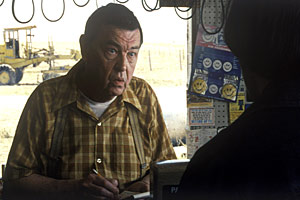
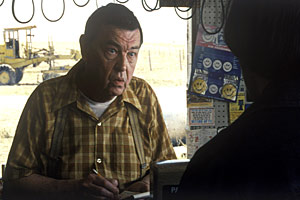
Early in the Coen Brother’s No Country for Old Men, Javier Bardem — playing a sadistic killer — faces down a meek, old gas station owner, played brilliantly by Gene Jones.

The result?

One of the best written, acted, and directed scenes of relentless menace that I have ever seen.

Two men in an old gas station.

See this piece in the LA Times about the actor Gene Jones, who in several minutes delivers a brilliant, electrifying performance.

“We will not walk in fear, one of another”


A lot of my political side – especially the passion and anger that I feel about issues and candidates — never makes it on to this blog. And I thought I would explain.

I am not without strongly held political beliefs.  Neither am I at all covert about them.  I will often share my basic opinions so students can have some sense of who I am as a political and social being. Feigned neutrality, I have always thought, would be its own form of dishonesty.

But anyone who has taken my classes (or who ever will in the future) knows of my special concern for the feelings and attitudes of students who I either suspect or know might disagree with me. As much as anything, I want my classes to be safe places for the expression of political views from anyplace on the political spectrum, and even for views so marginalized that they might not have even made it on to the mainstream spectrum!  The joy of clashing ideas, especially when marked by both passion and civility – is a special thrill of teaching at a university. If we can’t do it in a university, where can we do it?

Having said that, I did start this blog especially for my students at Hunter College.  Media Studies is a rapidly evolving field and is being defined and redefined in public discourse every single day. The main purpose of my blog — Media and Mayhem — is to share this ongoing change with students as it unfolds. Last week, for example, a historic moment occurred in the evolution of the Internet: More people saw Tina Fey’s impressions of Governor Palin on-line than saw them when they were originally broadcast on NBC.

I suppose I mention all this because we now face the last ten days of a long, hard-fought campaign for the presidency. And because I support one of the candidates, Senator Obama, I wanted to make absolutely sure that all of you who are Hunter students feel absolutely free to either publicly or privately express views that might be to the contrary. You are welcome to raise them in class, to come see me, or to be in touch via email.  Some of you already have, and this touches me very deeply.

Keep it coming. And if in the next week I blurt out something in my excitement or enthusiasm – or in my anger and frustration – know that your contrary expression of  excitement or anger will be even more welcome, and will be met with civility and respect.

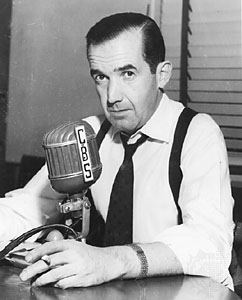
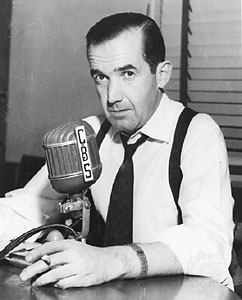
We are living through an extraordinarily historic election, taking place amidst economic chaos and wars on several fronts. Now is not the time to be shy, silent or reticent, whether you support Senator McCain, Senator Obama, Ralph Nader, Ron Paul, or any one of a number of other candidates.  As Edward R. Murrow once said in a broadcast that many of my students have seen:

 “We will not walk in fear, one of another, we will not be driven by fear into an age of unreason. If we dig deep into our history and our doctrine, we will remember we are not descended from fearful men. Not from men who feared to write, to speak, to associate, and to defend causes that were, for the moment, unpopular…. There is no way for a citizen of the republic to abdicate his responsibilities. As a nation we have come into our full inheritance at a tender age. We proclaim ourselves as indeed we are, the defenders of freedom where ever it still exists in the world. But we cannot defend freedom abroad by deserting it at home.”

What Will Constitute Virtual Capital Punishment? Or Virtual Life Without Parole?

October 23, 2008

Online Divorcee Jailed After Killing Virtual Hubby


Filed at 12:10 p.m. ET

TOKYO (AP) — A 43-year-old Japanese woman whose sudden divorce in a virtual game world made her so angry that she killed her online husband’s digital persona has been arrested on suspicion of hacking, police said Thursday.

Dave Morgan, Founder of Tacoda, at Newspaper Summit

Morgan suggesting that asking when online journalism will pay for the newspaper are asking wrong question. Newspapers in the traditional sense won’t survive.  The trick will be to disaggregate the following traditional componenents of newspapers and see which will  thrive and survive in a digital age:

Local news and editing

distribution

ad sales and marketing

printing

digital

Newspapers do have exisiting d  ansuccessful ad sales and marketing structures that may be ready to support a new newspaper model.

But printing is an enormous expense pulling whole companies down.  It is unlikely that any new model will have any serious printing component.

“Forgive Me My Cowardice!:” Why I Can’t Watch Tonight’s Debate


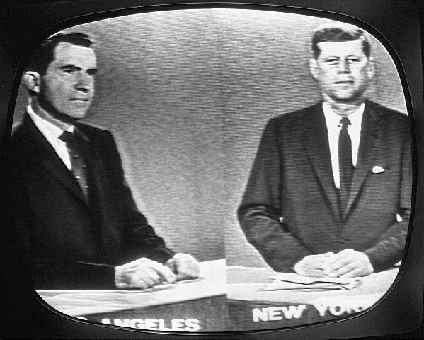
The night that John Kennedy first debated Richard Nixon in 1960 was, in some ways, the night my life began. I might have only been 9 years old, but I was a strange 9 year-old.  Even then, I knew that something with incredibly high stakes was unfolding, a real-time face-off that would have real consequences.  

I was hooked. Debates became my Olympics, my World Series, my Super Bowl.

In graduate school, when I had to complete a so-called qualifying paper, I wrote a comprehensive review of the literature on the effects of presidential debates on voting behavior. And I watched and re-watched hours of debate video.  I remember thinking how embarrassed I would be if anyone knew that I actually found video of the first Carter-Ford presidential debate to be entertaining.

I should confess that with all this work, I never really got very interested in the substance of these debates. To me, they were the highest form of theatrical, hand to hand combat, in which the weapons were impressions, body language, turns of phrases, and images. I loved the tension.

So why can’t I stand watching them anymore?

Any student of debates learns early on that many have been the occasion for inadvertent statements and other so-called “gotcha” moments. Candidates from both parties have accidentally made statements that quickly come to be seen as the “turning points” of campaigns. One candidate’s tongue slips, the other candidate pounces, and the world turns upside down.

I hate that. I hate that such an important decision can hinge on one unintentional mistake or misunderstanding.

I know that the counter-argument is that debates are precisely the high-stakes situations in which a person’s real feelings and attitudes are revealed. That might be so.  But what about the slip-up that comes out in a way that does not reflect the views of a candidate? What about a simple mistake?

Do we really want to allow these moments to change the course of history?

I have always felt that the most unfair example of these “gotcha” moments took place in the 1976 debates between President Gerald Ford and Governor Jimmy Carter. At one point, President Ford, in response to a question about the Soviet Union, stated:

“There is no Soviet domination of Eastern Europe and there never will be under a Ford administration.”

Carter argued that Ford didn’t understand the full extent of the domination exerted by the Soviets in Eastern Europe.  Yet it has always seemed perfectly clear to me that what Ford meant to suggest was that the United States refused to concede that the domination was a permanent reality. And that the people in those countries had not accepted this domination.

But the “Ford Doesn’t Get the Soviets” narrative caught on. My candidate – Carter — won. I guess I shouldn’t complain.

That may be ancient history. But it is also the reason I can no longer watch debates.  We are still a people who love the politics of the car crash.  We love the possibility that a collision could occur at any moment.  We watch politics as if it was the NASCAR title rather our future on the line.  

And I simply can no longer stand the tension of watching an event that might turn on a “gotcha” moment, on a slip of the tongue, rather than a well-crafted argument.

I am glad we have debates. They are about more than “gotcha” moments.  Everybody should watch them. The enormous audiences  may be as close as we come to a collective, national, civic gathering.

I just won’t be there with you. Too nerve-wracking.
Stepping Back from the Scaffold When All Hell Breaks Loose

Trust me.

I am as baffled as most of you are about the financial upheaval of the last few weeks. I don’t understand derivatives, cascading effects, and the intricacies of mortgage-backed securities.

But I have spent many years studying what sociologists call moral panic, sudden shocks to a social system in which it seems that the most basic assumptions about right and wrong, about the norms and values we take for granted, suddenly come undone.  The concept was developed by the British sociologist Stanley Cohen, whose work I admire greatly. I have been mostly interested in sudden violence, but any sudden, disorienting shock to a social system can rip away at the social fabric.

For all their seemingly unique horror, so much of what usually follows these events is predictable. Society rushes to the moral barricades. Portraits of evil are drawn so we all can share a collective image of who we are supposed to hate. Heroes are constructed who will save us. And scapegoats – those who brought this evil to our doorsteps — are sought and stigmatized and made to pay.

It’s the scapegoating that’s on my mind.

Social shocks are almost immediately followed by a hunt for the guilty. We need to know who to blame. We find it almost unbearable to live in a state of uncertainty in which a sudden, disturbing event cannot be blamed on a specific person or group. We need to see the face of evil. We need to hear its voice. We need to construct a narrative with a villain who knew what he or she was doing, yet still chose to act in a purposefully venal manner.

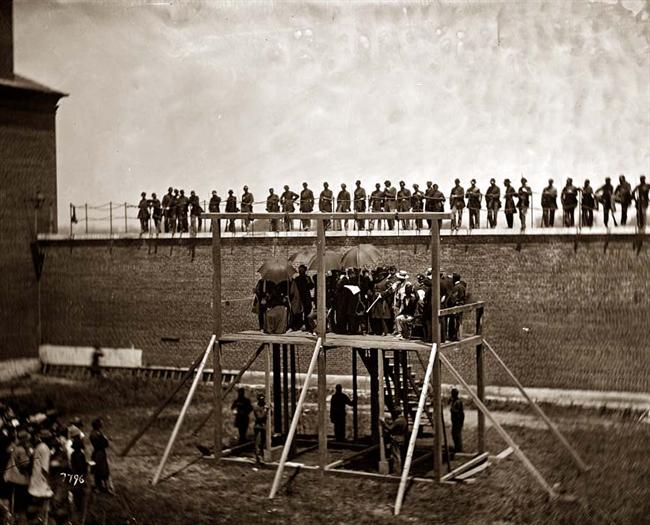
And then we need to join together and focus our collective loathing on the group or individual who tried to hurt us. Congressional hearings are wonderful settings in which the guilty are brought to the public scaffold and publicly humiliated. Right and wrong becomes clear during these rituals and we symbolically purge ourselves of those who would do us harm.

Yet this is precisely the point at which we often really screw things up.

Months after the panic has calmed, we almost always look back and see that, in our rush to the scaffold, we settled on the wrong culprit. Or we see how, without even realizing it, we lost the ability to see how an event might have resulted from the complex interaction of multiple culprits, or that even we ourselves might not have been blameless.

I was thinking of this as I watched former Lehman Brothers CEO Richard Fuld testify Monday on Capitol Hill. Trust me. You could waterboard me and I still wouldn’t be able to explain the dynamics of this financial collapse or what role Richard Fuld did or did not play. My forever secret math SAT score stands as silent testimony to why no one in their right mind should ever look to me for any economic wisdom.  And I certainly don’t know what Richard Fuld knew and when he knew it.

What I do know, though, is that my panic alarm starts to ring anytime I see someone publicly demonized in the midst of traumatic events. It’s not that they might not turn out to be demons. Or worse. I just wish we were all more aware of just how bad we are at assigning blame at these moments when we are afraid, when we are angry.

To suggest that events and their causes are complex is not what we want to hear right now, especially when we feel like somebody – anybody — has to pay. The question is whether, with all this anger, we can hold fire and struggle to see events in all their complexity before we decide who we should blame.

Fairness is never more important than in those moments when we are most tempted to ignore it.

Israel Kamakawiwo’ole May 20, 1959 – June 26, 1997

There will never be another IZ. Listen to the sublime guitar riff in the middle. 

Henehene Kou ‘Aka


Kalalau Valley, Kauai, Hawaii

Kalalau Valley, Kauai, Hawaii


I repeat, there will never be another IZ.