It is hard for me to look at a photograph that fuses tragedy and beauty without some guilt. The thought that I might feel any kind of pleasure or aesthetic satisfaction at an image of horror seems almost instinctively wrong.
Of course, at the same time, I know that beauty is a complex concept. It is not necessarily, nor even typically, “pretty.” We all have found pleasure in gazing at images depicting moments of unbearable sadness and pain.
So what is beauty?
I will always be haunted by a renowned virologist who tried to explain to me why he found the HIV virus – in its complexity and brilliant resistance to being destroyed or even tricked — a thing of beauty. Perhaps sometimes we describe something as beautiful, not because it gives us conventional pleasure or joy, but because we are humbled or stunned at what it reveals of our profound humanness and vulnerability. Humanness — stripped of artifice and faux gentility – can be sublimely beautiful, even when it leads us to horror. It is who we are.
To be sure, this is a different kind of beauty, rooted not in pleasure but in awe. If we see beauty in moments of fury, angry crowds, acts of violence, and even death, perhaps we are simply in awe of such unflinching glimpses of ourselves. Maybe we even find it titillating to see ourselves so nakedly human, so capable of evil, so overcome with grief?
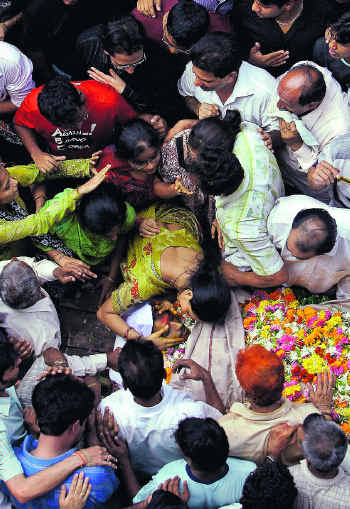
Which leads to this picture from the front page of today’s New York Times by AP photographer Gurinder Osan.
This is a crowd in the midst of unbearable grief; a heaving, surging, human crowd surrounding the grieving family of terror victim Haresh Gohil. It is living the shared pain of a community brought together in a volatile mixture of anger and sadness. It is a swirling and kinetic crowd that — from the unusual angle chosen by Osan — has formed a human tapestry of grief. The wailing and moaning even seems audible, yet it only takes a moment to recall that this is a silent photograph.
Each of us will have a day, a speech, or a moment that will be our mental marker for the presidential campaign of 2008. These will include moments of eloquence and moments of confusion, moments of high drama when both candidates revealed important personal qualities, and mundane moments that were just as revealing.
I wish that my most vivid markers were times when either candidate spoke from the better angels of their nature rather than from pettiness and cruelty.
But that apparently is not to be.
Because several sultry and rainy days in late August continue to echo with such cruelty and arrogance that they probably will shadow me as long as I live. That those responsible for those days of cruelty essentially hastened their party’s defeat should provide some small satisfaction. It doesn’t. I still feel the sting and rage of knowing I live in the same society with people who find pleasure in cruelty.
I refer to those days at the August Republican convention when the Republican party’s message of the day – delivered by former New York Governor George Pataki in the morning at a breakfast of the New York Republican delegation and later by former Mayor Rudolf Giuliani to the entire convention — was a vicious, full-frontal attack on the idea of community organizing.
Pataki began the day with this reference to Obama: “He was a community organizer. What in God’s name is a community organizer? I don’t even know if that’s a job,” he said. He received laughter and applause.
This was nothing short of a vicious attack on community volunteers and organizers who help poor people weather the kind of social policies promoted by politicians like Pataki and Giuliani. These are people who register voters of all parties, who help poor people find money to pay heating bills and buy food, who teach tenants their rights under the law, who provide their children alternatives to the street, who tutor kids after school.
By all rights, this moment of ugliness would be long forgotten and buried under the joy and hope engendered by the defeat of their politics of cruelty.
But forgetting would itself be negligent. We must never forget that on one day in August, 2008, this kind of hate and disdain came out of the hole in which it usually hides and was on exhibit for the whole world to see, in all its astounding selfishness. Community organizing, they said, is not a job. And their audience laughed.
They laughed.
They laughed at those who dedicate their loves to bringing warmth, nutrition, clothing, and housing to those who have never even seen or heard of a safety net, much less landed on one.
They laughed. Pataki laughed. Giuliani laughed. And their audience laughed.
But this also hit me in a personal way. Very early in 20th century, one particular unknown community organizer without a real job, a Chicago social worker named Jane Addams trying to found a settlement house, convinced a shy, destitute immigrant kid to train in medicine and promised that she would support him if he worked hard. Throughout his life, that kid (my grandfather) told his grandchildren stories about Jane. Only in later years did I fully appreciate that his “Jane” was Jane Addams, one of the founders of modern social work, the founder of Hull House, and winner of the Nobel Peace Prize.
But facts never adequately refute cruelty. Its purveyors must seek forgiveness for the hurt rather than simply present arguments to the contrary. To re-enter the public sphere of civility and decency, they must apologize. These two for whom cruelty rolled so easily off the tongue must atone.
And we who were rendered speechless must never forget what they said.
Remember: Politics is a system fueled by forgetfulness. Governor Pataki and Mayor Giuliani are banking on a system that they know will likely forget their words of cruelty. Someday they will again present themselves to voters and launch campaigns assuming that these words will be ancient history. Depending on how the winds blow, the same people who spoke these words might even try to wrap themselves in the mantle of compassion. Kindness — in their cynical world — is a strategy and a talking point, not a moral tenet. The day will come when some comparably insincere consultant will hand one of them a beautifully written, yet scandalously phony speech on how we have to do more and help more.
We can’t let that happen.
They laughed.
Watch them laugh at the people who dedicate their lives to insuring that others might have housing, be nourished, and enjoy some measure of basic human dignity. And tell me just what Giuliani and Palin find so funny.
But does anyone agree with me that the otherwise extraordinary screenplay might have slipped into implausibility with the murder and car bombing sub-plot?
Maybe I am the naive one. It just seemed to cross the line into ever-so-slight nuttiness.
I have spent over a week trying to find the words to tell this story. It is 3:00 a.m. I am in a strange hotel bed with lousy pillows. I can’t sleep. Maybe a nightmare is best told at 3:00 am.
When Barack Obama was elected President, the social and cultural earthquake I wanted so badly became possible. Certainly not an earthquake that would magically provide a final resolution to hundreds of years of shame, but one that might rip open the racial fault line with a vengeance.
And then came the rhyme. The damn rhyme.
Eeny, meeny, miny, moe
Catch a tiger by the toe
If he hollers let him go,
Eeny, meeny, miny, moe
My ten year-old daughter, trying to make some choice about lunch or a friend, was employing the old “eeny meeny miny moe” test. I think she and the tiger ended up picking the tuna sandwich. Yet I almost immediately recalled the countless times in 1950s schoolyards when kids used the same rhyme with a word other than tiger. It was the version that Rudyard Kipling published in 1923 as “A Counting-Out Song” in “Land and Sea Tales for Scouts and Guides:”
Eenee, Meenee, Mainee, Mo!
Catch a n——r by the toe!
If he hollers let him go!
Eenee, Meenee. Mainee, Mo!
You-are-It!
This would now be the time to confess that I also said that word out on the playground. But I didn’t. I do remember how it was often used to settle marble-trading disputes. I also remember kids feeling a perverse thrill that they could vicariously participate in the larger, social ugliness.
But this was a word that could not have been more forbidden in our house, a word I never uttered after the day — at the age of six – that my wonderful Dad heard me say it and placed a bar of Ivory Soap in my mouth and twisted it around a few times.
But I am stuck. The rhyme echoes and echoes. A nightmare. A rhyme. I want to fully celebrate that Barack Obama will be my President. I will. But the intruder is a rhyme; an echo of an ugliness that was part of what delayed this day for so long.
Eenee, Meenee, Mainee, Mo!
And that is where I am right now at 3 a.m.
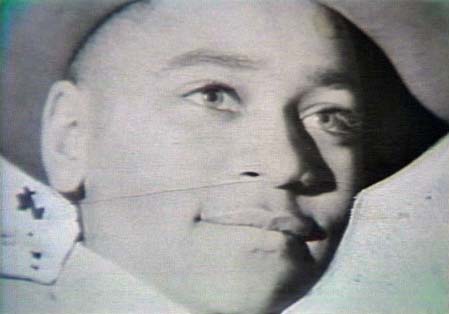
Knowing that at virtually the very moment that Emmett Till faced his final horror, at the very moment that his mother Mamie first heard the news, kids in my neighborhood were probably out in a park – shooting marbles or playing tag – and reciting:
The fact that it is election day has all but hidden the fact that today the US Supreme Court hears oral arguments in the case of FCC v. Fox Television Stations, Docket No. 07-582. Fox is unambiguously on the side of free speech, and is fighting the tendency of the FCC in recent years to punish broadcasters for “isolated and fleeting utterances” that it deems indecent. The vagueness of the FCC’s indecency standard is very much at issue.
An isolted utterance would, for example, occur if — in a post-game locker room interview — a player remarked on live television that he didn’t give a f____ing s_____t what the coach thought of his five missed pass receptions.
If you care about censorship, read the accounts of today’s arguments and watch for a final decision. And if you are really interested, check out the slew of amicus briefs filed by all manner of organizations opposing censorship. And some favoring it.
What makes the case interesting is that the indecency at issue is spontaneous, and not planned in advance or written in a script. Some of us support the right of a broadcasters to do even that, but the FCC in this case is essentially arguing for — and FOX is opposing — the idea that stations should be held responsible for accidents!
Ridiculous. While these cases almost always involve defending someone’s right to say something stupid and even offensive, this is precisely how we establish and protect the principle of free expression.
When you’ve done retail politics in Brooklyn, not much surprizes you. But I just heard something that has me stunned.
Senator Charles Schumer voted this morning in a Brooklyn election district I know well. And he just said on MSNBC that he waited an hour. This is really a very big deal.
I cannot recall one election in that election district in which voters had to wait for a hour. Given that New York state is safe for Obama, and that there are no hotly contested races going on in Schumer’s neighborhood, it seems that the sheer excitement and history of the national election is driving turnout.
Without starting to tell hilarious stories about Brooklyn politics, let’s just say that general elections are virtually never contested there. All the action is in the Democratic primaries. But did we have fun! Brooklyn politics was my basic training in retail persuasion.
As my students know, I go out of my way to create an atmopshere in my classes that is safe for students of all political persuasions — Democrat, Republican, and all other parties. But neither have I hidden my preference for Senator Obama.
And sometime later today, Ill try to share the incredible emotion I feel as I cast my vote for him. Some of you in your 20s and 30s will probably end the day sick of hearing older people talk about how they never expected to see a day when an African American would have a serious chance of being elected President. I’m sick of hearing myself say it!
But I might never stop. Today is a day that is haunted by the ghosts of people — from famous to anonymous — who died to make this possible.
Have we erased the national shame that is the American experience with race? Of course not. Anger and privilege and bias don’t simply disappear. They don’t simply fade away without a fight.
But the distance we have travelled is nothing short of incredible.


 MEDIA AND MAYHEM