Mose Wright: Never Flinched. Never Hesitated.

mose-wright

This morning I was thinking about how quickly our culture anoints heroes. Some unspeakable act occurs and, in a desperate attempt to find a savior, heroes are selected and honored while the accused are demonized. In our infinite patience, we do this so quickly that medals are often presented before we even know exactly what the hero did.

Isn’t this backwards?

Doesn’t the magnitude of an act of courage only become clear with the passage of time, when we can look back and see the historical context in which an act was truly selfless? On the other hand, doesn’t time also occasionally reveal the self-interest and even selfishness that might have been the actual motive for an act initially hailed as courageous?

Here is my favorite scenario  for what makes a genuine hero:  A modest, decent person does something quintessentially selfless without regard for personal safety. Some people pay attention, but — for a whole host of reasons — the act takes place below the radar of public attention. Maybe the hero isn’t especially desirable. Maybe he or she is a member of a despised group. Or maybe the act itself is such a violation of current values that it is reviled rather than admired.

But then, as time passes, the magnitude of the act – the extent to which it fearlessly transcended the conventions of the moment — slowly becomes clear. And decades later we ask ourselves: How did anyone have the guts to do that?

And so I present my choice for a hero.

The 1955 murder of Emmett Till was a seminal moment in the history of the civil rights movement.Till was a 14 year-old African American from Chicago visiting his family in Mississippi. When he violated the unwritten laws of segregation by talking to a white woman, he was abducted and brutally murdered. Photographs of his open-coffin funeral, revealing an unspeakably savage beating, were widely circulated. Emmett’s mother Mamie became a passionate and eloquent voice for social justice.

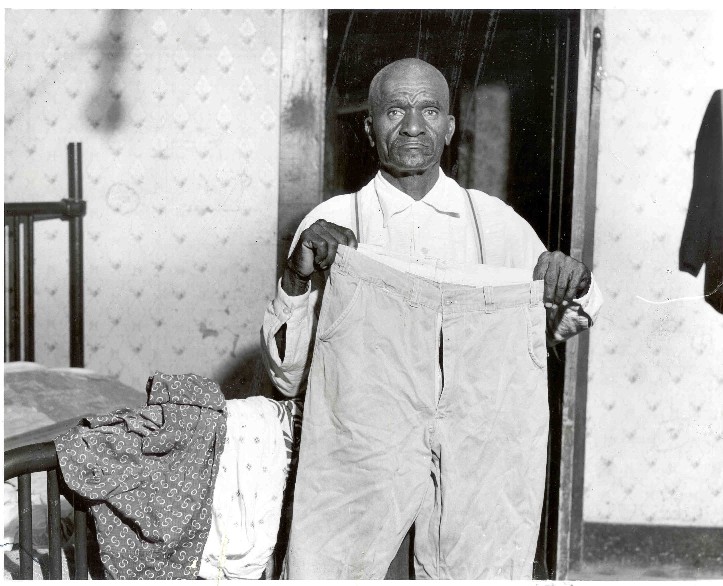
My hero, though, is Mose Wright. Mr. Wright was Emmett’s uncle and a witness to the abduction. When two men were accused of the crime, Wright chose to be a witness at the trial and personally identified the two white defendants. At the time, observers at the trial could not recall another example of a black man testifying against a white defendant. Wright moved to Chicago, but once more – ignoring warnings that he would be killed –returned to testify against his nephew’s killers. He never flinched or hesitated.

There’s a lot more to the story. The defendants were acquitted, yet later admitted the killing to Look Magazine for $4000.

And even more, many year later.

Wright died at the age of 83 in 1973.

There is courage. There is heroism. There is selflessness. There is sacrifice. There is near-greatness. There is greatness.

And sometimes, there is a Mose Wright.

I Think I Channel Louis C.K.

Check out this excerpt of comedian Louis C.K. on Conan O’Brien. It  is rare that I discover someone speaking words and expressing feelings that almost perfectly mirror my own.

22 Kids in Nepal: Grief and Compassion in the Age of Globalization

nepal-bus-accident

To be unusually concerned about one’s immediate environment is natural.  If a school bus crashes in Manhattan and 22 children are killed, I will be distraught. And I will  be more distraught than I would be about the same type of event taking place at a distance.

But I am profoundly uncomfortable with this pervasive  “parochial compassion.”  In a globally connected world, with so many of us frequently crossing boundaries , living in countries  in which we were not born, and with so many unintended consequences flowing from events far away,  we desperately need to nurture the ability to care about people  in distant and unfamiliar places. 

So obvious. So simple. Sunday school stuff.  So why is it so hard to extend our “terrain of grief” to places that lie at the margins of our mental map?

22 children. Nepal. Parents. Families. Extended Families.  22 funerals.

This is,  after all,  a time when my New Jersey neighbor might be from Nepal.  Some of my students are  from Nepal.  My son may be travelling to Nepal.  Grief as a parochial practice just won’t fly anymore.

I am trying to reach. We need to reach. We are human beings.

Why doesn’t it come easier?

Shelly “The Machine” Levene 1930 – 2008


prosky

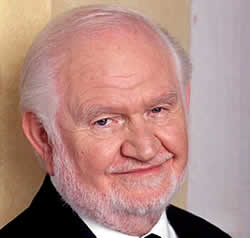
The  great actor Robert Prosky, who died today in Washington DC, worked frequently and with distinction.  His TV work was probably most widely known.

But for me, there will always be only one Shelley “The Machine” Levene in David Mamet’s  “Glengarry Glen Ross.”

Prosky was the first to play the role on Broadway and, if you saw him,   you may — like me — have remained permanently  haunted  by this quintessential  model of  unrepentant sleaze and desperation.

To this day, I’ll walk into a car dealership (always a nightmare in itself)  and — for a moment — imagine that  I see a room full of  Shelley “The Machine” Levenes.

This was a guy who loved his craft.

Thanks, Mr. Prosky.

Quick, Someone Call Sean Penn’s Agent. Get Gus Van Sant On The Line. They’re Casting the New Rod Blagojevich Bio-Pic


rod2

I have never been someone who easily finds pleasure in other people’s travails. It’s probably superstition as much as anything, and I am all too aware that human fallibility both goes around and comes around.

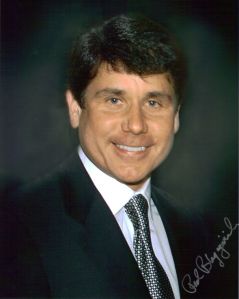
But today’s events in Illinois, in which Governor Rod R. Blagojevich  was  arrested on corruption charges for the attempted sale of Barack Obama’s senate seat, are simply too bizarre and too entertaining to ignore.

Entertaining?

I am privileged to teach in a department with students and faculty in various stages of writing and developing film scripts.  Several of my faculty colleagues are accomplished and produced writers for film. A whole lot of film talk goes on. Sometimes just listening is like being in a master class.

So I have read some fine work.  But I don’t recall anything that anticipated some of the cool stuff that federal prosecutors attributed to Governor Blagojevich in today’s complaint.

This was a tough guy who meant business.  We’re talking Scarface or Goodfellas quality. Apparently you did not mess with Rod Blagojevich. Check out these excerpts from the complaint:

·        ROD BLAGOJEVICH said that the consultants  (Advisor B and another consultant are believed to be on the call at that time)  are telling him that he has to “suck it up” for two years and do nothing and give this “motherf___er   [the President-elect]   his senator. F___  him.  For nothing?  F___  him.” ROD BLAGOJEVICH states that he will put “[Senate Candidate 4]” in the Senate “before I just give f___ing  [Senate Candidate 1]  a f___ing Senate seat and I don’t get anything.”


·        Later in the conversation, ROD BLAGOJEVICH said he knows that the President-elect wants Senate Candidate 1 for the Senate seat but “they’re not willing to give me anything except appreciation. F___  them.”


·        Later on November 12, 2008, ROD BLAGOJEVICH talked with JOHN HARRIS. ROD BLAGOJEVICH stated that his decision about the open Senate seat will be based on three criteria in the following order of importance: “our legal situation, our personal situation, my political situation. This decision, like every other one, needs to be based upon on that. Legal. Personal. Political.” HARRIS said, “legal is the hardest one to satisfy.” ROD BLAGOJEVICH said that his legal problems could be solved by naming himself to the Senate seat.


If you are interested, read the whole federal complaint.  I am sure that, at this very moment, scripts about corrupt politicians – previously rejected as implausible or as caricatures of venality — are being rescued from slag-heaps across the country and being given a second look.

 Think of it: One week to the day after the election, when many of us were imagining what it would be like to call Barack Obama Mr. President, Governor Blagojevich was practicing his own term for referring to the President-elect:


“ This mother___er.”


“They’re not willing to give me anything except appreciation.  F___   them.”


Governor Rod R. Blagojevich, State of Illinois,

November 11, 2008

Now This is Fun! Time Magazine Presents the Top 10 Video Moments of the Presidential Campaign

They’re all here. Enjoy.

And remember the obvious:  These are the video moments that created the most buzz.

Any relation to substance or policy is purely accidental.

“How Disgusting and Nakedly Self-Serving Can Spin Get?” Bulletin #1


mullaly

It is with no small amount of shame that I admit the following:  Much  of my disgust with self-serving “C.Y.A.”  spin is a function of my having on occasion been in a position of having to think up such nonsense.  Heaven help me, but I can smell this stuff a mile away.

Today I watched an interview with Ford CEO Alan R. Mullaly, who was proudly touting the fact that, rather flying to today’s bailout hearing in a private jet, he would be driving from Detroit in a new Ford Fusion Hybrid. He said he had “learned a lesson” after he flew to the last hearing in his private jet.

Look, I’m not suggesting there is anything else he could have said. But let’s be clear: He didn’t simply “learn a lesson.” He was so embedded in the culture of perqs and excessive compensation that it never even struck him or anyone in the company – not even their highly paid flacks — that flying a private jet might rub people the wrong way.  

This may surprise you:  I actually do not see a corporate jet as inherently evil.  It would be hard to persuade me, but I would at least listen to an honest argument about how speedy, on-demand air travel might promote profits and productivity. Given Ford’s current problems, I would think that it would be mind-bogglingly ridiculous to try and make that argument now. But if  Ford was thriving, if Ford was growing and employing more people, if Ford was paying its workers well and providing good benefits,  I don’t think that many people would be having a fit about the plane.

What does give me a fit is a guy getting caught using a private plane in the midst of an economic collapse – clueless about how it would be perceived — and spinning it as a “lesson learned.”

C’mon Mr. Mullaly: It was greed and excess revealed, not simply a lesson learned.