And the Shameless Hucksters Shall Lead Them: Emeril and His “Green” Knives


barnum

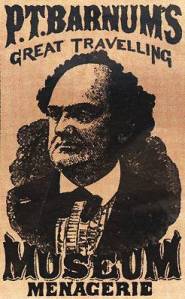
 When you are not dealing with a truly venal huckster – say, a dishonest car salesman or sub-prime mortgage lender— it can sometimes be incredibly fun to watch a transparent phony at work.  In fact, if you know that the huckster is a phony, and – even better – if he or she sort of knows that you know they are a phony, watching them sell a ginzu knife or a pocket fisherman can be pretty darn entertaining.

Sometimes this nonsense even rises to high art: Did you ever see Ron Popeil try to convince a roomful of bald men to cover their head with spray-on hair? You haven’t lived until you’ve seen 25 heads covered with dark Christmas-tree flocking.

This morning I saw a performance that has to rank with the best of them. File it under “Shameless Pathetic Attempts to Rip-Off Environmental Concerns to Sell Tchotchkes” Even Bernie Madoff, if he was watching from his couch, leg bracelet tightly fastened,  probably thought: “Now there’s a guy with nerve!”

This morning on the Martha Stewart show, which was playing on a TV at my gym, I saw Chef Emeril Lagasse selling what he described as a set of “green knives.”   I perked up to listen: What would an environmentally-sound knife look like, assuming he wasn’t simply suggesting it was sharp enough to injure a polluter?

The answer?  Emeril claimed the knives are “green” because no trees had to die to make them.

Translation: The handles are plastic.

Am I missing something here?  Does a plastic (poly) handle, classified by recyclers as a #7 plastic (the hardest to recycle and sometimes not recyclable at all), make it a “green” knife?

The green revolution is one of the most exciting developments of our age.  But please: Is there any chance that the “green” concept might also incorporate a reduction in hot-air, pseudo-environmentalist green-spinners, green-hucksters, green-phonies, and green-knife salesmen?  It might actually reduce global warming. Seriously, I can see now that environmental and green activism will have to fight tenaciously to reduce the cheapening and downright fraudulent use of the concept.

And now, if you’ll excuse me. I am going to turn on the Home Shopping Network. I have been looking for a cheap, “green,” and environmentally sound cubic zirconium nose ring.


Newly Released Inauguration Video Courtesy of the Digital Age

Well, not exactly new.  And not exactly digital. But check this out.  Four years later poor Bill McKinley was dead.

Wise Words from My Main Man: Charles Dickens, Media Scholar

dickens1

“Electric communication will never be a substitute for the face of someone who with their soul encourages another person to be brave and true.”  
–       Charles Dickens

Searching for Authenticity in the Age of Digital Ephemera: Case #1


casket21

To be immersed in digital media in the early 21st century is to swim — and sometimes drown — in a sea of  noise, feeds, texts, files, images, words, and more words.   Our lives become a struggle to find our way through a slog of bytes and mega-bytes.

So here is my frustration:   Sometimes the digital world feels like the inside of a 1000 piece jig-saw puzzle box.   The task of sense-making seems overwhelming.   Meaning seems completely elusive. 

Always another email, another picture, another text message. The message appears. It disappears. Emails arrive.  They are deleted.   Feelings are expressed. Feelings are deleted.

Which always leads me to the same question:   What is real when the ephemeral is ascendant?  What experiences are unambiguously concrete and only minimally mediated by some new technology?  What is authentic and enduring  in an age of bytes and ephemera? 

This is when I usually flash on some memory so indelible and real that it seems to occupy a space completely separate from all the noise and nonsense.  I know that neuroscience has located every brain function from jealousy to financial anxiety.   I wonder if they have located the place where the garbage dump of digital overstimulation gives way to the precious and the profound.

I thought I would share some of these fragments as they come to mind, i.e.,  concrete and profound experiences that transcended daily noise and left an indelible impression. I do this fully aware of the weirdness inherent in the fact that the moment I press the  “publish” button,  my authentic experience immediately becomes  part of someone else’s noise. Does this cheapen it?  Discount it?   Should I prolong these private experiences to protect their personal significance?  What happens when they are launched into the public sphere? I don’t know. 

Fragment #1 is an unforgettable image I saw on a number of West African roadsides, evidence that even grief has to be serviced and managed.  

This is my photograph, taken surreptitiously,  of one of the roadside casket merchants of Togo, West Africa.  There never seemed to be a shortage of customers.  Death as a daily physical presence —   unavoidable evidence of infant mortality, disease, and hunger — is not something a visitor from a “death-denying ”  culture will ever forget.

And,  at least for now, it is fully authentic.

How About a Shout Out to the Parents Television Council?

 people-applauding2

How about a shout out to the Parents Television Council, hard at work on  an issue  of such importance.   

At least they have the courage to keep us focused on what is right and decent,  and refuse to allow various inconvenient minor problems to divert our attention from what really matters.

Keep up the good work.

We Are Their Witnesses

Addie Mae Collins, Barack Hussein Obama,Sr., Carole Robertson, Coretta Scott King, Cynthia Wesley, Denise McNair, Emmett Till, Harry Truman, Harvey Milk, Hubert Humphrey, John Kennedy, John McCormack, Lady Bird Johnson, Lyndon Johnson, Madelyn Dunham, Medgar Evers, Paul Wellstone, Reverend C.L. Franklin, Robert Kennedy, Ron Brown,  Stanley Dunham, Steven Biko, Thomas Dorsey, Thomas Ferris, Tip O’Neill, Fannie Lou Hamer.

We Are Their Witnesses


barack-obama-for-president


I am speechless. I am crying.  I never thought I would see it. 

The names  of ghosts are overwhelming me,  people who did not live to see this day.

 Dr. Martin Luther King, Jr., Mose Wright,  James Chaney,  Andrew  Goodman, Michael Schwerner,  Robert Gorelick,, Robert Gilleece,   Elizabeth Gorelick, Harold Gorelick,  Abraham Minkus, Libby Minkus,  Barbara  Lombardo, Gregory Hines,  Langston  Hughes,  Zora Neale Hurston,  John Duvanich, Eva  Rubin,   Paul  Robeson, Tom  Bradley, Burke  Marshall, Malcolm,  Abraham Joshua Heschel.

I can’t think of anything else:  Those who aren’t here.

We are their witnesses.


In Praise of Shirley Temple


shirley-temple

Okay, so we are better off knowing the truth. 

But who knew how few of our most cherished illusions would — with the almost complete erosion of the distinction between public and private — survive the light of day?  Our heroes are unceremoniously unmasked as sleaze balls. Foods that we have eaten with abandon are revealed to have been slowly killing us. Celebrities whose lives we have watched and envied have turned out to be anything but enviable. 

For the most part, this is not a bad thing.  We are  still allowed our heroes, but we have no choice but to view them in the fullness of their humanity and the complexity of their character. 

That is why I tenaciously cleave to several illusions that no amount of fact or truth will ever dislodge. I cherish them too much, and refuse to ever let truth intrude on joy.

Which  leads to Shirley Temple.

By the time I was growing up, Shirley Temple’s films were already several decades old.  But they were shown repeatedly on television in Los Angeles, and for my sisters and me they were sheer joy.  She could sing, she could dance, and her singing and speaking voice could melt the heart of even the most crotchety old cynic.  I loved her.

And it’s not that this love was so easy to maintain.   Her charm was probably infinitely more saccharine than I will ever admit.  Very much in the spirit of the times in which she worked; black characters in her films were jesters, clowns, or fools. 

And, most controversially, there probably was something more than a little icky about a flirtatious eight-year-old wiggling and jiggling across the screen.  In a now famous 1937 paragraph, the author Graham Greene wrote words that engendered enough rage to force his immediate escape to Mexico.  But he probably was onto something:

Her admirers – middle-aged men and clergymen – respond to her dubious coquetry, to the sight of her well-shaped and desirable little body, packed with enormous vitality, only because the safety curtain of story and dialogue drops between their intelligence and their desire.

To watch a Shirley Temple movie is, sadly, to see the origins of those atrociously over-sexualized “Jon-Benet” beauty pageants that were so deliciously lampooned in the film  Little Miss Sunshine.

But I loved her and I always will. She made me happy. She made me laugh. And while at 10 years of age I didn’t really understand the notion of romance, I probably got my first inkling of it when I heard her sing a song that, to this day,  can  get me misty-eyed. 


Photographs, Sound, and Story: How “New” Newspapers Are Reviving the “Old” Photo Essay


weegee

There  are  many  recent examples I could have chosen  of the new look of newspapers,   but check out the  what  the  New York Times is doing with stories,  sound, and beautiful still  photography.

If,  like me,   you  think that still  photography  is a revealing and sometimes even profound way to tell a story,  I’m  curious what you think.  Some of these  photographs are  amazing  character  studies which  magnify and empahasize the qualities of the subject. 

The photographic essay is alive and well on-line. 

Use good headphones.   Someone did some fine sound work. 

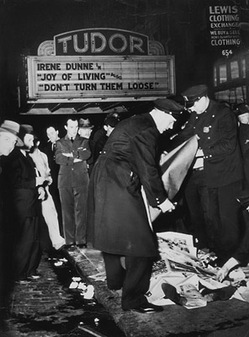
Weegee?   Maybe not.  But darn good.

Winter in the Pacific Northwest

sad

 Yes. Yes. Yes.   This blog  entry in  today’s  Times gets  it perfectly.

You have no idea.