The Aesthetic Power of Silence

Note to Readers, November 3, 2009: I have a question: Recently a lot of people have been reading this post.  I’m curious how and why you found your way here and what you thought.  I wonder if you might email  me at Steven.Gorelick@hunter.cuny.edu.  I really would be grateful.  Valuable prizes will be awarded. Thanks, Steve
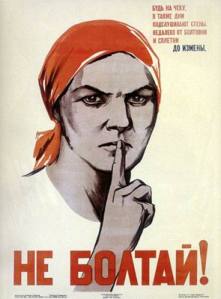

shush

How true.

One of the reasons this caught my eye is the great experience I have had in recent years with outstanding young documentary ffilmmakers in our MFA program in Integrated Media Arts  at Hunter.

Often,  watching fragments and rough cuts of films in which the filmmaker is either doing an interview or even a more direct and personal film in which he or she speaks, I have held my breath as other characters in the film begin to speak. Will, I wonder, the filmmaker let the character speak without interruption? Will the filmmaker allow the camera to linger on a subject after he or she has stopped speaking,  potentially capturing after-moments in which  the subject offers a subtle and nuanced facial expression that might be more revealing than all of the words they have spoken?

I have to tell you that most of our students  do know how to stay quiet and allow the subject to peel off their own layers of character.

One reason I think about this was my own propensity to open my fat trap during recorded ethnographic interviews of journalists I did  years ago. Time and again, I would sit at home listening to my interviews and suddenly start screaming:

“Steve, shut up. Shut up.  The guy was just about to say something earthshaking and there you were, talking over him just to …….talk.”

I learned my lesson and ever since have pretty successfully struggled to avoid the pitfalls of a certain late night host of a PBS interview show who contantly talks over his guests, usually to signal his knowledge rather than hear the answer to a question.

My favorite doc film that reveals the almost unbearable tension and sublime beauty of silence is the classic “Salesman” by the Maysles brothers. The film is a must see for anyone even slightly interested in doc film.  Watch how the camera lingers and lingers on subjects after they have finished speaking or when they are not speaking at all.

These are some of the most powerful moments in the history of doc film,  bible salesmen leading lives of quiet desperation who are photographed sitting  or walking in silence, visibly anguishing over their failures or their  loneliness. The  scenes in which they are trying to close a sale are extraordinary, to be sure, but next time you watch the film, pay  careful attention to the moments of uneasy silence either right after or right before the pitch. Part of  the  Maysles genius is leaving the camera on during silence and not becoming “speech-centric.”

One unbearably tense scene (of many) shows a salesman walking in silence up to the door of a prospect.  The anticipation that grows during the silence is brilliantly excruciating. A sale? A rejection? Who knows?
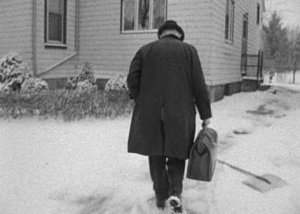
salesman

Don’t underestimate the  unbearable loudness  of  perfect silence.

Note: George Steiner’s “Language and Silence” is a wonderful exploration of some of these issues. I think one of the reasons I so deeply admire silence is my own apparent inability to maintain it!
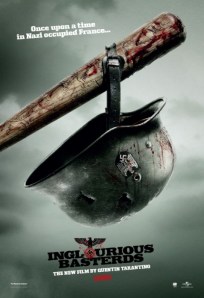
Quentin Tarantino Ignites Bloody Battle of the Critics

inglorious-basterds-1-477x699

I am usually pretty detached from the world of mainstream blockbuster films.   I simply find more pleasure in docs and indies.

But something unusual  is going on in the mega-film world that is really worth watching, a riveting case study in film marketing and  the dynamics of public opinion.

Quentin Tarantino’s film “Inglorious Basterds” has received some of the most mixed reviews I have ever seen. Ever.

And by “mixed” I mean that serious critics seem to have situated themnselves on both ends of a continuum that ranges from superb,  possible- masterpiece to complete and total piece of garbage.

I bring this up as a case for students to watch closely, especially this coming weekend.  The film’s first weekend box office of $37 million was stellar. Brad Pitt can do that for you on weekend #1.

Now, though, word of mouth will kick in and this coming weekend will be very revealing about how the larger audience has received the film. I am  really curious.

I’ll definitely see it.

Principle #243 in my unwritten, imaginary, self-absorbed and nonsensical book of rules for living requires that I go:

“Anyone writing a screenplay approaching, reaching or surpassing the quality of Pulp Fiction earns in perpetuity the right to have every film they ever make seen, regardless of reviews or word of mouth.”

An Incredible Injustice: The Case of Brandon Hein

brandon-hein1

Any of you who are students of mine have almost certainly heard me mention William Gazecki’s extraordinary film “Reckless Indifference.” It is a must see, both for its formal brilliance and terrifying account of  injustice.

Rather than give you all the details, let me ask you a simple question:

How many of you, when young, ever unthinkingly put yourself in a position that had the potential to go horribly and irreversibly wrong?  Not a moment when anything necessarily did go wrong, but a situation when a mild risk or peril could have easily morphed into a full-blown tragedy.

I did have such a moment, and one day I will take the time to tell the story. I can tell you that I dodged the bullet. Fate worked to my advantage and a situation in which people could have lost their lives ended up just fine.

Gazecki’s film tells the story of one young man, Brandon Hein, who  stepped into just such a situation. But fate was not on his side and the result is that he has been serving a life sentence for well over  14 years.  Please see the film, learn about Brandon’s case, learn about the legal controversy surrounding something called the felony murder rule, and decide for yourself.

I did, and I am absolutely certain that this is a monmental injustice and that Brandon must be freed.

Finally, check out a piece about Brandon this week in Newsweek written by actor and social commentator Charles Grodin.

As long as this young man is in prison, I will be haunted by the fact that my brush with fate ended with no harm only because of the direction the wind was blowing on one warm, dry day in 1963 in the San Gabriel Valley of California.

Think of it: The direction the wind was blowing.

Let me know what you think.  And remember Brandon.

Ron Takaki: A Teacher and Scholar for the Ages

ronald_takaki

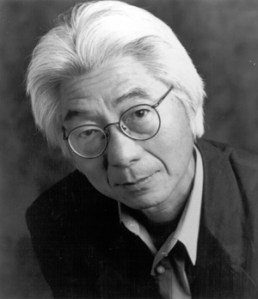
Ronald Takaki  was a teacher, historian,  and extraodinary human being.  He  was a pioneer in ethnic studies and a faculty member at UCLA and Berkeley.  Ron Takaki died at the age of 70 this past May.

Ron was also my teacher and  easily one of the 2 -3 greatest and most inspiring professors I had as an undergraduate at the University of California. He is one of the main reasons I chose to spend a lifetime in higher education. Remembering his brilliant and packed lectures, and thinking back to his influence on so many students, I am yet again reminded of the incredible responsibilities, challenges and opportunities we all have as faculty members.

In the spring of 1970, I can’t say I had ever heard the term “globalization.” National, ethnic, religious, and racial borders, especially in a place like California, could not have been more closely guarded. White middle class suburbs — even ones directly adjoining Chicano or African American or Asian neighborhoods — were social and cultural fortresses. Many of us who came directly from those fortresses to UCLA or Berkeley had never been in close proximity to any ethnic diversity. None. It was shameful. We lived in a well armored comfort zone that neither challenged us nor expanded our world view beyond the San Bernardino Freeway.

But there we were as freshmen, looking over the schedule of classes, trying to figure out who was responsible for the typo that had listed some professor with a Japanese surname as the professor for intro to African American history.

When we showed up at class, imagine how baffled we were to see this soft-spoken Asian American professor speaking  with a quiet yet furious indignation about the shame of slavery.  I vividly remember thinking almost immediately that nothing I thought knew about how the world worked, about the fortresses that were our ethnic and racial and religious enclaves, would ever be the same. Something was happening, and — if we didn’t fully understand all the complex forces — Professor Takaki would be there as a guide to the perplexed. And believe me, in the spring 1970 quarter we needed guiding —   Kent State, Cambodia, the Moratorium, and violent confrontations with campus police. Even a fatal shooting on campus. As I look back and calculate the chronology, I am stunned to realize that this gentle and powerful man was then  only in his early 30s.

There has never been a time in the intervening 40 years when, seeing someone trying to persuade with bluster and arrogance, I haven’t remembered Ron Takaki in the spring of 1970 and thought:  Rage born and nurtured in gentle soul can burn with even greater intensity.

It was an extraordinary time at UCLA, full of fury and passion. Across campus, another great and inspiring professor, Angela Davis, was approaching these issues of inequality from another perspective. And it was a loud time – a time of rage and grievance. How extraordinary it was to have Ron Takaki there amidst the ferment, showing us that even rage could be expressed with civility, that scholarship could reveal layers of barbarity and fuel the kind of anger that can lead to social change.

Sometime later he brought to campus some of the great figures of the infamous WW II relocation of Japanese Americans, people like Fred Korematsu and Joe Grant Masaoka. For many of us in 1969, this shameful episode was still virtually invisible in the exclusionist and triumphal narrative of California history.

He never minimized the conflicts and inequalities and injustices that fueled the growing rage. There was nothing “feel good” about these classes. But simply by explaining these forces, by struggling to help us understand the fires that were starting to burn in urban America, he helped us see that — through understanding and rigorous scholarship — a peaceful future just might be possible.

Really a teacher for the ages.

Controversy Rages Over Iconic Photo by Robert Capa

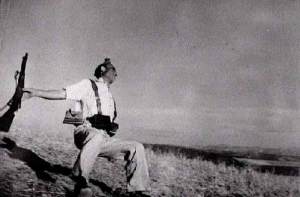
Any of you who have taken either an undergraduate or graduate class with me have almost certainly seen this picture.  Robert Capa’s “Falling Soldier” is  one of the most admired and important war photos taken in the 20th century.

capa

You may want to check out the details of a controversy about the photo that has been reported in the New York Times.

I am reserving judgement, but I can’t help wondering:   The authenticity of an image may go away, but what happens to all of the emotions  and ideas it may have inspired? Might  something revealed to be unreal  still remain absolutely real in its consequences?

After all, no one can retroactively cancel the emotions I felt when I first saw it as a child.  They are part of the cultural raw material that formed who I am.

This does, however, point out the risk we take when we give ourselves over, emotionally and intellectually, to any depiction of reality.  Sometimes we are so moved that we forget all of the complexities of the notion of “depiction” and think only of  the “reality” we think we are seeing.

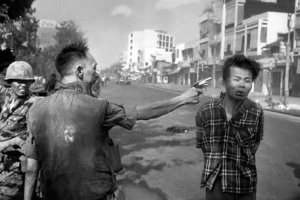
Think about it:  What in the world would we do and how would we adjust our view of the world if we learned today, several decades after first seeing the photo below taken by Eddie Adams,  that  General Nygoc Loan had not actually shot a Vietcong guerrilla point blank  and that the image was fake?

I honestly don’t know. So much thinking about that war has been invested in this image.

vietnam-shooting-456h082708