Yup, I loved the Jetsons. So sue me.
Meet George Jetson.
His Boy Elroy.
Daughter Judy.
Jane his wife.
Yup, I loved the Jetsons. So sue me.
Meet George Jetson.
His Boy Elroy.
Daughter Judy.
Jane his wife.
Sometime in the late 1950s, my elementary school class was loaded onto a bus for the 27 mile trip down the San Bernardino Freeway from Rowland Avenue Elementary School in West Covina, California to CBS Television City in Hollywood.

The media were already in my blood and I just may have been the most excited kid in the class. We were going to be in the audience of Art Linkletter’s House Party to watch several of my classmates appear on a legendary segment of the show called “Kids Say the Darndest Things.”

To this day, it bothers me that I wasn’t chosen to be on the kids segment. I never learned why. I actually remember a counselor at UCLA’s psychological services center in 1969 looking at me like I was nuts when I described it as one of my “fundamental hurts.”
But the real shocker was when we pulled up in front of Television City and my entire class walked onto Linkletter’s soundstage, with the exception of Rachel, Barbara, and me. A nice man in a bow tie who looked vaguely like Wally Cox diverted us into a small screening room studio with wires everywhere and asked us to remain seated and quiet.
I was devastated. No Art Linkletter. No “Kids Say the Darndest Things.” No soundstage.
Then Wally returned and told us that we were going to be part of an important experiment. They wanted to see how a machine that had already been around for a while, a machine that tested whether people did or did not like television shows, would work with kids. And so they gave us each two small devices, one of which we were to hold in each hand.
“Press one button when you like the show, Wally told us, and press the other when you don’t.” Then the lights dimmed and an episode of the not yet broadcast sit-com “Dennis the Menace” came on the screen. For 25 minutes, I watched this ridiculous show and never lifted my finger from the “don’t like” button.

I really thought it was dumb. I was mad at missing all the fun. Story over.
Well, not quite.
Almost exactly twenty years later I was sitting in a graduate seminar on methods of media research at Columbia with a brilliant young professor, Dr. Josephine Holz. And that was the day that I learned that the machine had not been just any contraption, but something called the Lazarsfeld-Stanton Program Analyzer, a pioneering device designed by two towering figures in the history of broadcasting, Drs. Frank Stanton and Paul Lazarsfeld. It may have taken 20 years, but finally it was the other kids who had been the losers and it was me who had been actually hooked up to the machine.
Oh, and I still think Dennis the Menace was a dumb show.
Now if you want to talk about The Jetsons, that was a work of genius.

P.S. This is an old yet fascinating scholarly article about the machine.
Levy, Mark R. The Lazarsfeld-Stanton Program Analyzer: An Historical Note
The Journal of Communication, 1982 VL. 32, No. 4. PG: 30-38.
After a day filled with serious news and other gravitas, I’m almost always looking to come down with music. And I never have even the slightest idea where I will end up. Ave Maria is just as likely as Cream. Mozart’s Clarinet Concerto has as good a chance as Skeeter Davis.
Well here is where I went tonight. These are two of my favorite songs by the boys, “You Can’t Do That” and “It Won’t Be Long.”
And yes, I did see them in concert in the summer of 1965, thanks my Mom, who surprized my sister and I with tickets when I got out of the hospital after having my tonsils removed.
I still have the stub and the program from that night. They played from a stage that covered second base.
.
Sometimes I think that the word “liar” is the linguistic third rail of American politics. Even in the dirtiest political campaigns, adversaries are often reluctant to call each other liars, as if avoiding that word means they have held the line and remained civil.
Thanks goodness I’m not running for office. I can say “lie” or “liar” when I want.
But – truth be told — I rarely do so. And when I do, I do it carefully. Because lying, at least as I have always understood it, is not simply making a mistake: It is intentionally telling someone something that you know not to be true. It is using a position of superior power and influence to say something untrue to hurt or deceive another person.
And, in the worst case, it is intentional deception that makes it more likely that another human being might be hurt, injured, or killed.
That is why I really have no problem saying that David Barstow’s remarkable piece in today’s New York Times, telling the story of how the Pentagon groomed some of the military analysts who have appeared on television to offer opinions about the war in Iraq, is a story about liars.
After reading Barstow’s piece, I feel on absolutely solid ground using the word. This is the story of a small group of senior military officers who, knowing one truth about the disastrous progress on the ground of the war in Iraq, intentionally went before mass audiences and – under the direction of the Pentagon — made contradictory and untrue statements, statements that they hoped would have the effect of marginalizing and silencing opponents of the war.
Even worse, these were lies that several now admit were made to protect ongoing profitable relationships with the Pentagon and defense contractors.
Angry disagreement about foreign policy is one thing.
But this was lying. And it was lying that cost lives. It is despicable.
Read it and see if you agree.
I hate the term “must read.” Who decides what the “musts” are? And whose interests are served when something must be read?
Forget all that. This is a must read.
Today’s New York Times strips away the veneer of phony objectivity of the military analysts who appear on network television. David Barstow’s riveting story “Hidden Hand of Pentagon Helps Steer Military Analysts” (registration required) details the Bush Administration’s effort to curry favor with a group of network television military analysts and keep them supplied with self-serving talking points.
And yet this isn’t the most stunning part of the story.
Administrations have always fought to have the media well supplied with a selective version of facts that are often at odds with what soldiers are seeing on the ground. Spinning and hosing is an old story.
The real stunner, and I’ll let you read it and decide, is the story’s evidence that — by not even telling the truth to the analysts ostensibly sympathetic to the administration — the adminstration left a slew of their allies feeling burned and lied to or what one senior officer called “hosed.”
It’s one thing to create propaganda that you dish up to your adversaries. This is the story of how the Pentagon tried, often unsuccessfully, to spin their own supporters in the military who served as media analysts.
And how one ended up saying “I felt like we’d been hosed.”
A must read. Superb reporting by David Barstow.
Andrew Malcolm does a blog on politics for the Los Angeles Times. It is called “Top of the Ticket.”
I need someone to do a reality check for me.
In the last hour Malcolm posted what is either a pretty nifty prank or an astoundingly dumb column suggesting that today in Pennsylvania Barack Obama gave Hilary Clinton the finger during a speech. Now I think Malcolm may be joking as a way of satirizing last night’s nit-picking, issue-free debate. I have seen Obama scratch his cheek this way countless times.
But what do you think?
I think that if he is serious, and that if he really believes he sees Obama flipping the bird, Malcolm may truly be coming undone. And the LA Times may have posted the single strangest column thus far in the election season. Am I hopelessly old-fashioned or am I right to think that it is beyond weird for the LA Times to use any of their space for nuttiness like this?
Check out Malcolm’s post and the Youtube video below. Somebody please tell me if you think Malcolm is joking or if you think he did give the middle finger.
Are any of you watching tonight’s “Compassion Forum” live from Messiah College in Pennsylvania? One after the other, Senators Clinton and Obama are answering questions about religion, faith, and compassion.
I’ll share something that I rarely talk about: My religious beliefs are central to who I am, especially what Jews call Tikkun Olam, or “repairing the world” through selflessness, good works and charity. No big surprise that I don’t always act in according to those principles, but I do try.
So why does a “Compassion Forum” give me the willies? Why do I find myself interested in the questions being asked of each candidate and the answers being given, yet still profoundly uneasy about the whole thing?
I had the privilege of growing up with a close friend whose father was the sage and compassionate leader of a major Protestant denomination. Not the typical friend of a Jewish kid from Southern California, but – hey — how often do you get a best friend with whom you can simultaneously act out adolescent nuttiness and contemplate profound matters of faith.
What I am leading to was a view of church-state relations I learned from my friend that has been basic to who I am: The temptation to mix and confuse the unique roles of government and religion, especially in fearful and uncertain times, is understandably great. This impulse makes perfect sense given that religion offers beliefs and ideas that can enrich so many areas of human endeavor, especially the political realm where, shall we say, truth seems to be a pretty slippery concept.
But I also learned that the separation of the two realms protects both: Government in a democracy needs to protect the free expression of diverse and even unpopular takes on religious faith. Religion needs the freedom to proclaim ideas and beliefs without having to answer to government institutions that seem pretty inept when it comes to the realm of the spiritual.
So again: The sight I am watching of two presidential candidates being grilled about their beliefs, however fascinating, is not something with which I will ever be comfortable. It simply has too much of the feel of a public test, in which each candidate’s views will be judged for adequate piety and purity; in which the candidates can easily slip into a “faith-competition.”
I’m watching. And listening raptly. And wishing they never felt this necessary.
This happened about six months ago. I have tried to forget it. So much for forgetting.
A famous person was killed. Within the hour, people who knew dead famous person (D.F.P.) began circulating the news and posting emotional reactions on the Internet.
One of those posts was by a less famous, high profile journalist who almost immediately published an astoundingly scathing portrait of D.F.P.
D.F.P., he argued, was – in his relationships with other still-alive famous persons — mean-spirited, arrogant, dishonest, and even cruel. Those who only knew of D.F.P.’s public contributions and admirable body of work (like me) were stunned. This wasn’t Pol Pot, but was someone who very well might have been a jerk.
The story would have ended there, were it not for the anger I began to feel for the speed with which the critical piece appeared. D.F.P.’s funeral had not yet taken place, and many friends and admirers were still coming to terms with a tragic death.
So I called journalist, and asked:
“Is there any case to be made for a “grace period,” however short, between a death and the publication of a scathing personal portrait, particularly when the scathing stuff is primarily inside information?”
“Might D.F.P.’s family and friends deserve even a day or two before nuanced and critical portraits became absolutely acceptable?”
“Or has the era of blunt and instant information made it old-fashioned or impractical to temporarily hold fire out of respect for a family’s feelings?”
Journalist’s answer still chills me.
“Sorry, but I don’t buy into false sentimentalism. I wrote the truth. Period.”
I really couldn’t respond. I still can’t.
What can you say to someone who sees even temporary consideration of a family’s feelings to be nothing more than “false sentimentalism?”
Some of the purists will be wincing. This wasn’t really rock and roll. It was spectacle. It was pop. No edge. Overproduced.
Fair enough. All I know is that I loved, and still love, Freddie Mercury and Queen.
I had a hard but rewarding day and, when I got home tonight, I instinctively turned for relaxation to this excerpt from Queen’s July 13, 1985 Live Aid concert appearance at Wembley Stadium in London, England.
Freddie Mercury — an original, a character, and one of the greatest stadium performers ever. In fact, this specific peformance has, in several polls of rock critics, been voted among the greatest live performances ever. Did any of you ever see him perform live? I didn’t.
This excerpt from the concert includes Bohemian Rhapsody and Radio Ga Ga.
Freddie Mercury 1946 – 1991

Think of every episode of Leave It to Beaver or Father Knows Best that you’ve ever seen.
Think of every stock photo and stereotype about 1950s and 1960s suburban America. Think about Dick and Jane reading books, gingham aprons, milk served in pitchers and cookie jars.
Think about kids lined up for polio shots, Ed Sullivan, and service station attendants wearing well-pressed uniforms.
It was not a complete fiction. I know. I was there.
But also – while you’re at it — think of whiteness, of blocks and blocks of white families doing white things, opening mail boxes to find magazines filled with stories about patio furniture and backyard BBQs and vacations in station wagons. And think of house after identical house, where any internal emotional turbulence or troublesome external social ferment could always be neatly hidden beneath the veneer of Cub Scout meetings, bake sales, and summer vacations.

Think of a whiteness so relentless that it was both everywhere and nowhere, pervasive yet so taken for granted that it could hardly be noticed. Imagine a place where you could come of age without ever seeing a black person in the flesh.
I thought of all these things – suddenly and without warning — in the middle of giving a lecture this Wednesday to 150 undergraduates about the rise of demographics, targeted media, and the death of mass circulation magazines. I talked about bloated audiences who, in their lack of demographic desirability, held no interest for advertisers starting to strategically target their messages. I thought of Life Magazine, on the verge of collapse. And I then I remembered the day that this issue arrived in our mail box.
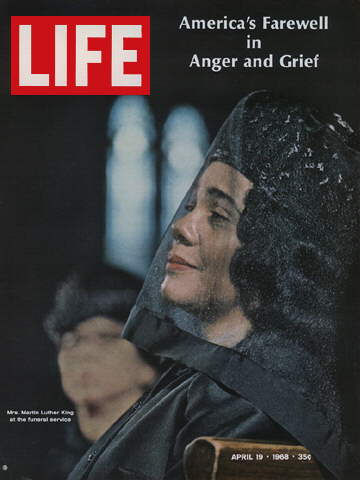
Martin Luther King had been assassinated two weeks before. The event stunned and horrified us. I was fortunate to have parents who had taught my sisters and I about racial injustice. I still treasure the memory of one of my father’s finest moments when, hearing me utter an offensive racial remark at the age of eight, followed the charming fashion of the day and filled my mouth with a bar of ivory soap.
But we lived where we lived, and this magazine arrived like a live grenade. Martin Luther King, Jr. was dead, and now we had to look his wife straight in the face. We had to see her grief. Even worse, we had to contend with her serenity in the midst of the horror. We had to imagine her husband with his eyes closed, stilled and silenced.
I know that sometimes, in our zeal to construct compelling life narratives, we look back and overstate the significance of events. But I also know that nothing was the same after that magazine arrived. Our comfortable world had been pierced by the reality that rifles could silence a man’s passion and indignation.
And there is no dramatic or profound ending to this story.
Nothing magic happened. Miraculous revelations of tolerance were nowhere to be seen. There was no justice and nothing was flowing like a mighty stream. Our neighborhood stayed the same. Most people remained remarkably skilled at maintaining a willful blindness that obscured the anger and ferment brewing in distant places.
But never again could we claim, at least not with a straight face, that we knew nothing of that other world where guns were fired and justice denied. It arrived on the cover of a long-defunct magazine, and somehow we sensed that the dream deferred, festering like a sore yet so invisible in our blindingly white world, would soon explode.
The names of those who in their lives fought for life
Who wore at their hearts the fire’s center.
Born of the sun they traveled a short while towards the sun,
And left the vivid air signed with their honor.
I Think Continually Of Those Who Were Truly Great
Stephen Spender
I think continually of those who were truly great.
Who, from the womb, remembered the soul’s history
Through corridors of light where the hours are suns
Endless and singing. Whose lovely ambition
Was that their lips, still touched with fire,
Should tell of the Spirit clothed from head to foot in song.
And who hoarded from the Spring branches
The desires falling across their bodies like blossoms.
What is precious is never to forget
The essential delight of the blood drawn from ageless springs
Breaking through rocks in worlds before our earth.
Never to deny its pleasure in the morning simple light
Nor its grave evening demand for love.
Never to allow gradually the traffic to smother
With noise and fog the flowering of the spirit.
Near the snow, near the sun, in the highest fields
See how these names are feted by the waving grass
And by the streamers of white cloud
And whispers of wind in the listening sky.
The names of those who in their lives fought for life
Who wore at their hearts the fire’s center.
Born of the sun they traveled a short while towards the sun,
And left the vivid air signed with their honor.
 MEDIA AND MAYHEM