No Escape from Grief: The Ballad of Esequiel Hernández

Yesterday, I saw a film of such shattering emotional impact that it forced me to face just how much I have been missing lately by focusing more on artistic form than visceral emotion. In fact, I found being torn apart and rendered incapable of rational analysis to be nothing short of liberating.

But there I go again with the self-serving language that obscures rather than reveals emotion. I wasn’t “rendered incapable of rational analysis.”

I was crying and I couldn’t stop. On a bus. With people staring at me.

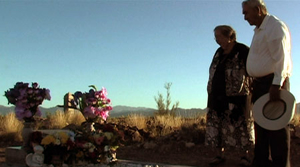
The Ballad of Esequiel Hernández (July 8th, 10 PM, PBS) tells the story of an 18 year-old American citizen – a son, a brother, a student, a friend – who was killed in 1997 near the Mexican border in Redford, Texas by US Marines watching for drug smugglers. While the rules of engagement did not call for deadly force, filmmaker Kieran Fitzgerald painstakingly details the series of events that led a U.S. Marine to shoot and kill Esequiel as he tended his family’s goats with a .22 rifle. Esequiel thus became the first American killed by U.S. military forces on American soil since the 1970 Kent State shootings.

So many of us respond to tragedy by playing an instinctive mental game. Surely, we tell ourselves, a tragic story will have one detail about a victim, one simple fact which will allow us to delude ourselves into thinking that we have found a reason for the unreasonable. Perhaps the victim was someplace he or she shouldn’t have been. Perhaps, even years before, the victim did or said something that even now allows us to temper our grief. It’s stunning how quickly we all, even unconsciously, resort to victim-blaming.

Some times we even say (or just think, if we are smart enough not to give voice to our least humane instincts) that “he got what was coming.” We think those words can provide a psychic antidote to the deeper horror that comes from pain that won’t go away. But that is when we must face the fact that good people like Esequiel Hernández, through no fault of their own, can sometimes die painful and tragic deaths simply by finding themselves in the cross-fire of powerful and violent institutions.

Esequiel dies because of an absolutely pointless and symbolic deployment of Marines as border guards in the “War on Drugs,” a mission for which they are scandalously unprepared. Before you know it — with the maniacal anti-immigrant rantings of media provocateurs like Bill O’Reilly playing in the background – a young man lies dead.

As I watched The Ballad of Esequiel Hernández, I kept playing a mental game in a vain attempt to rid myself of pain: At least, I told myself, the evil of the killers will provide a different kind of relief. They can be hated and resented and serve as the vessels in which I will place my rage at a young life lost too soon.

But then “The Ballad of Esequiel Hernández” deals a second blow. Fitzgerald profiles the four Marines — although the one who actually fired the fatal shot chooses not to be interviewed — with such nuance and emotional depth that it becomes impossible to find the relief and resolution that would come from clearly evil killers.

They are human.

And then all I felt was despair, left with a difficult challenge we all face as we try to make sense of the world. Like it or not, we must accept that some tragedies are destined to remain open sores on our souls, forever unresolved, forever a source of grief.

In the end, though, “The Ballad of Esequiel Hernández” comes back to a young man and his grieving parents. He didn’t have to die, but he did, and even now — a day later — I can’t figure out a way to move from relentless grief to any thoughtful action. I can’t figure out where to direct my rage.

I can only cry for Esequiel. And his mother and father and brother.


Why Not Feed the 24 Hour News Beast Something Truly Repulsive? The Case of Liz Trotta


With all the disgust I feel for much of the detritus that the 24 hour cable news channels use to fill their bottomless news hole, I won’t deny that I am simultaneously a fan. 


Hypocrisy? Maybe.  


CNN and MSNBC are simply indispensable for live coverage of breaking news. Further, they each are staffed with journalists capable of on the spot analysis and perceptive commentary that can be superb. I think of CNN’s William Schneider, former CNN Baghdad correspondent and bureau chief Jane Arraf and medical correspondent Sanjay Gupta.  And what about people at MSNBC like Robert Bazell, perhaps the best science and medical reporter of the last several decades, Keith Olbermann, political director Chuck Todd, and Tim Russert?


I should say that I don’t omit Fox News out of any knee-jerk revulsion.  I am glad the audience who feels their views represented by Fox has that highly partisan option. I only wish that they would at least be honest about their ideological slant, rather than continuing to make the embarrassing (and amusing) claim of fairness and balance.


Fox simply has very little, if anything,  to say to me.


But all three of the cable news networks are faced with an insatiable news beast demanding to be fed.  And it seems that, in the age of screaming and incivility, nothing fills a slow news day better than two or three minimally informed pseudo-experts trying ever-so-hard to out-shout each other. 


No surprise there.


There is an unintended, entertaining  benefit to all this: When your definition of news makes room for yelling by provocateurs rather than reporting by reporters, you occasionally are treated to an idiocy that transcends any definition of idiocy you ever imagined.


So here we go. Check out these comments on Fox News by Liz Trotta, her attempt to bring some “analysis” to the controversy over Hillary Clinton’s remarks about the RFK assassination.


And ask yourself: How does any news organization keep someone like Liz Trotta on the air? Where is her apology? Who will take the responsibility for deciding that suggesting the assassination of a presidential candidate should be a career-ender, something that should preclude her from ever doing news or commentary again?


This isn’t about her right to express herself.  She can be as astoundingly stupid as she wants. And she can do it on the air. The question is whether Fox will decide that the “decency-line” has been crossed.


Watch closely. Her comments come quickly at the end of this short excerpt. And they are repulsive.


Cornell Capa: 1918 – 2008

 No words.

Just Cornell Capa’s magnificent and profound photos, exquisitely gorgeous even when the subject was relentless suffering;  master of just how subtle and nuanced and packed with “color” a black and white palette could be.

Brother of Robert Capa and founder of the International Center of Photography.

It is sobering to think of the oppression, the suffering, the anguish that would have never come to light absent the body of work of the two extraordinary Brothers Capa.  

Cornell Capa, Photographer, Is Dead at 90


Dumb and Inappropriate Spontaneous Remarks by Politicians #1


There is one thing I find absolutely delicious about the otherwise suffocating 24 hour cable news beast. 


Politicians can be relentless in trying to fill the bottomless news hole with every last ounce of bloviation. But every minute they  spend on stage increases the chance that we will get a rare peak at the unexpected places his or her mind wanders when – heaven forbid – he or she momentarily sets the script aside. In a political world in which off-message spontaneity has become virtually extinct, we desperately need these moments to see what’s really inside.


I’ll never forget when Barack Obama was stunned by the second wave of Reverend Wright’s comments. Caught off guard, he uttered something almost never heard from a candidate for national office. He was hurt. Hurt. Later we got the more carefully crafted statement, but this brief moment of hurt revealed the extraordinary possibility that we may yet get a president willing to shatter political orthodoxy and — could it really happen? –admit to emotions.


But perhaps the mother of all unguarded moments in this election year came yesterday when Mike Huckabee lamely tried to be spontaneous and make a joke when his speech to the NRA was interrupted by some sort of loud noise.


I for one am perversely grateful that we now know what astounding stupidity was lurking just below the surface as Huckabee read from his canned script. I have heard dumb and I have heard dumber.


And this was monumental dumbness at its dumbest.


Tombs of Negligence: The Children of Sichuan


juyuan earthquake


Nothing gets me hyperventilating more quickly than rich countries allowing citizens lacking power and privilege to suffer in ways that are, at least to some extent,  preventable. 


Believe me, I am well aware of my own country’s shameful treatment of the powerless. But the cruelties we reserve for the hungry, the uninsured, the disabled, and the poor are old news. I already watched the horrors of Katrina unfold.  


But I honestly can’t say that, before the age of the Internet, I fully appreciated the seemingly limitless examples of wealthy societies that seem incapable of providing the most basic protections to those who might die without them.  


My favorite recent example of journalism shining a light on suffering amidst wealth was George Packer’s shattering portrait in The New Yorker of the slums of Lagos, Nigeria. If you have a strong stomach, read the piece and see the quality of life that the world’s 12th largest oil producing country reserves for its poorest citizens.


And now the Sichuan earthquake.


This week, virtually every new media technology brought us horrifying details of how the Chinese economic miracle had apparently not been quite miraculous enough to insure basic standards of safe school construction.  


In fact, so-called micro-blogging (Twitter, etc.) – which I now am ashamed to have occasionally ridiculed as nothing more than knowing when a friend decides to make a salami sandwich — came into its own and provided a tidal wave of instant details about the extent of death and destruction in Sichuan province.  In real time, we heard the cries of grief and the rage of Chinese citizens at a government that had allowed thousands of children to die in tombs of negligence, arrogance and shoddy construction. Who knew that cheap construction – specifically the use of concrete without steel reinforcement — is so widespread in China that it has its own nickname – “Tofu building?”


Richard Spencer, reporting from Sichuan province for The Telegraph, tells a chilling story of promises broken and young lives lost. Faced with this tidal wave of revelations, Chinese officials were forced to promise a rigorous investigation resulting in severe punishment for those at fault.


 A child is buried under the rubble at the earthquake-hit Beichuan County, Sichuan Province, May 13, 2008. China poured more troops into the earthquake-ravaged province of Sichuan on Wednesday to speed up the search for survivors as time ran out for thousands of people buried under rubble and mud. Picture taken May 13, 2008.


Smooth. Really smooth. And straight out of the authoritarian propaganda playbook: We’ll root out those at fault and punish them. “If quality problems do exist in the school buildings, those found responsible will be dealt with severely,” said Housing and Urban and Rural Construction Minister Jiang Weixin.


Excuse me Minister Jiang Weixin: Is there any chance you might be one of “those found responsible?”


I just had a sickening thought: Given the authoritarian impulse to quickly cover up crimes and negligence, at least Jiang Weixin will probably have those schools fully rebuilt before the reconstruction of New Orleans consists of anything more than Bush administration photo-ops.

Earthquakes, Catastrophe, and the Digital Age

The tragic earthquake in China has provided an extraordinary example of how a variety of new digital tools and technologies have dramatically changed the way we perceive, learn about, and – through media and culture — socially construct the narrative and reality of catastrophe.

The natural disaster has caused overwhelming and widespread damage in a fairly remote area of Sichuan province and revealed that many public buildings were not built to withstand an earthquake of this intensity. Many of the dead were in schools that collapsed and, according to reports, left thousands of students and teachers trapped and dead.


What I wanted to point out is that, alongside the tragedy and obviously deficient infrastructure, a fairly elaborate and advanced digital culture thrives. Consequently, while some cell phone service has been interrupted, an almost instantaneous and extensive use of various digital tools has unfolded.

Start with this link to the Poynter Center for an early rundown of how horrible, natural disasters unfold in the age of cell phones, Twitter, Youtube, blogs, streaming audio and video, video sharing, news aggregators, social networking and everything else.

http://www.poynter.org/column.asp?id=31

I have seen some interesting examples today of how Twitter in particular has emerged as a major source of news and information for concerned friends and family members in China and around the world.

I wouldn’t want anyone to think that, in pointing out deficiencies in Chinese infrastructure, I had forgotten, or will ever forget, the race and class based infrastructure deficiencies existing here in the United States that were very much a part of why and how Katrina happened.

Hi Mom. Don’t Mind the Gunfire on the Answering Machine. It’s Just War.


I have written and rewritten this at least ten times which – if I was half as self-aware as I like to think — should have told me something. Because when I get stuck like this, I am almost always closing in on some emotion or anxiety that I would rather ignore. (Great strategy, huh? Ignoring emotions.)


But last week I was haunted by the experience of the Petee family in Oregon whose son, Stephen Phillips, is serving in Afghanistan. In the midst of a firefight, the young soldier accidentally activated his cell phone and sent home an audio message with a recording of the whole business — gunfire, screaming, everything.


 It struck a chord.


My son, of whom I am enormously proud, served in the Peace Corps in West Africa. During his service, the largely stable country where he was serving was thrown into chaos by the death of a long-standing dictator. For one short period, his safety was in doubt, but thanks to cellular communications, he remained in cell phone and email contact for all but several days.  Nothing happened even remotely comparable to the war in Afghanistan, but there was a lot of political violence and killing.


And to this day I still debate whether, given the choice, I would have preferred the detailed phone calls and emails I received or preferred ignorance.


I know mental health orthodoxy: It’s better to know the truth than to live with ignorance or illusions. But the digital age has enabled a level of immediacy that really tests this principle. Might there be times,  particularly in our personal lives, when globalization and transparency and instantaneous communication is unbearable? Do we always need, or can we always tolerate, living in real time?


Sure, I was able to share a few of my son’s most challenging moments. But the pain and the fear were palpable, despite the laughter and casualness I tried to project on the phone. He never experienced anything close to the soldier from Oregon, but – for a Dad who used to worry about his walks home from school — a civil war by cell phone was pretty painful.


The worst moment was when, after several days of frequent contact, the government shut down all cell service. At that moment, I had to instantly transition from full awareness of his situation to full ignorance. Not for the faint of heart. Not for me.


And so I again ask myself: Would it have been easier knowing little or nothing the whole time? Or was I less anxious because I had periodic, albeit erratic, news?


I only am certain of one thing: The answer doesn’t mean a thing. Because the digital genie is completely out of the bottle. We are now full participants in an age when we will quickly learn painful realities whether we want to or not.


My son is fine, by the way.


For those of you who didn’t hear it, here is the phone message that 22-year-old son Stephen Phillips left his parents on April 21st. The recording includes three minutes of gunfire, a voice shouting “Incoming!”, and a stark and sudden ending. Stephen Phillips suffered no injury. 


I wonder if we can say the same thing about his mom and dad.


P.O.V./PBS 2008 Season Preview

Vodpod videos no longer available.

Please do me a favor and look at a preview of POV’s extraordinary 21st season. If any of the films really grab you, more detailed information and trailers and broadcast times are available here.

The entire season schedule can also be downloaded or saved. You could hardly say that any of the 21 amazing seasons of Public Televsion’s most important showcase for docuimentary films were better than any other.

But 2008 is really breathtaking.

Now, if you’ll excuse me, I am watching Natalia Almada’s “Al Otro Lado” (POV’s 19th Season) for the 20th time so I can enjoy the incomparable footage of La Malandrina Jenni Rivera and Los Tigres del Norte!

Anybody know when Los Tigres are coming to New York? And do I have make a trip to my hometown LA to see Jenni? The last time I tried to buy tickets for Los Tigres, they were being scalped at $350 – $500.

L.A. is actually not such a bad idea. Perhaps I’ll post some Jenni Rivera music at some point so you can see why, when push came to shove and I was little under the weather this spring, Jenni and Los Tigres were there for me.

¿Quién sabe? ¿Soy quizá un Norteño judío?