My Ten Favorite Films


Ten best lists of films are dumb. They force dumb choices and add almost nothing to serious discussion and criticism.


Big deal.


I love them. I love reading them. I love making them. And here is how I go about it.


At any given time I always have a list of contenders. If a film has any claim whatsoever on ever making it into my top ten, it goes on the list. Then, one by one, I cross out films until there are only ten left. These are the films that I most enjoyed watching, not those that I would necessarily rank as the highest expressions of the craft. Having said that, it is almost certainly the case that my contenders are overwhelmingly well crafted. But to make my top 10, I have to viscerally and emotionally love the experience of watching the film.


Important: “Love” does not mean that I found the experience pleasant, just that I reveled in the pleasure of watching a story told with narrative skill and total command of the formal elements of film.


The best example of a film that embodies all these confusing criteria is my favorite of them all, Krzysztof Kieslowski’s “Dekalog.”  I suppose you could say I enjoyed watching it, but if you have seen it you will understand why “enjoy” is perhaps not quite the most apt word for the experience. What, after all, do you say about a film in which one of the very best of the  sections (#1  I Am the Lord Your God) was so emotionally shattering that I have only watched it once and almost certainly will never be able to watch it again?


So here is the list as of today. If a film has a number, it made the top ten. The reasons why a film didn’t make the top ten are varied and, most often, beyond rational explanation. My choices are infinitely more visceral than cerebral.


By the way, I have a separate documentary list, which I will post soon. Salesman, although a documentary,  is a work of such poignancy and genius that it would make any list I create. 


I very much hope you might post your ten best lists and describe your agreements and your quarrels with mine. Perhaps you think that either an omission or inclusion of mine is unforgivable.


Let me know.


Mr. Smith Goes to Washington


1. Dekalog (1989) 


Au Revoir les Enfants


Shop on Main Street  (1965)


10. Midnight Cowboy


It’s a Wonderful Life


3. Jeux interdits


Smile


Atlantic City


Fargo


Das Boot


The General


The Swimmer  


7. Goodfellas


Paris, Texas


8. Rear Window


Shoah


Invaders from Mars


4. Salesman


Strangers on a Train


The Graduate


French Connection


2. Godfather 1/Godfather 2


9. Double Indemnity


Les Enfants du Paradis


Les Diaboliques


Psycho


Le Salaire de la peur


Hotel Terminus


5. Amarcord


6. Night and Fog


Happiness


The Third Man


M


The Marriage of Maria Braun


The Night in 1968 I Was Born: Public Broadcast Laboratory’s “Birth and Death”

My lifetime of interest in documentary film began sometime during the week of December 4, 1968.

I was 17 years old. The $12.5 million Ford Foundation experiment in public television and precursor to PBS, the Public Broadcast Laboratory, was starting its second and final season with a two hour cinema verite film by Arthur Barron and Gene Marner, “Birth and Death.” The concept was to follow the birth of a baby in the first hour and the death of a man in the second hour.

I have always felt like I was born that night. Neither childbirth nor death had yet become the openly discussed public events that they are now, and the film was a revelation.

Coming around the same time as “Salesman” by Albert and David Maysles, and a year before two incredible semesters at UCLA studying the history of documentary film with Professor Edgar Brokaw, it was the first time in my life that I saw the raw and emotionally jarring power of cinema verite documentary. Before that night I had no idea what was possible when a first-rate cinematographer, often working with a handheld camera, would use excruciatingly intimate close-ups and candid reaction shots to capture the inherent power of lived experience.

“Birth and Death”  (1968) is discussed and remembered far too seldom, and was very much an early, brief precursor to POV. The night of that broadcast began what became PBS’s proud history of showing the work of outstanding documentary filmmakers to national audiences. It was also the night on which, as a teenager typically oblivious to mortality, it first struck me at the deepest level that going to Viet Nam with the rest of my age cohort might mean that I would die.  And I remember thinking after seeing the Barron film: Dying means you stop breathing. Dying means darkness. Not good. Not good at all.

I thought of all those years tonight when I heard that Fred Wiseman’s film company, Zipporah, has gradually been releasing his extraordinary body of work on DVD. Wiseman, I only learned a year later in 1969 at UCLA, had — at the very same time as Barron’s “Birth and Death” — already begun his astounding body of verite work in 1967 with “Titicut Follies.”

I later saw most of that work, much of which was also broadcast on PBS. Check out the Zipporah site and catch up on some of the greatest verite film ever made. I have a personal favorite, “Near Death,” and I’m sure many of you have yours.

1967 – 1972.

An amazing time for cinema verite. An amazing time to be coming of age. And – for a 17 year old about to contend with the Viet Nam draft — an amazing time to realize that, sooner or later, for good or for bad, birth would eventually be followed by death.

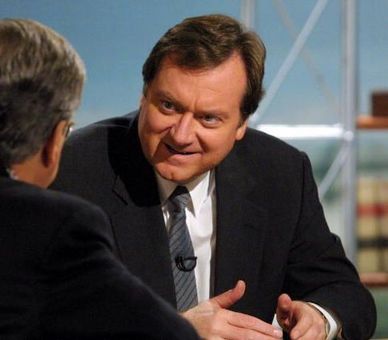
Skewering Hypocrites and Liars With Civility: In Praise of Tim Russert


The last few days have been filled with tributes to NBC Chief Washington Correspondent  and host of Meet the Press Tim Russert.  


I have one to add.


In the fall of 2005, I left a senior administrative position in which one of my responsibilities was government and political relations. There were some years when politics was really in my blood, especially when there was an issue to be fought or a worthy project to be funded. There also were years when the trek back and forth to our state capital was excruciating. At least, because my “client” was public higher education, I always believed deeply in the inherent value of what I was selling. 


But then I lost it.  


Mostly, I became completely unable to tolerate a parallel universe in which a politician’s words and actions often simultaneously contained 1) an ostensibly noble, yet utterly phony, public rationale and 2) a more authentic, yet venal or self-serving, private rationale. I know. That’s politics. And it is a game. But enough was enough.


It was almost indescribably cathartic in those days to watch Tim Russert who – with infinite civility – would fillet those spinmeisters and phonies right down the middle. He always knew exactly what questions a guest wanted to avoid, issues on which they were vulnerable to charges of hypocrisy or excessive spinning. And he would ask them.


“Senator, why with all your public support and enthusiasm for the health care bill, were you absent on the day the vote took place? Why in two days did you make two speeches that offer completely contradictory views on the Iraq war? Why did you vote so enthusiastically and visibly for the Smith/Jones bill, yet then vote against every appropriation that would have made it a reality?”


And on and on.


No one cut to the chase with more decency.


We live in an age of salivating provocateurs, people like Bill O’Reilly and Michael Savage and Lou Dobbs,  who confuse rants and smarts. Completely unaware of how ridiculous they look, they get so lost in their infantile tantrums that — for all their histrionics – they miss the chance to really cut through to the truth.  They ask incendiary questions and get incendiary answers. They create a lot of heat, generate almost no light, and — while everyone is getting hot and bothered — no one notices that the hard questions, the nuanced questions, have not even been asked. 


Russert, on the other hand, never lost his civility. Yet he still could nail a sleazeball better than any of the loonies in the media shoutocracy. He knew that skewering was best accomplished by preparation, substance and civility, by asking precisely the right questions. The slippery and the ill-informed were unmasked before a national audience without any assault on their essential dignity as human beings. 


After Tim Russert, no journalist will ever be able to persuasively argue that getting to the truth requires that another human being be demeaned or berated. When Tim Russert’s questions led to your humiliation or the end of your political career, you had no one to blame but yourself.

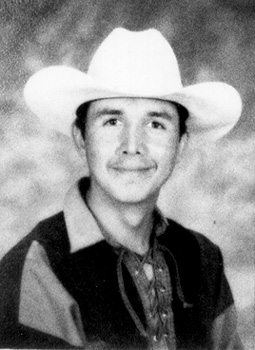
Now All I Feel is Rage: “The Ballad of Esequiel Hernandez” Pt. 2


A few weeks ago I tried to describe the emotional impact of Kieran Fitzgerald’s “The Ballad of Esequiel Hernandez.” It’s been a long time since a documentary left me so incapacitated by grief. The first time was in the midst of violent anti-war protests against the Viet Nam war, in a room full of cynical boomers at the UCLA Film School, as we watched Albert and David Maysles’s “Salesman” and were reduced to sobbing.

“The Ballad of Esequiel Hernandez” is a superb example of a documentary that shrewdly reaches for the pain without pouring on the polemics. Only after delivering a blow to the heart does that pain slowly make way for rage about the larger social context in which Esequiel was killed.

Rage? That’s right. I’m no longer paralyzed.

Watching “The Ballad of Esequiel Hernandez” brought to mind every example of pathetically misguided criminal justice policies that have been adopted exclusively as public theatre, remedies designed to create elegant yet completely phony illusions of action.

Oh, I know that these “solutions” are sold to the public as the latest and greatest answers to public anxiety. And I know that a scared public is vulnerable to quickly adopting almost anything that looks tough.

It’s just that these “solutions” are so often scams, quick and dirty fixes proposed by some politician who knows that a politically successful policy will always trump an effective one.

And do we come up with some good ones! A mandatory sentencing law takes discretion away from judges, young men and women are imprisoned for life because they are present during a homicide someone else committed, the merchants of toughness continue the absurd and oxymoronic hunt for a fair and humane death penalty, boot camps open that are nothing more than modern chain gangs, and US Marines are deployed to the border to watch for drugs. Everyone is thrilled. Whoopee.

Mission accomplished. Society has drawn a line in the sand. Aren’t we the tough guys?

Which would be just hunky-dory if not for the fact that virtually no one is any safer. And even worse, as we revel in our new feelings of “security,” we completely miss all the ways that our faux toughness has created a whole new set of victims — innocent people on death row, juveniles tried as adults, 50 year olds entering their third decade of imprisonment for drug possession, and young men like Esequiel — shot dead on land that he and his family honored and tended.

When the Clinton administration decided to calm an anxious public by deploying US Marines to the border near Redford, Texas, it was engaging in pointless feel-good theatrics. It looked great. The US Marines looked great. We showed those creeps who was in charge.

Too bad an innocent young man in South Texas had to ruin all the fun.


Men Who Never Give Up Are Heroes. Women Are Obstructionists. What Nonsense.

A few minutes ago, I was moved to again watch the video from the Women’s Resource Center that shows just how much vile and persistent sexism was on display during this year’s presidential primary campaign. I cannot recommend it strongly enough. Here it is again.

It reminded me of one of the 20th century’s truly legendary commencement addresses. On October 29, 1941, Prime Minister Winston Churchill visited Harrow School. The worst of the bombing of England by the Nazis had ended several months before. And these were virtually the only words Churchill spoke that day:

Never give in. Never give in. Never, never, never, never–in nothing, great or small, large or petty–never give in, except to convictions of honor and good sense. Never yield to force. Never yield to the apparently overwhelming might of the enemy.

These words came to mind in the context of the months-long clamoring for Senator Clinton to quit the race and make way for the inevitable. A great man urges stubborn adherence to principles and his words become immortal. A great woman, showing just this kind of stubborn courage, becomes the target of anger and ridicule.

Look, I have never been a fan of Senator Clinton for what I think are legitimate reasons. My candidate won the nomination. But I know sexism when I see it. And I will never forget the double-standard that was on display when, showing such stubborn grit and determination, even in the face of impossible odds, she was told by some that she should simply and gracefully get out of the way.

But you know the drill: Men who persist against impossible odds get medals. Women are obstructionists.

As I watched the video, I found myself yelling (all the plentiful expletives have been deleted): “Don’t these idiots have daughters, lovers, wives, or mothers or any other women whose future they care about? Is this the message they will send: Try hard, honey, but don’t be stubborn. Don’t be pushy.”

Jerks. Real jerks.

But then came one of those light bulb moments: I realized that my almost instinctive disgust with the idea of male privilege is overwhelmingly a function of the kind of man my father is. I am not sure I know a less sexist man. The idea that women should have complete and unfettered freedom to pursue their goals and aspirations is an absolutely fundamental part of who he is. Incredible as it may seem, my best guess is that he has never even had the idea that any unique or special advantage should accrue to him simply because he is a man. And not once have I ever heard him utter an either subtle or overtly sexist remark.

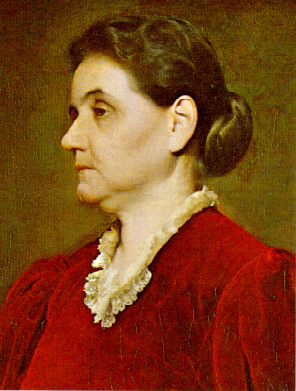
There is some history here. His mother, my grandmother Elizabeth, was one of the first women to graduate from Northwestern University. And she first enrolled before women were even guaranteed the right to vote. Her husband, my grandfather, was always proud that the first encouragement he ever received as a young immigrant to seek higher education came from Jane Addams, one of the 20th century’s greatest feminists and activists and founder of Chicago’s Hull House.

Later, when most of the mothers of baby boomers were staying home, my mom told my dad that she wanted to return to college. And as young as I was, I still vividly remember him assuring her that together they would do whatever they needed to do to make this a reality. He didn’t even slightly agonize about it. If those were her aspirations, he would be there for her.

I have never heard him utter a sexist remark (or racist or homophobic for that matter). I have never seen him minimize or ridicule the potential of any woman to accomplish anything. In fact, I have never even seen the kind of subtle, coded body language — a raised eyebrow, a snicker, a dismissive laugh, a puffed-up chest – that might have signaled some hidden well of macho posturing.

It just wasn’t there. And at 78 years of age, it still is nowhere to be seen.

And his son will never forget it.

These Sexist Jerks Actually Thought They Were Being Cute: Gag Me With a Spoon

There has never been a moment when I doubted that this campaign would be an ongoing showcase for our worst sexist and racist impulses.

I wasn’t disappointed. 

Check out this remarkable video produced by The Women’s Resource Center.  These  men are not even vaguely ashamed of their idiocy and misogyny. They are proud and oh so amused with themselves.

Despicable stuff.

All the more despicable for the lack of any vocal indignation from the network suits responsible for this nonsense.

You Wanna Talk Cool? Check Out Antonio Machin.


Many people know the song “Dos Gardenias” from the film Buena Vista Social Club, in which it was sung by the great Ibrahim Ferrer. This is one of the most famous of the bolero songs and was written by the legendary Isolina Carrilo in the 1930s.


The classic performance of this impossibly romantic song was by the Cuban singer and band leader Antonio Machin.


Imagine how I felt when I found a video of Machin’s performance. It reminds me that one of the most thrilling consequences of the digital age is that it has allowed the resurrection and wide distribution of classic, long hidden  performances. 


Watch how subtly and minimally Machin moves. The bolero singers were a special breed, masters of romance. He works his magic with his voice rather than any elaborate body movement.


Antonio Machin was impossibly cool. I am not sure I have ever seen anyone fit into such a superbly tailored suit with more grace and natural elegance.


I think my new personal “field of dreams”  fantasy is to wake up a band leader in a Havana nightclub, circa 1935. 

Robert Francis “Bobby” Kennedy (November 20, 1925 – June 6, 1968)

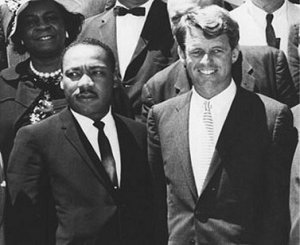
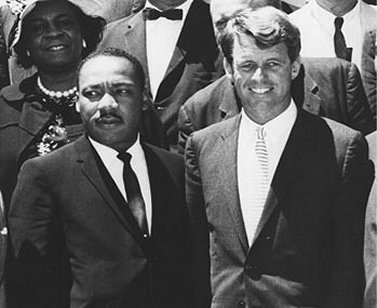
On the 40th anniversary of the assassination of Robert Kennedy, I would like to again share what I still believe is the greatest impromptu speech in American political history. The speech begins after you hear Kennedy asking an aide if the crowd knows that King has been killed.

By now, RFK’s speech in Indianapolis on April 4, 1968 — the night Martin Luther King Jr. was murdered — is the stuff of legend. Books and articles have parsed it and honored it and even shown that his beautiful quote from Aeschylus might have been slightly inaccurate. No matter. I will never tire of hearing it.

Almost exactly two months later, Robert Kennedy was killed at the Ambassador Hotel in Los Angeles.

I was one of thousands of anonymous witnesses to these horrible events in LA. In fact, a year ago I was stunned to see that Evan Thomas’s wonderful RFK, Jr. biography includes a photo in which I can be seen, along with hundreds of others, clinging to the car in which Kennedy was campaigning in El Monte, California. I was actually there as a volunteer for the campaign of Kennedy’s opponent, Senator Eugene McCarthy. But as RFK’s convertible approached, I was lost in the frenzy.

Two days later, it was over.

This is the quote from Aeschylus that Kennedy spoke in Indianapolis on the night of April 4, 1968.

And even in our sleep, pain that cannot forget
falls drop by drop upon the heart,
and in our own despite, against our will,
comes wisdom to us
by the awful grace of God.

Aeschylus. Agamemnon (The Oresteia), 458 BCE