I have always tried to be realistic when it comes to the weird topics that attract large audiences. Some topics that are easy to dismiss as disgusting and sensational really do speak to some of our most basic fears and anxieties. In all their sleaziness, they can connect to basic aspects of what it means to be a human being.
Stories of violence, infidelity, and disaster have grabbed our attention since antiquity, and I have always thought it futile to deny these fascinations or to suggest that we pay less attention. We are going to pay attention.
Having said that, this morning I read about an upcoming broadcast that will almost certainly set some unofficial record for pathetic pandering and shameless sensationalism. We are talking about nonsense of the highest order.
Will anyone watch this? Of course. And that fact alone gives me a feeling someplace between the discomfort of indigestion and a minor traffic accident.
If this essay is a tongue-in-cheek humor piece, I send it along with sincere compliments to the author for so deliciously and humorously impersonating idiocy at its most astounding.
If the guy is serious, then I send it along as idiocy at its most astounding.
What do you think?
I honestly can’t tell.
P.S. I just re-read it, and — if I had to bet the college fund ( or what’s left of it) — I’d say the author could not be serious and that this is a humor piece.
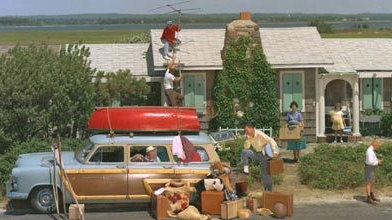
In retrospect, for all the occasional attractiveness of the giant photographs, the 40 year tenure of the Kodak colorama was really a blight on the Grand Central Station’s elegant architecture.
I still miss it, though. I loved so many of the pictures, even though the vision of American society they depicted was as cloying and sentimental as you can imagine.
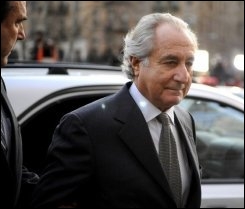
Which leads me to ask the same question I have been asking for years: is it too much to ask that a high profile public apology for criminal acts of this magnitude be written by the person who is actually apologizing? For years “repentant” offenders have simply mouthed the handiwork of attorneys and public relations experts whose “rhetoric of deep regret” is as phony and unmistakable as a $2 bill.
I am not saying that Madoff had nothing to do with this statement, but it is packed with the kind of morally empty boilerplate that really is no apology at all.
I have a half-serious idea: When someone pleads guilty and wants to apologize for his or her crimes, he or she should be be handed some paper and a pen by the judge and asked to spend an hour writing a hand-written apology.
Of course this doesn’t even slightly guarantee sincerity. But isn’t it about time we end this charade of supposedly remorseful people reading statements actually written by other people?
What happens to genuine contrition in a world where crafting apologies has become an occupation?
A blog post today by Andrew Sullivan on his “Daily Dish” is a perfect example of why, while I don’t share his conservative politics, I have so much respect for the rigor and honesty with which he grapples with ideas. Andrew doesn’t issue pronouncements. He shares an ongoing, flexible, and painfully honest internal debate about what he thinks is right.
Most of all, he does this with profound humility and attention to the moral and ethical implications of his thinking. He actually asks whether public policies are civil, are ethical, are compassionate.
Quaint, huh?
It feels strange to express my admiration for someone with whom I so frequently disagree. I suppose I am more and more frustrated with the incivility of those bloviators who seem so willfully apathetic about the human and emotional dimensions of public policy. Andrew rarely loses track of those things.
Check out this important article in Wired. While Google still offers a variety of privacy settings, this effort to use a person’s search history to target ads is more than a little worrisome.
In March, 2008, I posted a short piece about character actors. Then, as now, I was uneasy about terms like “character” or “supporting” that even unintentionally diminish the contribution that these performer can make to a film.
I was thinking about this recently as I listened to Florian Henckel von Donnersmarck’s director’s commentary on the DVD of his masterpiece The Lives of Others (Das Leben der Anderen). (Yes, I respect the term ” masterpiece.” No, I don’t use it promiscuously.) When I first watched the film, I didn’t know the work of many of the actors with small parts. But I could tell that something unusual was happening, that each of them was contributing something profound and well beyond what is usually expected from someone with three or four lines.
That is why it was so fascinating to hear von Donnersmarck talk about how he cast these roles. Apparently, the parade of actors with small parts in that film was a veritable treasure trove of great German actors. Von Donnersmarck told of apologetic call after call that he made to these highly respected actors, apologizing for offering them a small part and simultaneously trying to convince them that their role would be central. His argument was that these are among the most important casting decisions made by a director.
I couldn’t agree more.
So here is my second, admittedly selective, listing of actors with small roles who I think were arguably indispensable to the films in which they appeared. In some cases, they are actors who have played major roles in their home countries but generally smaller roles in films that are widely distributed in the United States.
The great film noir, Naked City, directed by Jules Dassin, would have been just as mesmerizing without this self-conscious two-minute introduction by producer Mark Hellinger telling you just how cool the film is.
But with its aerial shots of the city and images of Manhattan at night, even the intro has its own voice and charms — a tough-talking producer talking about a tough city and preparing you for a tough movie.
See the film. Since you can’t take a stroll around Manhattan in 1948, this is a pretty good consolation prize.
It’s infinitely hokier than Double Indemnity or Sunset Boulevard, and close to silly with its pseudo-documentary style. But still hypnotic.
The recent bankruptcy of Muzak, originator of so-called elevator music, was a reminder of all the ways that music — rather than being appreciated for intrinsic, transcendent beauty — has been used for propaganda and social control.
This morning, I received the following news bulletin from Fox News. I subscribe to the breaking news alerts of every major network. Fox was the only network that sent this alert:
Now, take a look at this story from today’s Chicago Sun-Times. It’s not that the Fox bulletin was blatantly inaccurate, but it certainly was very misleading. Shouldn’t the term “breaking news” be reserved for urgent events that are in the process of taking place?
Several months ago, I posted a piece about an extraordinary man who I have always felt was one of the least known and least celebrated heroes of the civil rights movement.
Mose Wright was Emmett Till’s uncle. At great personal danger, Mr. Wright testified twice against those who we now know murdered Emmett Till.
What is baffling to me is why so many people have continued to read that post on my site every day. It’s great that there is interest in Mr. Wright. But I thought maybe someone could help me figure out why so many people want to read this story.
I really am thrilled that so many people are interested.
Over the years, many of my classes have heard the recording of the famous Orson Welles broadcast “War of the Worlds.” The broadcast, and especially the subsequent social research done by Hadley Cantril and his colleagues at Princeton, is a really interesting way to introduce topics in collective behavior, mass media, and social psychology.
If the broadcast interests you, you will get a major kick out of this broadcast from RadioLab, the program produced at WNYC radio in New York City by Jad Abumrad, supported by his colleague Robert Krulwich.
This incredibly entertaining and informative broadcast puts the “War of the Worlds” in the larger context of a series of hoaxes over the 20th century that showed just how persuadable many of us are.
Last night in a graduate seminar, our topic was the key role that language plays as both a process and product which we use to make sense of the world.
Our readings came from cultural theorist Raymond Williams, but something incredible was published today on Nate Silver’s FiveThirtyEight.com website that brilliantly illustrates how language — including the words we choose, the ideas implicit in our rhetoric, and the deep structure of our arguments — is so important in understanding how politicians craft public messages.
Check out this piece by George Lakoff, one of the greatest living scholars of linguistics and someone who frequently analyzes the explicit and implicit meanings in political rhetoric.
In anticipation of tonight’s address by Pres. Obama to the Congress, Lakoff looks closely at what he calls the “Obama Code.”
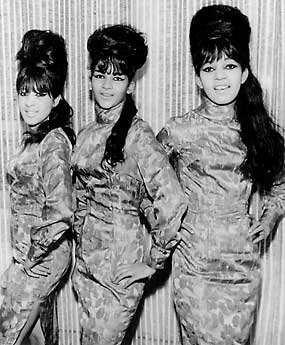
The passing of Estelle Bennett reminded me of the 2007 induction ceremony of the Ronettes into the Rock and Roll Hall of Fame. Estelle attended but was not well enough to perform. Ronnie Bennett Spector and Nedra Talley performed three of their greatest hits — “Baby I Love You,” “(Walking) In the Rain” and “Be My Baby.”
This is really an incredible performance, completely unlike the typical reunion/nostalgia concert. Paul Shaffer leads a massive band/orchestra that pulls off the best recreation of Phil Spector’s “wall of sound” I have ever heard. (Other than the studio productions themselves. )
There is a bizarre coda to the performance. At the end, Shaffer reads a congratulatory message from Phil Spector. This message came after Spector, in his role as a member of the Hall of Fame Board of Governors, prevented their induction. And that is only one piece of the behind the scenes abuse and theft that marked Spector’s treatment of the Ronettes and his former wife Ronnie Spector.
Why did Spector finally allow their induction? Let’s just say that being charged with murder and being out on $1 million bail in 2007 didn’t leave him in the strongest position.
It really isn’t a surprise that the Chinese government censored their version of President Obama’s inaugural address.
But you have to wonder what digital world they are living in if they think that their amateur mischief is not immediately broadcast around the world. The Internet is beyond pervasive in China, and almost immediately after every lame attempt at censorship, millions of Chinese citizens and people around the world are instantly informed.
But it goes beyond the simple act of censorship.Their choice of forbidden passages reveals a complete lack of subtlety on their part, and almost immediately telegraph their authoritarian inclinations around the world.
Gee, I wonder what they might have found objectionable in the passage they cut:
“To those who cling to power through corruption and deceit and the silencing of dissent, know that you are on the wrong side of history, but that we will extend a hand if you are willing to unclench your fist.”
Advice to China:
Good news: Authoritarian government and oppression is still possible in the digital age.
If you know about the mechanics of blogging, you know I receive a list of all the various combinations of web search terms that people use to reach my site. Some are heart-breaking and some are hilarious. Some are scary. Here are some recent examples. In each case, my blog did in fact include each search term. Let’s just say that I was probably not what they were looking for.
famous boring speech
michael savage opinion on colonoscopy
why do prisoners have cable
i feel fear when i walk by someone
One poignant reality of the Internet is that these people will forever remain a mystery; that I will never know who wanted to know Michael Savage’s opinion on colonoscopy.
If you lived and breathed 60’s girls groups, you worshipped the Ronettes. Who knew that Estelle Bennett, Ronette extraordinaire, had such a relentlessly painful life? Estelle died this week at age 67.
I do not point out episodes like this to ridicule the individual involved.
Unless I believe someone to be clearly and purposefully cruel and evil, in which case I confess to occasionally reveling in their misfortune, human frailty goes and comes around enough for me to usually avoid Schadenfreude. All of us have inner-jerks capable of being revealed, and — perhaps out of superstition — I generally avoid ridiculing other people’s screw-ups in the hope that my inner-jerk won’t be the next one exposed!
But what do you say about a performance like the one by Shoichi Nakagawa?
The world economy is in shambles. Every word out of the mouth of a head of state or finance minister from Lagos to Reyjakvik can send economic shockwaves around the globe. And Monday at the Rome G-7 conference of finance ministers, the Japanese finance minister, Shoichi Nakagawa, acted erratically, slurred words and even momentarily went to sleep at a press conference. Drunkenness is not an unreasonable conclusion.
Set aside his monumental irresponsibility. What was his staff thinking? In the instantaneous world of early 21st century media, you can’t do something like this in private and not have it broadcast around the world, much less go bonkers at a press conference in front of hundreds of millions of people.
As I write this at 12:40 AM EST on February 17th, the Nikkei index is down 109 points and Minister Nakagawa has announced his intention to resign.
A final point because I have students from Japan and many other countries: This minister and his inexcusable behavior could have come from anywhere. Someday I’ll tell you the stories of Wilbur Mills and John Tower.
I will give him some benefit of the doubt: While I don’t understand Japanese, he did fall asleep during a question of such length that perhaps sleep was the appropriate response.
And it wasn’t even the propaganda that was the mortal sin. Our system is one in which politicians and agencies are allowed to vigorously promote their point of view while we are obligated to vigorously monitor their output for spin and fluff and other self-serving nonsense. I have occasionally helped government agencies shape messages about safety and health emergencies.
But the “sins” uncovered in Bartow’s brilliant series “Message Machine” went way beyond the pale. The paid military analysts were misrepresented by the networks as neutral experts. In fact, a number of them were shown to directly financially benefit from defense contractors when they promoted a certain point of view. Sure, we are all drowning in phoniness. But this was phoniness for bucks that had life and death implications.
If you have any interest in the role of the press in society, the Barstow series is a must read.
A confession: I am not naive about news management and spinning and lying and payoffs and all the rest. May God forgive me any spinning I have ever done that, well, spun more than it should have.
I only have one question: Do you think those who invited her have seen, I mean really seen and heard, her routine? Are they really ready for the comedy equivalent of a nuclear weapon?
Now this is going to be one history-making, sidesplitting , controversy-creating night. There are statues in that city who will probably start laughing.
My default position on narration in documentary film is almost always negative, especially when it is used as an amateurish substitute for skilled cinematic storytelling. But I don’t have a hard and fast rule, and sometimes a few strategically placed, eloquent words fit seamlessly into a narrative. For the most part, though, I am a fan of wordless ”narration” that tells a story with meticulous and rhythmic editing.
Of course, all bets are off in first-person documentaries. When these films are done well, (far too seldom) the narration is precisely the point. I think of the films of Alan Berliner, Doug Blank, Ross McElwee, and Elizabeth Barret.
In Elizabeth Barret’sStranger with a Camera, narration rises to the level of sublimely beautiful poetry. Barret — one of my favorite filmmakers — uses her own voice and creates a truly haunting meditation on life, loss, memory, and the ethics of the visual image. I confess that I deeply admired her film for almost two years before I noticed that much of the narration had been written by Fenton Johnson, an accomplished Kentucky novelist. I hope you can see this great film and hear Elizabeth speaking Johnson’s remarkable prose and what I am sure were many of her own words.
Tonight I had a surprise. I was watching an episode of PBS’s American Experience about the assassination of President Abraham Lincoln. I didn’t immediately recognize the voice of the narrator, but it was so understated and mournful that I knew I was not listening to your average voiceover artist. It was almost a new genre, something you might call historical oral theatre.
Then I realized that it was Chris Cooper, one of the finest actors working today. You may have seen him in Adaptation or Capote. Like any brilliant actor, he knows instinctively that less is almost always more. But please listen to his narration if you have a chance. This was stunningly beautiful work and showed how a great actor like Chris Cooper can turn prose into poetry.
Finally, if you want to hear another remarkable example of the use of a narrative voice in film, listen to Tommy Lee Jones speaking Cormac McCarthy’s poetic prose in Ethan and Joel Coen’s “No Country for Old Men.”
The list of Chris Cooper’s accomplishments, already long and packed with one masterful performance after another, has to include this little recognized use of his voice. Check out Barak Goodman’s The Assassination of Abraham Lincoln.
At various places on Media and Mayhem, I mention the names of singers and actors and other celebrities. And among the thousands of other words also used, “p–n” can be found in one place on my blog.
Well within the last several months, a virulently viral rumor has circulated on the Internet that an amateur p–n film of one of these celebrities can be found.
The result is that hundreds of people put the name of the celebrity and the word “p–n” into a google search and get to my blog.
I am sure they are sorely disappointed. You see, I use the word “p–n” to refer to those trashy MSNBC pseudo-documentaries of prison life where the main attractions are nice, bloody beatings.
Yup, undeserved and unwanted hits. And the lesson is that the number of hits a blog or a site gets can be a very deceptive figure.
Meredith Whitefield, one of my students, called my attention to this wonderful quote from Virginia Woolf. It is from Three Guineas (Annotated) , probably her most polemical feminist work. What a nifty manifesto for the guts and muscularity to which culture should aspire.
“And “culture”, that amorphous bundle, swaddled up as she now is in insincerity, emitting half truths from her timid lips, sweetening and diluting her message with whatever sugar or water serves to swell the writer’s fame or his master’s purse, would regain her shape and become, as Milton, Keats and other great writers assure us that she is in reality, muscular, adventurous, free.”
Friedrich Hans Ulrich Mühe (Ulrich Mühe) will always be one of my favorite actors. His performance in Florian Henckel von Donnersmarck’s Das Leben der AnderenThe Lives of Others (2006) is masterful. I have rarely seen a film peformance in which a character’s small exterior gestures and ticks so subtly and perfectly hint at a turbulent, anguished interior. One tear dripping down Mühe’s cheek was almost impossibly painful to watch.
Several weeks ago, I described my disgust with the Chinese government’s censorship of Pres. Obama’s inaugural address. It’s not that I was that shocked. In fact, I was almost amused at the amateurishness they revealed by censoring a passage so obviously directed at them.
“To those who cling to power through corruption and deceit and the silencing of dissent, know that you are on the wrong side of history, but that we will extend a hand if you are willing to unclench your fist.”
Wow, Gorelick. Big revelations. The Chinese government is authoritarian. The Chinese government engages in censorship. The Chinese government allowed shoddy construction practices that maximized fatalities of young students during last year’s earthquake. Who doesn’t know those things? End of story. Not quite.
Ever since, that particular post has been bombarded with hundreds and hundreds of spam. The spam protection I use, Akismet, is excellent. They have all been caught and deleted. But no post of mine has ever resulted in an attack of this magnitude.
And so I wonder, certain that I must sound excessively paranoid, whether anyone, anywhere is trying to communicate anything to me.
I’ll leave it at that. In fact, as I write this, it seems grandiose to even imagine that some little blog post might have caught the attention of any even mini-muckety-muck.
But I wonder. Over 700 spams directed at one post?
Hasan Elahi’s remarkable ongoing project “Tracking Transience” takes surveillance to extremes you never imagined possible. Faced with government harrassment, Hasan chose to resist with an amazing public digital art project in which anyone, at any time, can learn almost anything about his comings and goings.
I’m sure some people see Hasan’s work and, using everyone’s current favorite acronym, think it is “T.M.I.”
I think it is brilliant.
By the way, in the spirit of Hasan Elahi and Google Latitude and the whole era of excruciatingly transparent transparency, here is where I am right this second. Whoopdedoo!
P.S. I really do like the concept of transparency. Unfortunately I am still uncomfortable with it as a way toactually live! So pretty soon I’ll share why I finally got too uncomfortable with Facebook and signed off.
Check out Max Raabe, one of my absolute favorites. Max is a German baritone who, with his Palast Orchester, recreates German dance, film, and cabaret music of the 1920s and 1930s. If the flowering of Weimar-era film, music, theatre and art before the Nazi onslaught interests you, you must get to know Max.
Max is other-worldly, hilarious in a dry, mischeivous way, and a really great singer. The Palast Orchester musicians are incredible.
When you are not dealing with a truly venal huckster – say, a dishonest car salesman or sub-prime mortgage lender— it can sometimes be incredibly fun to watch a transparent phony at work.In fact, if you know that the huckster is a phony, and – even better – if he or she sort of knows that you know they are a phony, watching them sell a ginzu knife or a pocket fisherman can be pretty darn entertaining.
Sometimes this nonsense even rises to high art: Did you ever see Ron Popeil try to convince a roomful of bald men to cover their head with spray-on hair? You haven’t lived until you’ve seen 25 heads covered with dark Christmas-tree flocking.
This morning I saw a performance that has to rank with the best of them. File it under “Shameless Pathetic Attempts to Rip-Off Environmental Concerns to Sell Tchotchkes” Even Bernie Madoff, if he was watching from his couch, leg bracelet tightly fastened, probably thought: “Now there’s a guy with nerve!”
This morning on the Martha Stewart show, which was playing on a TV at my gym, I saw Chef Emeril Lagasse selling what he described as a set of “green knives.”I perked up to listen: What would an environmentally-sound knife look like, assuming he wasn’t simply suggesting it was sharp enough to injure a polluter?
The answer? Emeril claimed the knives are “green” because no trees had to die to make them.
Translation: The handles are plastic.
Am I missing something here? Does a plastic (poly) handle, classified by recyclers as a #7 plastic (the hardest to recycle and sometimes not recyclable at all), make it a “green” knife?
The green revolution is one of the most exciting developments of our age.But please: Is there any chance that the “green” concept might also incorporate a reduction in hot-air, pseudo-environmentalist green-spinners, green-hucksters, green-phonies, and green-knife salesmen? It might actually reduce global warming. Seriously, I can see now that environmental and green activism will have to fight tenaciously to reduce the cheapening and downright fraudulent use of the concept.
And now, if you’ll excuse me. I am going to turn on the Home Shopping Network. I have been looking for a cheap, “green,” and environmentally sound cubic zirconium nose ring.
To be immersed in digital media in the early 21st century is to swim — and sometimes drown — in a sea of noise, feeds, texts, files, images, words, and more words. Our lives become a struggle to find our way through a slog of bytes and mega-bytes.
So here is my frustration: Sometimes the digital world feels like the inside of a 1000 piece jig-saw puzzle box. The task of sense-making seems overwhelming. Meaning seems completely elusive.
Always another email, another picture, another text message. The message appears. It disappears. Emails arrive. They are deleted. Feelings are expressed. Feelings are deleted.
Which always leads me to the same question: What is real when the ephemeral is ascendant? What experiences are unambiguously concrete and only minimally mediated by some new technology? What is authentic and enduring in an age of bytes and ephemera?
This is when I usually flash on some memory so indelible and real that it seems to occupy a space completely separate from all the noise and nonsense. I know that neuroscience has located every brain function from jealousy to financial anxiety. I wonder if they have located the place where the garbage dump of digital overstimulation gives way to the precious and the profound.
I thought I would share some of these fragments as they come to mind, i.e., concrete and profound experiences that transcended daily noise and left an indelible impression. I do this fully aware of the weirdness inherent in the fact that the moment I press the “publish” button, my authentic experience immediately becomes part of someone else’s noise. Does this cheapen it? Discount it? Should I prolong these private experiences to protect their personal significance? What happens when they are launched into the public sphere? I don’t know.
Fragment #1 is an unforgettable image I saw on a number of West African roadsides, evidence that even grief has to be serviced and managed.
This is my photograph, taken surreptitiously, of one of the roadside casket merchants of Togo, West Africa. There never seemed to be a shortage of customers. Death as a daily physical presence — unavoidable evidence of infant mortality, disease, and hunger — is not something a visitor from a “death-denying ” culture will ever forget.
How about a shout out to the Parents Television Council, hard at work on an issue of such importance.
At least they have the courage to keep us focused on what is right and decent, and refuse to allow variousinconvenientminorproblems to divert our attention from what really matters.
But who knew how few of our most cherished illusions would — with the almost complete erosion of the distinction between public and private — survive the light of day? Our heroes are unceremoniously unmasked as sleaze balls. Foods that we have eaten with abandon are revealed to have been slowly killing us. Celebrities whose lives we have watched and envied have turned out to be anything but enviable.
For the most part, this is not a bad thing. We are still allowed our heroes, but we have no choice but to view them in the fullness of their humanity and the complexity of their character.
That is why I tenaciously cleave to several illusions that no amount of fact or truth will ever dislodge. I cherish them too much, and refuse to ever let truth intrude on joy.
Which leads to Shirley Temple.
By the time I was growing up, Shirley Temple’s films were already several decades old. But they were shown repeatedly on television in Los Angeles, and for my sisters and me they were sheer joy. She could sing, she could dance, and her singing and speaking voice could melt the heart of even the most crotchety old cynic. I loved her.
And it’s not that this love was so easy to maintain. Her charm was probably infinitely more saccharine than I will ever admit. Very much in the spirit of the times in which she worked; black characters in her films were jesters, clowns, or fools.
And, most controversially, there probably was something more than a little icky about a flirtatious eight-year-old wiggling and jiggling across the screen. In a now famous 1937 paragraph, the author Graham Greene wrote words that engendered enough rage to force his immediate escape to Mexico. But he probably was onto something:
Her admirers – middle-aged men and clergymen – respond to her dubious coquetry, to the sight of her well-shaped and desirable little body, packed with enormous vitality, only because the safety curtain of story and dialogue drops between their intelligence and their desire.
To watch a Shirley Temple movie is, sadly, to see the origins of those atrociously over-sexualized “Jon-Benet” beauty pageants that were so deliciously lampooned in the film Little Miss Sunshine.
But I loved her and I always will. She made me happy. She made me laugh. And while at 10 years of age I didn’t really understand the notion of romance, I probably got my first inkling of it when I heard her sing a song that, to this day, can get me misty-eyed.
If, like me, you think that still photography is a revealing and sometimes even profound way to tell a story, I’m curious what you think. Some of these photographs are amazing character studies which magnify and empahasize the qualities of the subject.
The photographic essay is alive and well on-line.
Use good headphones. Someone did some fine sound work.
This morning I was thinking about how quickly our culture anoints heroes. Some unspeakable act occurs and, in a desperate attempt to find a savior, heroes are selected and honored while the accused are demonized. In our infinite patience, we do this so quickly that medals are often presented before we even know exactly what the hero did.
Isn’t this backwards?
Doesn’t the magnitude of an act of courage only become clear with the passage of time, when we can look back and see the historical context in which an act was truly selfless? On the other hand, doesn’t time also occasionally reveal the self-interest and even selfishness that might have been the actual motive for an act initially hailed as courageous?
Here is my favorite scenario for what makes a genuine hero: A modest, decent person does something quintessentially selfless without regard for personal safety. Some people pay attention, but — for a whole host of reasons — the act takes place below the radar of public attention. Maybe the hero isn’t especially desirable. Maybe he or she is a member of a despised group. Or maybe the act itself is such a violation of current values that it is reviled rather than admired.
But then, as time passes, the magnitude of the act – the extent to which it fearlessly transcended the conventions of the moment — slowly becomes clear. And decades later we ask ourselves: How did anyone have the guts to do that?
And so I present my choice for a hero.
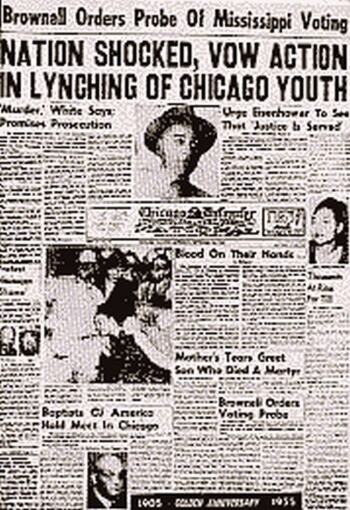
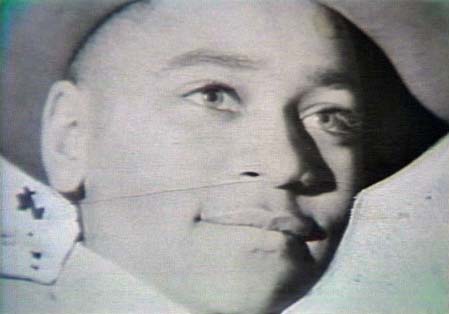
The 1955 murder of Emmett Till was a seminal moment in the history of the civil rights movement.Till was a 14 year-old African American from Chicago visiting his family in Mississippi. When he violated the unwritten laws of segregation by talking to a white woman, he was abducted and brutally murdered. Photographs of his open-coffin funeral, revealing an unspeakably savage beating, were widely circulated. Emmett’s mother Mamie became a passionate and eloquent voice for social justice.
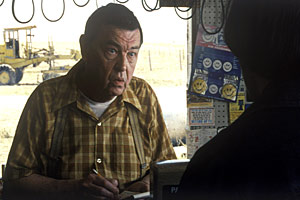
My hero, though, is Mose Wright. Mr. Wright was Emmett’s uncle and a witness to the abduction. When two men were accused of the crime, Wright chose to be a witness at the trial and personally identified the two white defendants. At the time, observers at the trial could not recall another example of a black man testifying against a white defendant. Wright moved to Chicago, but once more – ignoring warnings that he would be killed –returned to testify against his nephew’s killers. He never flinched or hesitated.
Check out this excerpt of comedian Louis C.K. on Conan O’Brien. It is rare that I discover someone speaking words and expressing feelings that almost perfectly mirror my own.
To be unusually concerned about one’s immediate environment is natural. If a school bus crashes in Manhattan and 22 children are killed, I will be distraught. And I will be more distraught than I would be about the same type of event taking place at a distance.
But I am profoundly uncomfortable with this pervasive “parochial compassion.” In a globally connected world, with so many of us frequently crossing boundaries , living in countries in which we were not born, and with so many unintended consequences flowing from events far away, we desperately need to nurture the ability to care about people in distant and unfamiliar places.
So obvious. So simple. Sunday school stuff. So why is it so hard to extend our “terrain of grief” to places that lie at the margins of our mental map?
This is, after all, a time when my New Jersey neighbor might be from Nepal. Some of my students are from Nepal. My son may be travelling to Nepal. Grief as a parochial practice just won’t fly anymore.
I am trying to reach. We need to reach. We are human beings.
The great actor Robert Prosky, who died today in Washington DC, worked frequently and with distinction. His TV work was probably most widely known.
But for me, there will always be only one Shelley “The Machine” Levene in David Mamet’s “Glengarry Glen Ross.”
Prosky was the first to play the role on Broadway and, if you saw him, you may — like me — have remained permanently haunted by this quintessential model of unrepentant sleaze and desperation.
To this day, I’ll walk into a car dealership (always a nightmare in itself) and — for a moment — imagine that I see a room full of Shelley “The Machine” Levenes.
I have never been someone who easily finds pleasure in other people’s travails. It’s probably superstition as much as anything, and I am all too aware that human fallibility both goes around and comes around.
But today’s events in Illinois, in which Governor Rod R. Blagojevichwas arrested on corruption charges for the attempted sale of Barack Obama’s senate seat, are simply too bizarre and too entertaining to ignore.
Entertaining?
I am privileged to teach in a department with students and faculty in various stages of writing and developing film scripts. Several of my faculty colleagues are accomplished and produced writers for film. A whole lot of film talk goes on. Sometimes just listening is like being in a master class.
So I have read some fine work.But I don’t recall anything that anticipated some of the cool stuff that federal prosecutors attributed to Governor Blagojevich in today’s complaint.
This was a tough guy who meant business. We’re talking Scarface or Goodfellas quality. Apparently you did not mess with Rod Blagojevich. Check out these excerpts from the complaint:
·ROD BLAGOJEVICH said that the consultants (Advisor B and another consultant are believed to be on the call at that time) are telling him that he has to “suck it up” for two years and do nothing and give this “motherf___er [the President-elect] his senator. F___ him. For nothing? F___ him.” ROD BLAGOJEVICH states that he will put “[Senate Candidate 4]” in the Senate “before I just give f___ing [Senate Candidate 1] a f___ing Senate seat and I don’t get anything.”
·Later in the conversation, ROD BLAGOJEVICH said he knows that the President-elect wants Senate Candidate 1 for the Senate seat but “they’re not willing to give me anything except appreciation. F___ them.”
·Later on November 12, 2008, ROD BLAGOJEVICH talked with JOHN HARRIS. ROD BLAGOJEVICH stated that his decision about the open Senate seat will be based on three criteria in the following order of importance: “our legal situation, our personal situation, my political situation. This decision, like every other one, needs to be based upon on that. Legal. Personal. Political.” HARRIS said, “legal is the hardest one to satisfy.” ROD BLAGOJEVICH said that his legal problems could be solved by naming himself to the Senate seat.
If you are interested, read the whole federal complaint. I am sure that, at this very moment, scripts about corrupt politicians – previously rejected as implausible or as caricatures of venality — are being rescued from slag-heaps across the country and being given a second look.
Think of it: One week to the day after the election, when many of us were imagining what it would be like to call Barack Obama Mr. President, Governor Blagojevich was practicing his own term for referring to the President-elect:
“ This mother___er.”
“They’re not willing to give me anything except appreciation. F___ them.”
It is with no small amount of shame that I admit the following: Much of my disgust with self-serving “C.Y.A.” spin is a function of my having on occasion been in a position of having to think up such nonsense. Heaven help me, but I can smell this stuff a mile away.
Today I watched an interview with Ford CEO Alan R. Mullaly, who was proudly touting the fact that, rather flying to today’s bailout hearing in a private jet, he would be driving from Detroit in a new Ford Fusion Hybrid. He said he had “learned a lesson” after he flew to the last hearing in his private jet.
Look, I’m not suggesting there is anything else he could have said. But let’s be clear: He didn’t simply “learn a lesson.” He was so embedded in the culture of perqs and excessive compensation that it never even struck him or anyone in the company – not even their highly paid flacks — that flying a private jet might rub people the wrong way.
This may surprise you: I actually do not see a corporate jet as inherently evil. It would be hard to persuade me, but I would at least listen to an honest argument about how speedy, on-demand air travel might promote profits and productivity. Given Ford’s current problems, I would think that it would be mind-bogglingly ridiculous to try and make that argument now. But if Ford was thriving, if Ford was growing and employing more people, if Ford was paying its workers well and providing good benefits, I don’t think that many people would be having a fit about the plane.
What does give me a fit is a guy getting caught using a private plane in the midst of an economic collapse – clueless about how it would be perceived — and spinning it as a “lesson learned.”
C’mon Mr. Mullaly: It was greed and excess revealed, not simply a lesson learned.
It is hard for me to look at a photograph that fuses tragedy and beauty without some guilt. The thought that I might feel any kind of pleasure or aesthetic satisfaction at an image of horror seems almost instinctively wrong.
Of course, at the same time, I know that beauty is a complex concept. It is not necessarily, nor even typically, “pretty.” We all have found pleasure in gazing at images depicting moments of unbearable sadness and pain.
So what is beauty?
I will always be haunted by a renowned virologist who tried to explain to me why he found the HIV virus – in its complexity and brilliant resistance to being destroyed or even tricked — a thing of beauty. Perhaps sometimes we describe something as beautiful, not because it gives us conventional pleasure or joy, but because we are humbled or stunned at what it reveals of our profound humanness and vulnerability. Humanness — stripped of artifice and faux gentility – can be sublimely beautiful, even when it leads us to horror. It is who we are.
To be sure, this is a different kind of beauty, rooted not in pleasure but in awe. If we see beauty in moments of fury, angry crowds, acts of violence, and even death, perhaps we are simply in awe of such unflinching glimpses of ourselves. Maybe we even find it titillating to see ourselves so nakedly human, so capable of evil, so overcome with grief?
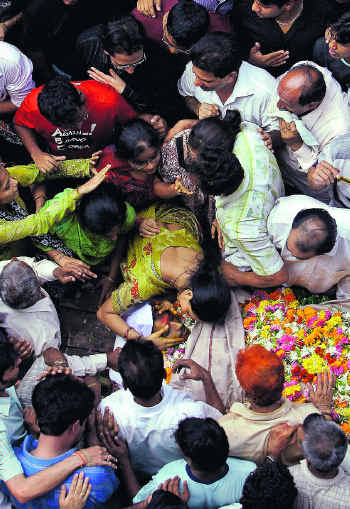
Which leads to this picture from the front page of today’s New York Times by AP photographer Gurinder Osan.
This is a crowd in the midst of unbearable grief; a heaving, surging, human crowd surrounding the grieving family of terror victim Haresh Gohil. It is living the shared pain of a community brought together in a volatile mixture of anger and sadness. It is a swirling and kinetic crowd that — from the unusual angle chosen by Osan — has formed a human tapestry of grief. The wailing and moaning even seems audible, yet it only takes a moment to recall that this is a silent photograph.
Each of us will have a day, a speech, or a moment that will be our mental marker for the presidential campaign of 2008. These will include moments of eloquence and moments of confusion, moments of high drama when both candidates revealed important personal qualities, and mundane moments that were just as revealing.
I wish that my most vivid markers were times when either candidate spoke from the better angels of their nature rather than from pettiness and cruelty.
But that apparently is not to be.
Because several sultry and rainy days in late August continue to echo with such cruelty and arrogance that they probably will shadow me as long as I live. That those responsible for those days of cruelty essentially hastened their party’s defeat should provide some small satisfaction. It doesn’t. I still feel the sting and rage of knowing I live in the same society with people who find pleasure in cruelty.
I refer to those days at the August Republican convention when the Republican party’s message of the day – delivered by former New York Governor George Pataki in the morning at a breakfast of the New York Republican delegation and later by former Mayor Rudolf Giuliani to the entire convention — was a vicious, full-frontal attack on the idea of community organizing.
Pataki began the day with this reference to Obama: “He was a community organizer. What in God’s name is a community organizer? I don’t even know if that’s a job,” he said. He received laughter and applause.
This was nothing short of a vicious attack on community volunteers and organizers who help poor people weather the kind of social policies promoted by politicians like Pataki and Giuliani. These are people who register voters of all parties, who help poor people find money to pay heating bills and buy food, who teach tenants their rights under the law, who provide their children alternatives to the street, who tutor kids after school.
By all rights, this moment of ugliness would be long forgotten and buried under the joy and hope engendered by the defeat of their politics of cruelty.
But forgetting would itself be negligent. We must never forget that on one day in August, 2008, this kind of hate and disdain came out of the hole in which it usually hides and was on exhibit for the whole world to see, in all its astounding selfishness. Community organizing, they said, is not a job. And their audience laughed.
They laughed.
They laughed at those who dedicate their loves to bringing warmth, nutrition, clothing, and housing to those who have never even seen or heard of a safety net, much less landed on one.
They laughed. Pataki laughed. Giuliani laughed. And their audience laughed.
But this also hit me in a personal way. Very early in 20th century, one particular unknown community organizer without a real job, a Chicago social worker named Jane Addams trying to found a settlement house, convinced a shy, destitute immigrant kid to train in medicine and promised that she would support him if he worked hard. Throughout his life, that kid (my grandfather) told his grandchildren stories about Jane. Only in later years did I fully appreciate that his “Jane” was Jane Addams, one of the founders of modern social work, the founder of Hull House, and winner of the Nobel Peace Prize.
But facts never adequately refute cruelty. Its purveyors must seek forgiveness for the hurt rather than simply present arguments to the contrary. To re-enter the public sphere of civility and decency, they must apologize. These two for whom cruelty rolled so easily off the tongue must atone.
And we who were rendered speechless must never forget what they said.
Remember: Politics is a system fueled by forgetfulness. Governor Pataki and Mayor Giuliani are banking on a system that they know will likely forget their words of cruelty. Someday they will again present themselves to voters and launch campaigns assuming that these words will be ancient history. Depending on how the winds blow, the same people who spoke these words might even try to wrap themselves in the mantle of compassion. Kindness — in their cynical world — is a strategy and a talking point, not a moral tenet. The day will come when some comparably insincere consultant will hand one of them a beautifully written, yet scandalously phony speech on how we have to do more and help more.
We can’t let that happen.
They laughed.
Watch them laugh at the people who dedicate their lives to insuring that others might have housing, be nourished, and enjoy some measure of basic human dignity. And tell me just what Giuliani and Palin find so funny.
But does anyone agree with me that the otherwise extraordinary screenplay might have slipped into implausibility with the murder and car bombing sub-plot?
Maybe I am the naive one. It just seemed to cross the line into ever-so-slight nuttiness.
I have spent over a week trying to find the words to tell this story. It is 3:00 a.m. I am in a strange hotel bed with lousy pillows. I can’t sleep. Maybe a nightmare is best told at 3:00 am.
When Barack Obama was elected President, the social and cultural earthquake I wanted so badly became possible. Certainly not an earthquake that would magically provide a final resolution to hundreds of years of shame, but one that might rip open the racial fault line with a vengeance.
And then came the rhyme. The damn rhyme.
Eeny, meeny, miny, moe
Catch a tiger by the toe
If he hollers let him go,
Eeny, meeny, miny, moe
My ten year-old daughter, trying to make some choice about lunch or a friend, was employing the old “eeny meeny miny moe” test. I think she and the tiger ended up picking the tuna sandwich. Yet I almost immediately recalled the countless times in 1950s schoolyards when kids used the same rhyme with a word other than tiger. It was the version that Rudyard Kipling published in 1923 as “A Counting-Out Song” in “Land and Sea Tales for Scouts and Guides:”
Eenee, Meenee, Mainee, Mo!
Catch a n——r by the toe!
If he hollers let him go!
Eenee, Meenee. Mainee, Mo!
You-are-It!
This would now be the time to confess that I also said that word out on the playground. But I didn’t. I do remember how it was often used to settle marble-trading disputes. I also remember kids feeling a perverse thrill that they could vicariously participate in the larger, social ugliness.
But this was a word that could not have been more forbidden in our house, a word I never uttered after the day — at the age of six – that my wonderful Dad heard me say it and placed a bar of Ivory Soap in my mouth and twisted it around a few times.
But I am stuck. The rhyme echoes and echoes. A nightmare. A rhyme. I want to fully celebrate that Barack Obama will be my President. I will. But the intruder is a rhyme; an echo of an ugliness that was part of what delayed this day for so long.
Eenee, Meenee, Mainee, Mo!
And that is where I am right now at 3 a.m.
Knowing that at virtually the very moment that Emmett Till faced his final horror, at the very moment that his mother Mamie first heard the news, kids in my neighborhood were probably out in a park – shooting marbles or playing tag – and reciting:
The fact that it is election day has all but hidden the fact that today the US Supreme Court hears oral arguments in the case of FCC v. Fox Television Stations, Docket No. 07-582. Fox is unambiguously on the side of free speech, and is fighting the tendency of the FCC in recent years to punish broadcasters for “isolated and fleeting utterances” that it deems indecent. The vagueness of the FCC’s indecency standard is very much at issue.
An isolted utterance would, for example, occur if — in a post-game locker room interview — a player remarked on live television that he didn’t give a f____ing s_____t what the coach thought of his five missed pass receptions.
If you care about censorship, read the accounts of today’s arguments and watch for a final decision. And if you are really interested, check out the slew of amicus briefs filed by all manner of organizations opposing censorship. And some favoring it.
What makes the case interesting is that the indecency at issue is spontaneous, and not planned in advance or written in a script. Some of us support the right of a broadcasters to do even that, but the FCC in this case is essentially arguing for — and FOX is opposing — the idea that stations should be held responsible for accidents!
Ridiculous. While these cases almost always involve defending someone’s right to say something stupid and even offensive, this is precisely how we establish and protect the principle of free expression.
When you’ve done retail politics in Brooklyn, not much surprizes you. But I just heard something that has me stunned.
Senator Charles Schumer voted this morning in a Brooklyn election district I know well. And he just said on MSNBC that he waited an hour. This is really a very big deal.
I cannot recall one election in that election district in which voters had to wait for a hour. Given that New York state is safe for Obama, and that there are no hotly contested races going on in Schumer’s neighborhood, it seems that the sheer excitement and history of the national election is driving turnout.
Without starting to tell hilarious stories about Brooklyn politics, let’s just say that general elections are virtually never contested there. All the action is in the Democratic primaries. But did we have fun! Brooklyn politics was my basic training in retail persuasion.
As my students know, I go out of my way to create an atmopshere in my classes that is safe for students of all political persuasions — Democrat, Republican, and all other parties. But neither have I hidden my preference for Senator Obama.
And sometime later today, Ill try to share the incredible emotion I feel as I cast my vote for him. Some of you in your 20s and 30s will probably end the day sick of hearing older people talk about how they never expected to see a day when an African American would have a serious chance of being elected President. I’m sick of hearing myself say it!
But I might never stop. Today is a day that is haunted by the ghosts of people — from famous to anonymous — who died to make this possible.
Have we erased the national shame that is the American experience with race? Of course not. Anger and privilege and bias don’t simply disappear. They don’t simply fade away without a fight.
But the distance we have travelled is nothing short of incredible.
I know that one person’s nostlagia can be another person’s mind-numbing boredom. Sometimes the things from the past that most touch us, that most bring us to life, are things which no audience — not even an audience of one — is eager to hear about.
So some of us keep a lot of our memories to ourself. Or we try.
Last week, I had the still shocking experience of learning that one of my graduate students here in NYC grew up in the same southern California suburb I did, and that her family owned the Five Lanterns Chinese Retaurant, in Covina, California, the place I had my first job in 1965.
It’s a UPS store now.
I was a bus boy in that wonderful Chinese Restaurant, one of only two Chinese Restaurants for miles around in a suburb that — to this day — I recall as one of the least diverse places I have ever seen or visited.
The result is that, in the last week, I have been overwhelmed with memories of two towns, West Covina and Covina, California, from which I had supposedly escaped close to 40 years ago.
Today at the former site of The Five Lanterns Chinese Restaurant: My First Job, 1965, Covina, California
I may have more to say later: For now, all I am feeling is the flimsiness of concepts like escaping, “getting away from it all,” or starting over. They may be occasionally useful in the course of a lifetime, but it seems that I have rarely been able to truly escape or get away from anything.
Memories, joys, and hurts travel. And travel well.
I dropped an enormous tray of dishes at that restaurant. On a busy weekend night. And until last week, that tray was gone forever.
It’s back.
A Tike style mug from The Five Lanterns Chinese Restaurant. I broke quite a few of these one night in December, 1965.
A lot of my political side – especially the passion and anger that I feel about issues and candidates — never makes it on to this blog. And I thought I would explain.
I am not without strongly held political beliefs. Neither am I at all covert about them. I will often share my basic opinions so students can have some sense of who I am as a political and social being. Feigned neutrality, I have always thought, would be its own form of dishonesty.
But anyone who has taken my classes (or who ever will in the future) knows of my special concern for the feelings and attitudes of students who I either suspect or know might disagree with me. As much as anything, I want my classes to be safe places for the expression of political views from anyplace on the political spectrum, and even for views so marginalized that they might not have even made it on to the mainstream spectrum! The joy of clashing ideas, especially when marked by both passion and civility – is a special thrill of teaching at a university. If we can’t do it in a university, where can we do it?
Having said that, I did start this blog especially for my students at Hunter College.Media Studies is a rapidly evolving field and is being defined and redefined in public discourse every single day. The main purpose of my blog — Media and Mayhem — is to share this ongoing change with students as it unfolds. Last week, for example, a historic moment occurred in the evolution of the Internet: More people saw Tina Fey’s impressions of Governor Palin on-line than saw them when they were originally broadcast on NBC.
I suppose I mention all this because we now face the last ten days of a long, hard-fought campaign for the presidency. And because I support one of the candidates, Senator Obama, I wanted to make absolutely sure that all of you who are Hunter students feel absolutely free to either publicly or privately express views that might be to the contrary. You are welcome to raise them in class, to come see me, or to be in touch via email. Some of you already have, and this touches me very deeply.
Keep it coming. And if in the next week I blurt out something in my excitement or enthusiasm – or in my anger and frustration – know that your contrary expression of excitement or anger will be even more welcome, and will be met with civility and respect.
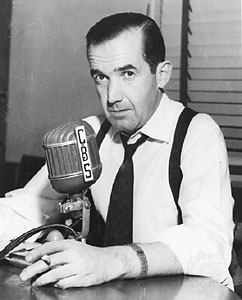
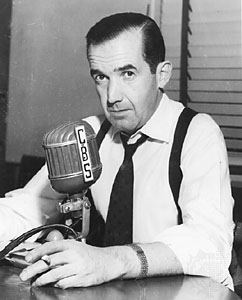
We are living through an extraordinarily historic election, taking place amidst economic chaos and wars on several fronts. Now is not the time to be shy, silent or reticent, whether you support Senator McCain, Senator Obama, Ralph Nader, Ron Paul, or any one of a number of other candidates. As Edward R. Murrow once said in a broadcast that many of my students have seen:
“We will not walk in fear, one of another, we will not be driven by fear into an age of unreason. If we dig deep into our history and our doctrine, we will remember we are not descended from fearful men. Not from men who feared to write, to speak, to associate, and to defend causes that were, for the moment, unpopular…. There is no way for a citizen of the republic to abdicate his responsibilities. As a nation we have come into our full inheritance at a tender age. We proclaim ourselves as indeed we are, the defenders of freedom where ever it still exists in the world. But we cannot defend freedom abroad by deserting it at home.”
Online Divorcee Jailed After Killing Virtual Hubby
By THE ASSOCIATED PRESS
Filed at 12:10 p.m. ET
TOKYO (AP) — A 43-year-old Japanese woman whose sudden divorce in a virtual game world made her so angry that she killed her online husband’s digital persona has been arrested on suspicion of hacking, police said Thursday.
Morgan suggesting that asking when online journalism will pay for the newspaper are asking wrong question. Newspapers in the traditional sense won’t survive. The trick will be to disaggregate the following traditional componenents of newspapers and see which will thrive and survive in a digital age:
Local news and editing
distribution
ad sales and marketing
printing
digital
Newspapers do have exisiting d ansuccessful ad sales and marketing structures that may be ready to support a new newspaper model.
But printing is an enormous expense pulling whole companies down. It is unlikely that any new model will have any serious printing component.
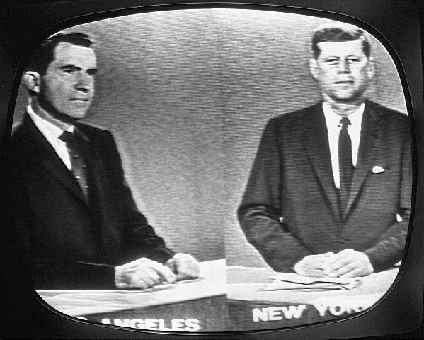
The night that John Kennedy first debated Richard Nixon in 1960 was, in some ways, the night my life began. I might have only been 9 years old, but I was a strange 9 year-old. Even then, I knew that something with incredibly high stakes was unfolding, a real-time face-off that would have real consequences.
I was hooked. Debates became my Olympics, my World Series, my Super Bowl.
In graduate school, when I had to complete a so-called qualifying paper, I wrote a comprehensive review of the literature on the effects of presidential debates on voting behavior. And I watched and re-watched hours of debate video. I remember thinking how embarrassed I would be if anyone knew that I actually found video of the first Carter-Ford presidential debate to be entertaining.
I should confess that with all this work, I never really got very interested in the substance of these debates. To me, they were the highest form of theatrical, hand to hand combat, in which the weapons were impressions, body language, turns of phrases, and images. I loved the tension.
So why can’t I stand watching them anymore?
Any student of debates learns early on that many have been the occasion for inadvertent statements and other so-called “gotcha” moments. Candidates from both parties have accidentally made statements that quickly come to be seen as the “turning points” of campaigns. One candidate’s tongue slips, the other candidate pounces, and the world turns upside down.
I hate that. I hate that such an important decision can hinge on one unintentional mistake or misunderstanding.
I know that the counter-argument is that debates are precisely the high-stakes situations in which a person’s real feelings and attitudes are revealed. That might be so.But what about the slip-up that comes out in a way that does not reflect the views of a candidate? What about a simple mistake?
Do we really want to allow these moments to change the course of history?
I have always felt that the most unfair example of these “gotcha” moments took place in the 1976 debates between President Gerald Ford and Governor Jimmy Carter. At one point, President Ford, in response to a question about the Soviet Union, stated:
“There is no Soviet domination of Eastern Europe and there never will be under a Ford administration.”
Carter argued that Ford didn’t understand the full extent of the domination exerted by the Soviets in Eastern Europe.Yet it has always seemed perfectly clear to me that what Ford meant to suggest was that the United States refused to concede that the domination was a permanent reality. And that the people in those countries had not accepted this domination.
But the “Ford Doesn’t Get the Soviets” narrative caught on. My candidate – Carter — won. I guess I shouldn’t complain.
That may be ancient history. But it is also the reason I can no longer watch debates.We are still a people who love the politics of the car crash.We love the possibility that a collision could occur at any moment. We watch politics as if it was the NASCAR title rather our future on the line.
And I simply can no longer stand the tension of watching an event that might turn on a “gotcha” moment, on a slip of the tongue, rather than a well-crafted argument.
I am glad we have debates. They are about more than “gotcha” moments.Everybody should watch them. The enormous audiencesmay be as close as we come to a collective, national, civic gathering.
I just won’t be there with you. Too nerve-wracking.
I am as baffled as most of you are about the financial upheaval of the last few weeks. I don’t understand derivatives, cascading effects, and the intricacies of mortgage-backed securities.
But I have spent many years studying what sociologists call moral panic, sudden shocks to a social system in which it seems that the most basic assumptions about right and wrong, about the norms and values we take for granted, suddenly come undone. The concept was developed by the British sociologist Stanley Cohen, whose work I admire greatly. I have been mostly interested in sudden violence, but any sudden, disorienting shock to a social system can rip away at the social fabric.
For all their seemingly unique horror, so much of what usually follows these events is predictable. Society rushes to the moral barricades. Portraits of evil are drawn so we all can share a collective image of who we are supposed to hate. Heroes are constructed who will save us. And scapegoats – those who brought this evil to our doorsteps — are sought and stigmatized and made to pay.
It’s the scapegoating that’s on my mind.
Social shocks are almost immediately followed by a hunt for the guilty. We need to know who to blame. We find it almost unbearable to live in a state of uncertainty in which a sudden, disturbing event cannot be blamed on a specific person or group. We need to see the face of evil. We need to hear its voice. We need to construct a narrative with a villain who knew what he or she was doing, yet still chose to act in a purposefully venal manner.
And then we need to join together and focus our collective loathing on the group or individual who tried to hurt us. Congressional hearings are wonderful settings in which the guilty are brought to the public scaffold and publicly humiliated. Right and wrong becomes clear during these rituals and we symbolically purge ourselves of those who would do us harm.
Yet this is precisely the point at which we often really screw things up.
Months after the panic has calmed, we almost always look back and see that, in our rush to the scaffold, we settled on the wrong culprit. Or we see how, without even realizing it, we lost the ability to see how an event might have resulted from the complex interaction of multiple culprits, or that even we ourselves might not have been blameless.
I was thinking of this as I watched former Lehman Brothers CEO Richard Fuld testify Monday on Capitol Hill. Trust me. You could waterboard me and I still wouldn’t be able to explain the dynamics of this financial collapse or what role Richard Fuld did or did not play. My forever secret math SAT score stands as silent testimony to why no one in their right mind should ever look to me for any economic wisdom. And I certainly don’t know what Richard Fuld knew and when he knew it.
What I do know, though, is that my panic alarm starts to ring anytime I see someone publicly demonized in the midst of traumatic events. It’s not that they might not turn out to be demons. Or worse. I just wish we were all more aware of just how bad we are at assigning blame at these moments when we are afraid, when we are angry.
To suggest that events and their causes are complex is not what we want to hear right now, especially when we feel like somebody – anybody — has to pay. The question is whether, with all this anger, we can hold fire and struggle to see events in all their complexity before we decide who we should blame.
Fairness is never more important than in those moments when we are most tempted to ignore it.
While some partisans might fairly consider me overly cautious, my tendency is to not immediately jump into all sorts of controversies. I prefer to wait and watch as they play out. I have enough experience with news coverage and the public arena to know that — even in several days — what looked certain might not end up being certain at all.
This is especially the case with public figures. I like to see what they say and how they handle themselves before I jump in with an expert opinion that turns out to be anything but expert, or even correct.
I try to be fair. I like to be judicious. Maybe I remember times when I felt I was judged prematurely and unfairly. I simply am not comfortable being part of any initial attack-pack.
So I have waited on Governor Palin.
Until today.
I just saw the video below. Watch it and decide for yourself. Watch it closely. Think about it. Replay it.
I am quite serious: For the first time in a long time, I have really been stunned into silence.
Now you might get a hint of why the life of a professor of media studies can be so downright joyous.
A sociologist of media and culture is like a free-range chicken. We are dead serious about the impact of media and culture on society, but we are relatively free to find that impact in all sorts of nooks and crannies, past and present.
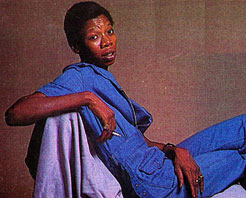
Which leads me to the great Ronnie Dyson.
This morning I accidentally popped the original Broadway soundtrack of “Hair” into my computer. I saw the show performed by the original company, and I have always loved the music, despite the saccharine covers of the songs that have been recorded over the years. It does, though, leave me with complicated, mixed feelings. So much of the enthusiasm and lunacy I felt when I saw the original cast in 1969 seems so distant.
And all those dreams. Some lead to dead ends. Others became life-long journeys. So much seemed possible.
And then I thought of Ronnie Dyson. Joyous, hilarious, gifted Ronnie Dyson. You might remember this song:
Ronnie Dyson was an ebullient, infectiously enthusiastic performer who brought the original cast of Hair to life. He had a sweet and powerful tenor voice and a wicked sense of humor. He was mischievous. If Hair was a celebration of life, Ronnie was the fuel, the raw material. He seemed to live more fully than everyone else.
Except that he didn’t. This morning I woke up, vowing to send him an email and tell him of the impression he made, only to learn that — after making several memorable recordings — he died in 1990 of heart failure. He was 40 years old.
Thank you. Ronnie Dyson. Bringer of joy. Thank you.






















 MEDIA AND MAYHEM