These decisions are widely available, but the move by Google will really make them easy to find.
Google Puts Supreme Court Decisions On-Line
Reply
These decisions are widely available, but the move by Google will really make them easy to find.
Every time I talk about top 10 lists, I always start with the disclaimer that I know how pointless they are.
And then I ask myself: OK, if they are so pointless, why do I have so much fun reading them and doing them and sharing them?
No good answer, In fact, making lists is far from the only pointless thing I do.
Today, I am adding some new films and slightly changing the order. It is not a 10 best list. It is a list of my ten favorites. A list of 10 best films would be beyond nervy given how many films have a legitimate claim to inclusion.
But it seems perfectly fair to make a list of ten favorites since they are, in fact, only my favorites.
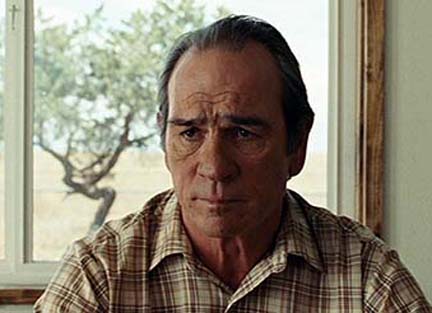
My favorites have stayed the same for over a year. But for the last few months I have been mulling over “No Country for Old Men” and “The Lives of Others.” (Now I can really hear you saying: This guy need a life! Who has time to mull anything over?)
Seriously, I want to make some changes to my list. But according to ground rules that some friends of mine and I set up many years ago in a UCLA dorm room, I have to remove one film for each one I add. I posted my last 10 favorite about a year ago. Here is my new one along with a list of contenders.
Comments welcome. Lists welcome. Ridicule welcome.
My Ten Favorite Films as of November 15, 2009
1. Dekalog
2. Godfather 1/Godfather 2
3. Salesman
4. The Lives of Others
5. Amarcord
6. Goodfellas
7 No Country for Old Men
8 Fargo
9. Rear Window
10 Night and Fog
__________________________________
Other Contenders (not in order)
Midnight Cowboy
Mr. Smith Goes to Washington
Au Revoir les Enfants
Shop on Main Street (1965)
It’s a Wonderful Life
Jeux interdits
Come and See
Smile
Atlantic City
Three Kings
Das Boot
The General
Paris, Texas
Shoah
Invaders from Mars
Strangers on a Train
The Graduate
The French Connection
Double Indemnity
Les Enfants du Paradis
Les Diaboliques
Psycho
Le Salaire de la peur
Sunset Boulevard
The Exiles
The Last Laugh
Hotel Terminus
Happiness
The Third Man
M
The Marriage of Maria Braun

I am not unaware that there are wide geographical differences in the distribution of the H1N1 vaccine. Some places need more vaccine and others have a surplus. No system of logistics is ever that flawless. But the story this week from multiple sources is that large supplies of the vaccine are reaching the public.
It’s just that vaccine arriving apparently isn’t as compelling a news story as a vaccine shortage.
I took the photo above from the page of one of the free newspapers that are handed out in the NYC Subway system. The story goes on to say that the supply of H1N1 vaccine is now so extensive in NYC that they are offering it to age cohorts that had previously been excluded because of the urgent need to get the vaccine to kids at highest risk.
But in what is a typical pattern of press coverage, the early vaccine shortage got the sensational coverage while the current successful broad distribution of the vaccine has gone relatively unnoticed. The only news story we would be less likely to hear about would be a group of “keep the government out of health care” ideologues now announcing their gratitude because, without the government, many of their children would not have been vaccinated.
To tell you the truth, though, I no longer pay much attention to “get the government out of people’s lives” crowd. Normally it would be a point of view that would deserve fair discussion and debate, and serious libertarians — however misguided — are at least consistent enough to be mildly interesting to speak with — but the hypocrisy of so many of those who complain about government is simply too blatant.
It turns out that a more accurate statement of their philosophy is “keep the government out of our lives” except in all the cases in which we DO want the government in your lives.
PS. I am going to go to Google Earth right now, choosing a random US location with my eyes closed, and then checkng the government web site to see if vaccine is available there. In fact, I’ll do two locations. My question is: At each of the two locations, is there vaccine available and how easy would it be to obtain?
Results:
1. My first random stop was an absolutely gorgeous piece of farmland in Greenville, Kentucky. On checking, every school child in Muhlenberg has been offered a free H1N1 vaccination.
2. Stop #2 was also a beautiful rural location, Hitchcock, Oklahoma. Located in Blaine County, the population of Hitchcock doesn’t quite crack 200. Every Tueday and Thursday in Blaine County, an H1N1 clinic is being offered in Watonga.
It’s not that this problem is fully solved.
It’s the foolishness of those who loathe the thought of the government in health care but who couldn’ t get in line for the vaccine fast enough, the people who griped about a shortage but who will be unwilling to acknowledge the now successful effort that is making it possible for their kids to be protected.
Some of the facts that show up in my blog statistics are real mysteries. And this week there is one that has me fascinated.
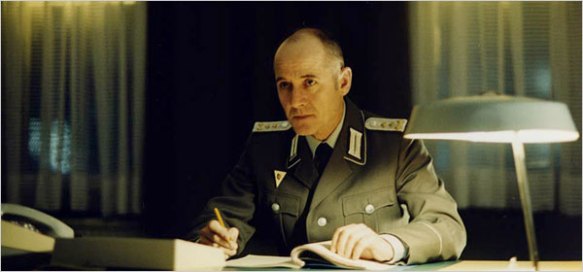
All of a sudden my post about Ulrich Mühe — Friedrich Hans Ulrich Mühe: An Actor Who Needed Only One Tear — had an unexpected increase in hits. I’d love to hear from anyone who knows why. (And right at the moment I write this, I realize that — at the 20th Anniversary of the fall of the Berlin Wall — it makes perfect sensed that people would think about him.)
His performance in 2006 as an East German Stasi agent in Florian Henckel von Donnersmarck’s Das Leben der Anderen ( The Lives of Others) is so emotionally shattering that, as I sit here playing it over in my head scene by scene, I find it hard to even discuss. Mühe died in 2007 and lived a life inextricably tied to the separation and later reunification of Germany. He should be remembered and his work honored. Much of his early work took place on the stage in East Germany before unification.
Actually I do have one more thing to say: Sometime Media and Mayhem commenter Dominic, my friend from high school and a talented filmmaker and animation artist, once told me something about the film that mortified me so much that I never even mentioned it to him again. Ever since I have been silently trying convince myself that he really didn’t say it.
But I still have to ask: There isn’ t going to be a Hollywood re-make, is there?
Say it ain’t so.
Have you ever perused the feature films available for viewing on Hulu? I understand the economics that precludes quality product from showing up as freebies. But the available films look like someone was given the specific assignment of finding the worst films possible.
In fact, it is such a perfectly putrid list of films that only an expert with exquisite taste could compile it. You would have to be so knowledgeable that you could authoritatively and instantly reject any film with even a few seconds of redeeming quality.
I only mention this because I saw a rumor in the trades that ad-supported Hulu was contemplating a pay-wall. I can hear all of you pulling out your credit cards.
But I say let a thousand flowers bloom. If you succeed, guys, I’m buying the rights to Ishtar and Waterworld for national theatrical release.
True Story:
An hour ago — with full sincerity — I chided my 12 year-old daughter for a comment she made as we were watching the House debate on the health care. She had heard a comment by an opponent of the health care bill and crossed what I have struggled to teach her about the “civility” line. So I found myself coming up with words that — while sappy and saccharine — I think I still believe.
“It’s true, I said, I don’t agree with what he said either. But this doesn’t mean he is a bad person. In our country we can disagree and still be kind to each other.”
Part of me was gagging with guilt as I said it. I remembered all the distinctly uncivil rage she has seen me express. I knew that she knew that I don’t always live those words. But I still believe that quaint qualities like kindness and decency and civility are anything but quaint.
Then I turned on the television and began to watch the health care debate. And wouldn’t you know that here I am struggling with the civility thing again.
Why is it that, among all the speakers opposing the health care bill, not one representative — not one — started with anything close to the following:
“We rise in opposition to the health care bill. But before we make clear why this is a bad bill, we want to clearly state for the record that we are not blind to the pain of the uninsured and unemployed, we are not blind to the thousands of uninsured children who were taken to emergency rooms today with life-threatening illnesses, we are not blind to productive, employed people who — in a flash — find themselves unemployed and uninsured, we are not blind to the struggles of those in pain. We don’t disagree about compassion, we disagree on how to be compassionate.”
I did not, and have not, heard one opponent say anything close to this. I have not heard one opponent, before launching into his or her argument, give even a tip of the hat to the fact that somebody, somewhere is hurting. Apparently, this wasn’t on the list of approved talking points.
I really do want to hear your argument.
But don’t say anything — NOT ONE THING — before at least one of you makes a simple statement of concern (2 -3 words would count) for all the people who can’t take the time to think about politics when they are busy deciding which of their three kids will get treated first and who will get which medication.
C’mon guys: Say you feel bad. Say you know hurt when you see it. Acknowledge the existence of people who have done everything right but who find themselves uninsured for a whole host of reasons. Then you can dump on the bill to your heart’s content. I’ll even try to listen quietly.
But if you want me or any other supporter of the bill to take your objections seriously, we are waiting to see any sign — OK, I’ll settle for body language or even a wink of the eye — that signals any compassion underlying your obsession with government control.
So far, all I hear about is socialism, the end of free choice, and Nancy “Beelzebub” Pelosi. You think you are right and I think you are wrong. That’s our system. I respect your right to express your views. If you were sitting here now I would listen respectfully.
But I insist on an answer to this question: Why has there not been one opponent today who has who preceded his or her argument with an affirmation of plain, old-fashioned compassion? Couldn’t you have at least lied and pretended that compassion is a fundamental value?
I am still trying to hang in there with civility, but can’t you see how loudly your silence speaks? You have not given us one reason to think your script goes anywhere beyond government control, socialism, and dumping on Nancy Pelosi.
C’mon, compassion isnt controversial, it’s not some rhetorical trick. It is Sunday school stuff and , while I wasn’t always listening during the bible passage, I apparently was awake during the part about sharing and giving and sacrifice.
Your silence speaks volumes. And yes, I grant unanimous consent for you to revise and extend your selfishness.
There are two great short essays in the Columbia Journalism Review that explain perfectly why the instant cable coverage of sudden catastrophes is often so astoundingly misinformed and incompetent.
To watch talking heads, lacking much if any authoritative information, coming to instant, facile conclusions about suspects, motives, and details is not to watch journalism. It is the equivalent of attending a seance or meeting with a psychic. Armed with little knowledge and even less common sense, these hyper-ventilating bloviators fill the air with conjecture that is so uninformed, so embarrassingly foolish, that the only thing clarified is their incompetence. They will dispense psychiatric diagnoses, forensic theories, and all sorts of other expert opinions when the only thing they lack is — whoops — expertise.
I am going to start to cite specific examples so I can then provide names. All I know is that, if there was ever a time when 24 hour cable news performers showed any journalistic restraint and skepticism, that is now history.
One laughable example is a CNN reporter who not only freely offers his strange guesses about what might be going on and compares one incident with another he may have covered a few years back. He also asks questions of witnesses in which he coaxes them, not to inform, but to guess, to imagine, to hypothesize. After what I saw during the Ft. Hood coverage, I am now on a mission to bring you specific examples of just how speculative a talking head can be when hyperventilation rather than reporting is the goal.
I just received this comment and wanted to share it and my response with you. Someone was trying to be amusing, and even if it is clear that comedy isn’t in his future, he does reveal the carricature of the lazy uninsured that the “soldiers of the selfish revolution”© are trying to promote.
Comment: “I agree, I smoke and over eat, I am way overweight and I just found out I have diabetes. It’s only fair rich healthy people should pay for my health care. I have the freedom to abuse myself thats being a good american. I should nit be punished with higher insurance cost just becouse I love life.”
My Response: You’ re hilarious. And with a little work on spelling and grammar you could be a real comedian.
For now I can only say that your silliness is actually very useful.
Because I have never read a more perfect description of the stereotype of the uninsured that the soldiers of the selfish revolution© would like you to believe. The picture of the uninsured that they promote is full of fat, lazy, self-destructive gluttons who want us “good people” to fund their debauchery. What pathetic nonsense. Do you really buy this?
Come to New York City and I’ll take you to some children’s health clinics and introduce you to some of these creeps. Together we’ll look for the slobs, the drunks, and the smokers. Just don’t say I didn’t warn you about your inevitable disappointment when all we find are uninsured children choking from asthma, unisured parents unable to afford life-saving medications, and kids who go to emergency rooms for an infection of some sort but who are then diagnosed with malnutrition. Really lazy creeps, huh?
By the way, you are sort of right about one thing. Our premiums are higher because of the unhealthy lifestyles people embrace. But you are looking in the wrong place: If you really want to find the overeating, drinking, and smoking, come out to the burbs and I’ll take you on a trip you’ll never forget. We’ve got eaters and drinkers and smokers by the bushel. But I warn you: They virtually all have great health insurance and big houses and big appetites and, yes, your premium is higher to partially subsidize their irresponsibility.

Absolutely and mind-bogglingly astounding.
Today, in a compelling demonstration of just how compassionate and altruistic some people can be, thousands of people with health insurance gathered on Capitol Hill to protest a bill that would provide some coverage for those who are not covered.
What happened to the grand American tradition of at least being a little ashamed and even secretive about your selfishness? Now, apparently, you can boldly and even proudly trumpet your belief that your good fortune should not be extended to others.
I can’t believe that some of these soldiers of the selfish revolution © didn’t at least wear masks.
Yes I’m angry. But I learned a long time ago to always look for the sadness underneath my occasional ranting and raving. And this time it wasn’t hard to find: I share a country with at least some people whose social conscience ends right at the place where the needs, sometimes the desperate needs, of others have to be considered.
Listen to the wisdom of one of these anti-government misanthropes:
“It’s time to make a stand,” he said. “We want to see limited government, not more taxes put in our face. We don’t believe our health care system entirely broken. We need to slow down, stop and start over with this legislation.”
Mr. Scevola said that he had health insurance through his employer. “Kaiser Permanente,” he said proudly. “They are the best on the West Coast.”
I’m so thrilled he is happy with his coverage.

I am the last person who expected to find a documentary about a typeface to be riveting. Yet for two years, Gary Hustwit’s documentary Helvetica has stuck with me, a brilliant examination of how typefaces worm their way into the very nature of how we perceive the world.
One result of great documentary is to reveal the significance of something that, in its very pervasiveness, was completely missed and taken for granted. Antonio Gramsci pointed out as well as anyone how much implicit ideology we miss when we take reality for granted, when we avoid looking closely at assumptions and words and symbols — and, yes, typefaces — that seem self-evident.
This is the accomplishment of Helvetica. A must for students of media, culture, design, digital culture.
Whether the non-profit model for investigative journalism ultimately catches fire, the best of the current non-profit organizations doing in-depth reporting is Pro-Publica. I previously called your attention to Pro Publica’s incredible cooperative reporting effort with the New York Times, written and reported by Sheri Fink, detailing the struggle for survival inside Memorial Hospital during Hurricane Katrina.
And now another: Pro-Publica reporter Sharona Coutts has written a detailed and compelling report about abuses at the University of Phoenix, the nation’s largest for-profit university that relies heavily on on-line instruction. The report details mind-boggling recruiting and financial aid abuses.
One reason I get excited about the Pro-Publica model, even though it may be short-lived, is that it is almost impossible to imagine a major media outlet covering a story like this with substantial human and financial resources. Yet it is a story that must see the light of day in an economy in which countless prospective students are desperately seeking the training they need to keep their head above water.
Pro Publica deserves a real pat on the back.

Every so often, “Media and Mayhem” focuses on the “Mayhem” part of the blog title.
For many years I have been studying how society — media, government, all institutions — operate during times of social stress. What happens when normal social norms and media practices confront catastrophe or danger? How does an atmosphere of fear affect our behavior and our attitudes? How do all the new and old media of communication respond?
A pandemic is an interesting case. It is not an event in which illness and death occur in one mass conflagration, but a series of events — millions in fact — that occur outside the lens of collective public scrutiny. In other words, you don’t see the whole thing at once.
On any given day and at any given moment, most people are feeling fine. They very well might not have seen anyone sick. Pandemic damage unfolds slowly, the cumulative effect of all these infections and deaths. The mass media will cover the worst (and all too real) atrocity tales of young children dying quickly and unexpectedly, but the massive and speedy infection of millions of people will occur quietly. No buildings explode. No planes crash. No bridges collapse. The infection spreads.
And the solutions are not the kind of visible dramatic actions that are unleashed after other kinds of catastrophes: There are no beaches to storm with troops, no fire trucks to dispatch.
There are vaccinations. Hand washing. And if symptoms occur, there is a very effective drug called Tamiflu.
So this weekend I took my 12 year-old daughter for a vaccination. I am almost embarrassed at the amount of expert opinion I sought before doing this. But after I was absolutely convinced that it was important, and after reading the most recent statistics about who was at risk (I actually am a regular reader of an outstanding government publication with the appetizing title “Mortality and Morbidity”) , we got in the car and drove to a county health department here in New Jersey.
And I still can’t believe what I encountered.
The county staff could not have been more efficient and welcoming. This was public health at its best. Long lines of children most likely to suffer serious complications from an infection were getting the vaccine. The line was moving. And I saw many seriously disabled kids whose disabilities, I was told, made them especially vulnerable to complications if they got the flu.
And wouldn’t you know that here and there people in line were using the time to rail against health care reform, to moan about the disaster that is inevitable when the government gets involved in health care. I was incredulous. Here they were, potentially protecting the lives of their children courtesy of an efficient government effort to deliver vaccine, and their response was to complain.
But this post is not about what health care reform should look like or how much government-delivered care there should be. It’s not even that much about the complaining I heard. Scared people look for scapegoats, and while I might think they are horribly misguided, I learned long ago that people concerned about a threat to their children (me too) will babble all manner of legends, folk-theories, and political propaganda.
What I did learn was the way that fear can blind people to painfully obvious facts. Who did these people think had gotten them the vaccine? Pharmaceutical companies produced it. And then thousands of much-maligned bureaucrats at federal and state agencies, schools, health departments, law enforcement agencies, and other institutions worked to get it to my daughter on October 31, 2009 at 3:00PM on a rainy Saturday.
I will not romanticize the functioning of any large institution. Logistics and organization can be messy, confusing, and occasionally negligent. It is all part of how institutions function.
But could there be anything more misguided and loony than to get angry at the involvement of government in health care at the very moment that government has delivered a dose of vaccine to your child?
To the some of the moms and dads I met Saturday : It’s natural to be afraid. It’s even natural to lash out after seeing a news report about children dying. It’s natural to channel your fear into blame. But just because its natural doesnt mean it isn’t dumb. It was one of those bureaucrats doing their job — and doing it well — that got you the vaccine.
And before you so quickly buy into the dishonest reactionary demonization of any government involvement in health care, remember the public health nurse who calmed your little one down before the vaccination.
You know which one. The nurse to the right. The smiling one. The one from the government.
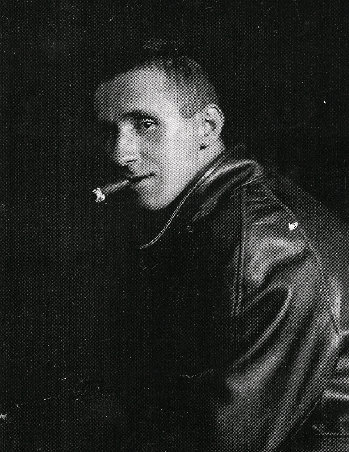

Ok, so I’m sitting here alone in the dark scaring myself crazy for the umpteenth time watching Hitchcock’s masterpiece Psycho.
It reminded me of a Saturday night in the early 1960s when my parents left my sister and I home for the evening — I think we were 11 and 12 — and one of the television networks actually broadcast the film. We were terrified and our parents came home to us whimpering and cowering in the corner of the living room.
The reason I stopped the film for a moment, though, is that yet again I am marvelling at the musical score by the extraodinary Bernard Herrmann.
Have a film and a musical score ever fit together so well, with such extraordinary and terrifying results? In fact, have a director and composer ever been so indispensable to each other?
Don’t laugh, but it just might be a little too dark and little too late and a little too rainy here on the east coast to turn it back on. Janet Leigh is about to be stopped by THE POLICEMAN and, if you’ve never seen the film and never seen THE POLICEMAN’S sun glasses, get some friends to keep you company and do so immediately.
Or maybe I could fast-forward past THE POLICEMAN. Let me go get a Mallomar while I decide. In fact, I think that unfinished barbecued chicken leg is still in the fridge.

No shock here. The virtually unbroken string of bad biopics apparently continues with Amelia. I will see it out of almost unqualified admiration for director Mira Nair, but nothing in the many reviews I have seen suggests that the film transcends standard, tired biopic conventions.
Gus Van Sant’s “Milk” probably came the closest to reviving the whole genre. In fact, Van Sant may have fully succeeded (your call). But there are, I think, some good reasons that biopic screenplays usually stink up the house:
– including every obligatory “sacred” historic moment, regardless of how well they fit into a coherent story or how true they might be
– the over-investment in making sure the actors look and sound like the people they are playing. I have always felt that physical resemblance only works when the effort put into makeup, however precise, is exceeded by the even greater performance of a brilliant actor. It makes perfect sense that the two best “look-alike” performances I have ever seen were by actors who are consensus members of the pantheon — Bruno Ganz in Der Untergang and Sean Penn in Milk. )
– the unavoidable hagiography
– the drive to be so exhaustively complete that the story sinks from the weight of its self-conscious authority
– a director or actor so obsessed with an historical personality that he or she confuses the character in the film and the actual person being depicted. (Kevin Spacey and Bobby Darin?) Rare but spooky.
The baffling thing here is that a great filmmaker like Mira Nair took on Amelia.
Mira Nair. The Mira Nair who made Monsoon Wedding and The Namesake. The brilliant, luminous Mira Nair.
We need to remember that authenticity and accuracy are historical, not dramaturgical, concepts.
The very best films about lives don’t take on the heavy and weighted obligation of completeness. They pick an episode in a life and, through the unfolding of events and character during that episode, reveal aspects of a complex life. Capote, Henry and June, and Downfall (Der Untergang) are three good, random examples. These films also succeed by embedding the main character in a world of comparably interesting , and maybe even more interesting, characters.
I’ll leave you with one admittedly unconventional recommendation and one worry.
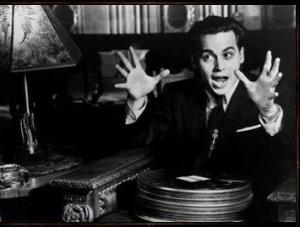
Recommendation: My favorite biopic really isn’t a biopic at all. But with its crazy sensibility, hilarity, cast of grotesque characters, and overwhelming quirkiness, Tim Burton’s Ed Wood is my favorite “life-story” of them all.
Worry: Spielberg, as you may know, is doing Lincoln. I believe Liam Neeson got the part. My fear is that Lincoln’s complex, even anguished , life could be buried beneath “Private Ryan” schmaltz, expensive costumes, overwrought John Williams music, the flood of signature close-ups of Lincoln’s face, and the quest for accuracy. None of these equal compelling drama and conflict. In fact, all this nonsense often hides a lack of compelling narrative.
We’ll see.
The energy of punk with the soul of Appalachia. I have never heard anything like this.
They found him. He was at home the whole time.
Let’s cut to the chase. I was a difficult little kid. But I am absolutely sure that my Mom would agree I never did anything like this.
I mean, how do you calculate the appropriate length of time to ground a kid when the offense is nothing less than scaring millions of people and mobilizing legions of rescuers? Life grounding without parole? Trying a juvenile “hider-in-a-box” as an adult?
And how much, if any, blame do you assign to the parents?
I don’t know, I don’t care, and I am finished with this topic
What a day.

One occupational reality of someone who grapples with trauma and its media and cultural representations is that a moment of terror — I mean MY terror — is (after the worst of the shock wears off) a chance to learn about, not only myself, but about what makes terror.
I don’t want to imply that I come quickly to clinical distance. I am fully capable of feeling terror and trauma. I feel it right now and have felt it for the last hour and a half. But I long ago gave up the idea that any amount of intellectual understanding would immunize me from these or any feelings.
Please take a look at the news bulletin above that I received about an hour and a half ago from CNN. I am still shaking.
Perhaps you help me explore what variables came together — everything from the larger social context to the nature of the story to my own shtick (which of course you don’t know very well) — to give me (and now I read thousands of others) almost unbearably terrifying feelings.
The worst is over, but I am still shaky.
As of 5:25 EST, this was where the story stood.

I have always been a collector of memories. And, as many of you already know, the digital age has made memory-collecting a very different and exciting enterprise. People are easier to find. Old photos easier to scan and share. Google “Street-View” even lets you see what a given address looks like today.
This morning I woke up thinking of Vincent Avenue Elementary School in Covina, California. I was a 6th grader there and had a teacher — John Duvanich — who was an extraordinary influence on my life.
Anyway, I checked and found out that Vincent School is no more but that it now houses a wonderful entity called The Vincent Children’s Center, with special education programs for pre-schoolers. Is that great or what?

The school was originally one of many built in the 1950s to handle the mob of baby boomers. When we all stopped booming, the school closed and then reopened to provide special education services.
When I attended, virtually no special education services were provided. The Individuals With Disabilities Education Act of 2005, with its origins in an earlier 1975 law, had not yet mandated equal treatment for the disabled. The law made The Vincent Children’s Center possible.
Given all available digital tools, this took me 10 minutes to find out.
Nice. Real nice.
Now I have to go back and visit Room 16.
Room 16. Magic.

This will be an interesting couple of weeks for the producers of ground beef.
Michael Moss has produced a masterful piece of investigative reporting in today’s Sunday New York Times entitled “The Burger That Shattered Her Life.”
If someone had told me that a meat-grinding expose was coming, I would have assumed that, since no inspection process is perfect, problems would inevitably be discovered and reported.
But I never would have expected revelations about the content of ground beef that seem drawn from Upton Sinclair’s nightmarish early 20th century muckraking classic ” The Jungle.”
I mean, we are talking about a serious “yuck-factor.”
Moss’s story is a brilliant combination of the poignant story of an individual victim embedded in a larger story about the shoddy and secretive system that was responsible for her sickness and paralysis. The story closely follows the specific lot of tainted meat that harmed the young woman from the various factories that produced it to her dinner table. It is not a pleasant journey.
This is what a great reporter can do.
I may be dating myself , but the “Sheila Rule” is a little known principle that has guided record producers since the mid-1950s.
The rule states that, when all else fails for a recording artist or producer, record any song with a title including the name Sheila. It will be successful solely because Sheilas are inherently and magically charming .
Here is something interesting. Tommy Roe had an early 60s mega-hit with the song Pretty Sheila. But several years before, in 1957 I think, he recorded a stripped-down , garage-version of the same song for Judd records that I just found after searching for quite a while. Notice how Judd Records mispelled the name Sheila as Shelia.
Enjoy and all hail the “Sheila Rule.”
Ok, I confess. Sheila was my first love. I was 11.
Last night, David Letterman opened his late night television with a startling account a blackmail plot. Apparently, the alleged blackmailer had information that Letterman had had sexual relations with some members of his staff and was demanding a payment of $2 million to keep silent.
I in no way want to minimize the extent to which sexual relations in the workplace have the potential, given the power of the employer to hire ands fire, to be exploitative and oppressive. It has happened in many cases and on occasion led to litigation.
However, this serious issue is not what I wanted to mention.
It is Letterman’s performance.
The video below, in which Letterman tells the whole story to his audience, is one of the most surreal things I have ever seen. Watch how long the audience takes to figure out that Letterman is not doing a comedy monologue. It seems as if, through humor, he is 1) easing his own way through a disclosure that must have been excruciating to make and 2) providing the audience with just enough levity to help them sit through a story that, if told without any irony or self-mockery, could really have been a horrifying experience.
I also find it interesting to watch because, in addition to everything else Letterman is trying to accomplish, it is clear he is also trying to walk the line between humor and horror in a way that protects what is, more than anything else, a valuable comedy franchise/brand.
Again, I point this out as a case study in high-stakes communication and rhetoric with full awareness that I am not addressing the serious questions about sexual harassment that may or may not have been at play in this case.
How does a comedian make a a painful confession in a way that minimizes the erosion of his reputation as a comedian?
This is how.
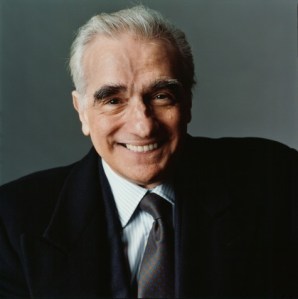
Now this is a treat:
Scorsese’s legendary four-hour walk through his favorite American films is now available on YouTube, in ten minute segments.
The real joy here are the many “minor” films that Scorsese suggests are worthy of attention. Ida Lupino and Sam Fuller, for example, have received much deserved attention, but wait until you hear Scorsese’s incredibly informed case.
I’m telling you: It is enormous fun watching a master filmmaker make his case for various films, even if you don’t agree with his choices.
Here is the first episode:


The Lede, the main New York Times news blog, is reporting that Ohio officials were forced to halt an execution by lethal injection when — 90 minutes after it started — technicians were unable to find a usable vein. The description of the episode is horrifying, with the condemned reported to have tried to help the executioners find a vein.
As a death penalty opponent in Ohio said today:“The sentence is death, not torture plus death.”
This will almost certainly reignite the question of whether lethal injection does or does not constitute cruel and unusual punishment.
My objections go deeper, and relate to whether there is any way a death penalty can be fairly applied. I think it cannot, and I would share with you one of the most eloquent paragraphs I have ever read, an excerpt from Harry Blackmun’s dissent in Callin v. James (1994) . Blackmun argues that a fair death penalty is not possible:
From this day forward, I no longer shall tinker with the machinery of death. For more than 20 years I have endeavored…to develop…rules that would lend more than the mere appearance of fairness to the death penalty endeavor…Rather than continue to coddle the court’s delusion that the desired level of fairness has been achieved…I feel…obligated simply to concede that the death penalty experiment has failed. It is virtually self-evident to me now that no combination of procedural rules or substantive regulations ever can save the death penalty from its inherent constitutional deficiencies… Perhaps one day this court will develop procedural rules or verbal formulas that actually will provide consistency, fairness and reliability in a capital-sentencing scheme. I am not optimistic that such a day will come. I am more optimistic, though, that this court eventually will conclude that the effort to eliminate arbitrariness while preserving fairness ‘in the infliction of [death] is so plainly doomed to failure that it and the death penalty must be abandoned altogether.’ (Godfrey v. Georgia, 1980) I may not live to see that day, but I have faith that eventually it will arrive. The path the court has chosen lessen us all.”
Today, courtesy of Andrew Sullivan’s blog “The Daily Dish,” we are treated to the work of master retoucher/airbrusher/painter Dru Blair.
I make no comment about the aesthetics or larger significance of the work, or why it was an important artistic exercise , but admit I am stunned at the astounding technical accomplishment of being able to paint a portrait that cannot be distinguished from a photograph.
It also raises yet again the question that has haunted us from antiquity: What is real? Who decides?
After seeing Blair’s work, Ill be darned if I know.
Tell you something else: It also raises the interesting question of exactly what a pixel is!
Sometimes songs of grief are so fully human that they are, in their own way, joyful.
The pain can be intense, but these songs also celebrate that we have the capacity, the gift, of feeling loss as fully we do.
That’s how this beautiful, mournful song by Stephen Foster makes me feel. Sung by the wonderful McGarrigles.

There’s joy in Mudville today.
A film, “Subprimed,” made in our MFA program at Hunter College by students Sarah Friedland, Kahil Shkymba, and Joy Nayo Simmons, under the supervision of Professors Kelly Anderson and Tom Angotti, is the subject of Jim Dwyer’s column in the New York Times, “Student Filmmakers, Not Ceasing or Desisting.”
Check out the column and read about just what this subprime crisis means for real people, living real lives on the edge, who had a dream of owning a house. And take a look at those who sought to exploit those dreams, one of whom, Mr. Makhani, is filmed offering the compassionate observation that “If the client is stupid, that’s not my problem…We’re not going to have classes to teach people how to read.”
Here are some clips from this work in progress.
Ah, just knowing that those who would hurt and exploit others are feeling some agita this morning.
And we thought that fairness, open-mindedness, civility, respect and plain decency were in decline.
How could we have been so blind?
Especially when we have these parents in Texas taking such a courageous stand against the immorality and decadence and socialism of the Obama administration.
I mean, this takes guts.
The rest of us may sit here, paralyzed by cowardly fairness and respect for the presidency, constrained by old-fashioned values like civility and decency. But here’s a group of gutsy people apparently feeling no such constraints; proud to trumpet their astounding lack of even the most minimal decency.
The scariest thing is that they almost certainly have no idea how relentlessly foolish they look, these self-proclaimed “values-voters” busy imparting “values” to their kids.
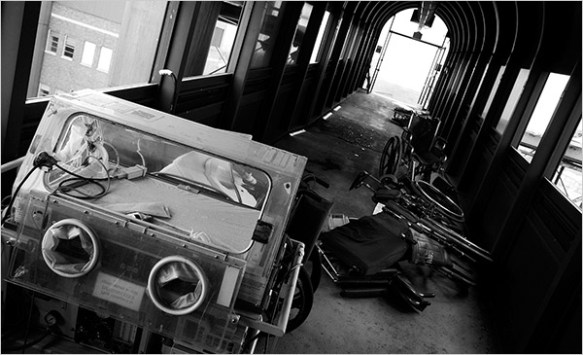
A truly ground-breaking news story appeared in the Times this weekend. Done in cooperation with the non-profit nvestigative journalism group Pro Publica, and reported by A.C. Thompson and Sheri Fink, the piece describes the frenzied and painful struggle inside of a New Orleans hospital during Katrina as staff dealt with seriously ill patients.
One of the most amazing pieces of journalism about catastrophe I have ever read. And so painful to read that I had to struggle to finish it.
A must read.
For several semesters my students and I have been discussing some of the possible odd occurences and discoveries that might be made possible by Google Street View.
Most of the time we spoke in hypotheticals.
Note to Readers, November 3, 2009: I have a question: Recently a lot of people have been reading this post. I’m curious how and why you found your way here and what you thought. I wonder if you might email me at Steven.Gorelick@hunter.cuny.edu. I really would be grateful. Valuable prizes will be awarded. Thanks, Steve

One of the reasons this caught my eye is the great experience I have had in recent years with outstanding young documentary ffilmmakers in our MFA program in Integrated Media Arts at Hunter.
Often, watching fragments and rough cuts of films in which the filmmaker is either doing an interview or even a more direct and personal film in which he or she speaks, I have held my breath as other characters in the film begin to speak. Will, I wonder, the filmmaker let the character speak without interruption? Will the filmmaker allow the camera to linger on a subject after he or she has stopped speaking, potentially capturing after-moments in which the subject offers a subtle and nuanced facial expression that might be more revealing than all of the words they have spoken?
I have to tell you that most of our students do know how to stay quiet and allow the subject to peel off their own layers of character.
One reason I think about this was my own propensity to open my fat trap during recorded ethnographic interviews of journalists I did years ago. Time and again, I would sit at home listening to my interviews and suddenly start screaming:
“Steve, shut up. Shut up. The guy was just about to say something earthshaking and there you were, talking over him just to …….talk.”
I learned my lesson and ever since have pretty successfully struggled to avoid the pitfalls of a certain late night host of a PBS interview show who contantly talks over his guests, usually to signal his knowledge rather than hear the answer to a question.
My favorite doc film that reveals the almost unbearable tension and sublime beauty of silence is the classic “Salesman” by the Maysles brothers. The film is a must see for anyone even slightly interested in doc film. Watch how the camera lingers and lingers on subjects after they have finished speaking or when they are not speaking at all.
These are some of the most powerful moments in the history of doc film, bible salesmen leading lives of quiet desperation who are photographed sitting or walking in silence, visibly anguishing over their failures or their loneliness. The scenes in which they are trying to close a sale are extraordinary, to be sure, but next time you watch the film, pay careful attention to the moments of uneasy silence either right after or right before the pitch. Part of the Maysles genius is leaving the camera on during silence and not becoming “speech-centric.”
One unbearably tense scene (of many) shows a salesman walking in silence up to the door of a prospect. The anticipation that grows during the silence is brilliantly excruciating. A sale? A rejection? Who knows?
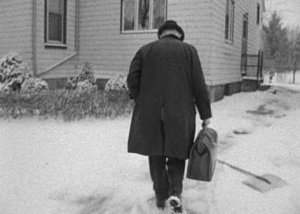
Don’t underestimate the unbearable loudness of perfect silence.
Note: George Steiner’s “Language and Silence” is a wonderful exploration of some of these issues. I think one of the reasons I so deeply admire silence is my own apparent inability to maintain it!
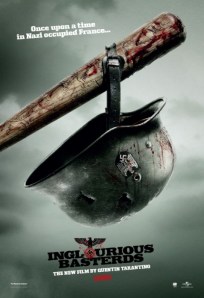
I am usually pretty detached from the world of mainstream blockbuster films. I simply find more pleasure in docs and indies.
But something unusual is going on in the mega-film world that is really worth watching, a riveting case study in film marketing and the dynamics of public opinion.
Quentin Tarantino’s film “Inglorious Basterds” has received some of the most mixed reviews I have ever seen. Ever.
And by “mixed” I mean that serious critics seem to have situated themnselves on both ends of a continuum that ranges from superb, possible- masterpiece to complete and total piece of garbage.
I bring this up as a case for students to watch closely, especially this coming weekend. The film’s first weekend box office of $37 million was stellar. Brad Pitt can do that for you on weekend #1.
Now, though, word of mouth will kick in and this coming weekend will be very revealing about how the larger audience has received the film. I am really curious.
I’ll definitely see it.
Principle #243 in my unwritten, imaginary, self-absorbed and nonsensical book of rules for living requires that I go:
“Anyone writing a screenplay approaching, reaching or surpassing the quality of Pulp Fiction earns in perpetuity the right to have every film they ever make seen, regardless of reviews or word of mouth.”
Any of you who are students of mine have almost certainly heard me mention William Gazecki’s extraordinary film “Reckless Indifference.” It is a must see, both for its formal brilliance and terrifying account of injustice.
Rather than give you all the details, let me ask you a simple question:
How many of you, when young, ever unthinkingly put yourself in a position that had the potential to go horribly and irreversibly wrong? Not a moment when anything necessarily did go wrong, but a situation when a mild risk or peril could have easily morphed into a full-blown tragedy.
I did have such a moment, and one day I will take the time to tell the story. I can tell you that I dodged the bullet. Fate worked to my advantage and a situation in which people could have lost their lives ended up just fine.
Gazecki’s film tells the story of one young man, Brandon Hein, who stepped into just such a situation. But fate was not on his side and the result is that he has been serving a life sentence for well over 14 years. Please see the film, learn about Brandon’s case, learn about the legal controversy surrounding something called the felony murder rule, and decide for yourself.
I did, and I am absolutely certain that this is a monmental injustice and that Brandon must be freed.
Finally, check out a piece about Brandon this week in Newsweek written by actor and social commentator Charles Grodin.
As long as this young man is in prison, I will be haunted by the fact that my brush with fate ended with no harm only because of the direction the wind was blowing on one warm, dry day in 1963 in the San Gabriel Valley of California.
Think of it: The direction the wind was blowing.
Let me know what you think. And remember Brandon.

Ronald Takaki was a teacher, historian, and extraodinary human being. He was a pioneer in ethnic studies and a faculty member at UCLA and Berkeley. Ron Takaki died at the age of 70 this past May.
Ron was also my teacher and easily one of the 2 -3 greatest and most inspiring professors I had as an undergraduate at the University of California. He is one of the main reasons I chose to spend a lifetime in higher education. Remembering his brilliant and packed lectures, and thinking back to his influence on so many students, I am yet again reminded of the incredible responsibilities, challenges and opportunities we all have as faculty members.
In the spring of 1970, I can’t say I had ever heard the term “globalization.” National, ethnic, religious, and racial borders, especially in a place like California, could not have been more closely guarded. White middle class suburbs — even ones directly adjoining Chicano or African American or Asian neighborhoods — were social and cultural fortresses. Many of us who came directly from those fortresses to UCLA or Berkeley had never been in close proximity to any ethnic diversity. None. It was shameful. We lived in a well armored comfort zone that neither challenged us nor expanded our world view beyond the San Bernardino Freeway.
But there we were as freshmen, looking over the schedule of classes, trying to figure out who was responsible for the typo that had listed some professor with a Japanese surname as the professor for intro to African American history.
When we showed up at class, imagine how baffled we were to see this soft-spoken Asian American professor speaking with a quiet yet furious indignation about the shame of slavery. I vividly remember thinking almost immediately that nothing I thought knew about how the world worked, about the fortresses that were our ethnic and racial and religious enclaves, would ever be the same. Something was happening, and — if we didn’t fully understand all the complex forces — Professor Takaki would be there as a guide to the perplexed. And believe me, in the spring 1970 quarter we needed guiding — Kent State, Cambodia, the Moratorium, and violent confrontations with campus police. Even a fatal shooting on campus. As I look back and calculate the chronology, I am stunned to realize that this gentle and powerful man was then only in his early 30s.
There has never been a time in the intervening 40 years when, seeing someone trying to persuade with bluster and arrogance, I haven’t remembered Ron Takaki in the spring of 1970 and thought: Rage born and nurtured in gentle soul can burn with even greater intensity.
It was an extraordinary time at UCLA, full of fury and passion. Across campus, another great and inspiring professor, Angela Davis, was approaching these issues of inequality from another perspective. And it was a loud time – a time of rage and grievance. How extraordinary it was to have Ron Takaki there amidst the ferment, showing us that even rage could be expressed with civility, that scholarship could reveal layers of barbarity and fuel the kind of anger that can lead to social change.
Sometime later he brought to campus some of the great figures of the infamous WW II relocation of Japanese Americans, people like Fred Korematsu and Joe Grant Masaoka. For many of us in 1969, this shameful episode was still virtually invisible in the exclusionist and triumphal narrative of California history.
He never minimized the conflicts and inequalities and injustices that fueled the growing rage. There was nothing “feel good” about these classes. But simply by explaining these forces, by struggling to help us understand the fires that were starting to burn in urban America, he helped us see that — through understanding and rigorous scholarship — a peaceful future just might be possible.
Really a teacher for the ages.
Any of you who have taken either an undergraduate or graduate class with me have almost certainly seen this picture. Robert Capa’s “Falling Soldier” is one of the most admired and important war photos taken in the 20th century.
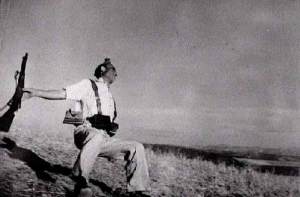
You may want to check out the details of a controversy about the photo that has been reported in the New York Times.
I am reserving judgement, but I can’t help wondering: The authenticity of an image may go away, but what happens to all of the emotions and ideas it may have inspired? Might something revealed to be unreal still remain absolutely real in its consequences?
After all, no one can retroactively cancel the emotions I felt when I first saw it as a child. They are part of the cultural raw material that formed who I am.
This does, however, point out the risk we take when we give ourselves over, emotionally and intellectually, to any depiction of reality. Sometimes we are so moved that we forget all of the complexities of the notion of “depiction” and think only of the “reality” we think we are seeing.
Think about it: What in the world would we do and how would we adjust our view of the world if we learned today, several decades after first seeing the photo below taken by Eddie Adams, that General Nygoc Loan had not actually shot a Vietcong guerrilla point blank and that the image was fake?
I honestly don’t know. So much thinking about that war has been invested in this image.

This happens every decade or so. I will see a film, and — for a whole host of reasons — get stuck on it.
On first viewing, the story unfolds, crafted elegantly and with meticulous attention to story and character. After that, when the basics of the story are no longer a mystery, one exquisite element after another is revealed with each viewing.
Sometimes it turns out that the story was even more perfectly crafted than I thought. After all, great screen writing is not conspicuous and ingenious narrative structures don’t typically telegraph their arrival.
Sometimes the cinematography or the color pallette or production design is so sublime, so perfectly integrated with the narrative, that it begs to be appreciated again and again.
And sometimes the acting so perfectly serves a scene or a story or the development of a character that individual scenes can be profitably watched again and again.
And so here I am, stuck on No Country for Old Men, the masterpiece by Joel and Ethan Coen.
As was the case with other films that have “trapped” me — their film Fargo, Wim Wenders’ Paris, Texas, Coppolla’s Godfather trilogy, and Scorsese’s The Departed and Goodfellas , Fellini’s Amarcord — the first viewing was a total immersion in a coherent whole. I was not thinking about its elements. I was living the work. Nothing can recreate that initial thrill of reveling in a complete work that is too carefully assembled to be seen as fragments.
But then the puzzle pieces begin to reveal themselves. And I am stuck.
A terrifying scene with Javier Bardem and Gene Jones. Lonely highways and cheap motels, photgraphed by the brilliant Roger Deakins, the dark night frequently punctuated by the blinding brightness of neon signs or oncoming headlights. A haunting, gravelly narration by Tommy Lee Jones. Craig Berkey’s sound design, a breathtaking symphony of creaking doors, wind, grunts, and scratches. An almost unbearable sense of foreboding. And as much sadistic and cruel menace as the Coens have ever put in one film.
Yup, I’m stuck. And it is absolutely hypnotic.
Tomorrow President Obama will visit the Cape Coast Castle in Ghana. The castle was a major departure point for Africans sold into slavery. This was where the horrors of the middle passage began.
My son, who was in the Peace Corps in West Africa at the time, took me to the Cape Coast castle in 2005.
The castle, as you can see in my picture, is actually a very peaceful and beautiful place. I remember visitors approaching the entrance quietly. But the quiet was temporary. Because as the guide described the atrocities that took place in each tunnel, each crevice, it was impossible not to imagine the terrified voices and the anguished moaning.

Yes, moaning. I thought I heard moaning. Then, we descended into the bowels of the underground prison, and heard stories of parents and children being violently separated.
Finally we reached the exit that led directly to the gangplanks of thousands of slave ships, the exit where millions faced either actual death on the ocean journey or survival in slavery that became what sociologists like Orlando Paterson call “social death.”
Today there are still boats at this exit, hundreds in fact. But they are the small and colorful ships of Ghanaian fishermen, and I will never forget the expanse of humanity that I saw as I walked out into the sunshine. Expecting more sadness, I saw only vitality, and I devoured the extraordinary sights and sounds of the life that now occupied what had been a place of such pain.

They that go down to the sea in ships, that do business in great waters; These see the works of the LORD, and his wonders in the deep. For he commandeth, and raiseth the stormy wind, which lifteth up the waves thereof. They mount up to the heaven, they go down again to the depths: their soul is melted because of trouble. Psalm 107.
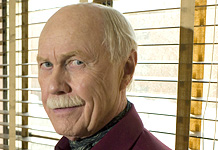
Harve Presnell died on Tuesday.
Harve was one of the great leading men in musical theatre and musical films. But thanks to Ethan and Joel Coen, late in his career he was cast as William H. Macy’s father-in-law, Wade Gustafson, in the film Fargo.
His performance was as remarkable as the film. And the scenes he did with Macy were classics.
               JERRY

               Well, you know Stan'll say no
               dice.  That's why you pay him.
               I'm asking you here, Wade.  This
               could work out real good for me
               and Jean and Scotty -

               WADE

               Jean and Scott never have to worry
No, I didn’t meet him.
But Jack Shafer’s piece in Slate is a superb and deserving takedown of all the journalists who seem obligated to recount their 30 seconds with Jackson.
Have you ever thought about how media and culture represent the concepts of “past” and “present?”
The past is always better. It is when things were less complicated, when people were more civil, and when music wasn’t as loud.
The present is when things are going to “hell in a handbasket.” It is when we have lost track of fundamental values and when we have become more crude and more thoughtless.
Most of all, the present is precisely when we have to return to the values that we honored until the present. They were the core of our goodness, the essence of our humanity, until — well — until today.
Why do we do this?
I don’t know, but as I look around at this turbulent and unforgiving world, I can only remember the “peace and decency” that was pervasive just moments ago when I started to write this.
Sometimes I think that, as pleasurable as it is to be nostalgic, there are few places where we more brazenly reveal our ignorance:
Do people really want to go back to that idyllic past — the one without polio vaccine, the one with segregation, the one where you weren’t inconvenienced by nuisances like seat belts, the one where anybody could freely make and distribute food without worrying about safety standards set by the FDA, the one where lynching was so pervasive that people sent lynching postcards back home to brag about being a witness, the one before medicare was established when my grandmother with heart disease could luxuriate in the serenity of knowing that the government was staying out of healthcare.
Those were special times, weren’t they?
Just one more thing about Mark Sanford.
By his own admission, he betrayed the trust of almost anyone who meant anything to him.
His acts crossed the line from private behavior to public performance in office, rendering him unsuitable to be Governor of South Carolina.
But I simply can’t revel in this misfortune. I recognize that some people — good journalists — do have to be immersed in all the sleaze to serve the public’s need to know. I don’t.
Now we have the letters between Sanford and his paramour. And most of what I see — beneath the contemptible conduct — is an incredibly frail and flawed human being.
I just can’t work up the glee and sarcasm that is flooding the news this morning.
I think this is the guy to whom I’ll give the final word.
He that is without sin among you, let him first cast a stone.
– John 8:7
Obviously, I won’t identify her.
But one of my friends (I’m telling you, she is such a witty smart a__ that she has probably already thought of a good line satirizing my having called her a friend in this sentence! ) sent me the following reaction to my piece on the sleazy Governor of South Carolina.
I will treasure it:
“Agree with you wholeheartedly – save this, I may never say it again.”
Believe me, I will save it. And I am already plotting my response.

“Oh what a tangled web we weave, When first we practice to deceive”
Sir Walter Scott
In the years I have been teaching, my students and I have closely monitored the evolution of the distinction between public and private. Slowly, and not always clearly, we have watched society change from a place where a private life could be conducted away from media scrutiny to a society in which virtually no private space seems to exist.
We have also watched as the public gradually came to accept that their national leaders would come with all manner of personal flaws that would not necessarily disqualify them from public office. It is almost hard to remember a time when some marijuana use could potentially derail a campaign for national office. I remember.
Infidelity, though, still seems to occupy a somewhat ambiguous place in political culture. To be sure, we have in the last two decades knowingly elected a president who had committed adultery. There might have been many who argued that adultery revealed something important about character. But those people were outnumbered by a majority who listened to the the taped conversation between Bill Clinton and Jennifer Flowers before the election and decided that it would not affect their vote.
Today, though, in South Carolina, we witnessed a bizarre episode that will almost certain reopen the discussion of when it might be entirely appropriate for the public to consider private behavior when evaluating public performance.
Governor Mark Sanford, after close to a week in which virtually no one knew his whereabouts, admitted — in what the New York Times called a “rambling” press conference — that contrary to previous reports placing him on the Appalachian Trail for some R&R, he had actually been in Argentina conducting an extra-marital affair.
Public or private?
I see this as an easy example of an episode in which private behavior clearly affected public performance; a case in which that behavior might rise to level of negligence and dereliction of duty. And I am not thinking primarily about the sex.
Governor Sanford disappeared. His wife told reporters during his absence that she didn’t know where he was. At some point, she announced that he was hiking on the Appalachian Trail. While she actually may have known more, the fact remains that the people of South Carolina didn’t. Their Governor was hiding.
Bad. Very bad.
And even if he had simply been ballroom dancing, he was would not have been available to his constituents if there had been some “God forbid” moment. The fact that he had disappeared into an ongoing extramarital affair simply reveals a little more of what went into his cost/benefit analysis when he contemplated flying the coop.
I will always have a weakness for human frailty. I won’t even bother to say that I don’t expect perfect leaders because no one is perfect, especially those who claim to be. Just because Sanford is an outsized character in a news saga does not mean he is not also a human being who hurts and hopes and struggles.
But this crosses a line. You can be a Governor. And you can disappear. But you can’t be a Governor and disappear.
Easy call. He has to go. Private acts, in this case, lead directly to professional neglect.
Later Comment: Just yesterday in my class Journalism and Society, we were discussing how honesty, even about difficult topics, usually trumps deception. Read the statement that Governor Sanford’s staff released in the midst of his disappearance.
“Gov. Sanford is taking some time away from the office this week to recharge after the stimulus battle and the legislative session, and to work on a couple of projects that have fallen by the wayside. We are not going to discuss the specifics of his travel arrangements or his security arrangements.”
I don’t know about you, but I find this kind of weasily lie drafted by a junior flack to be a greater sin than adultery.
Projects that have “fallen by the wayside?” Right. And even their decision to lie and put him on the Appalachian trail was calculated political claptrap. The Appalachian Trail comes close but does not run through South Carolina. So the lie put him in the glory of nature, kept him “fictionally” very close to South Carolina, but allowed them to “honestly” say he was “out of state.”

Have any of you checked out the incredible coverage of the events in Iran on Andrew Sullivan’s Daily Dish?
Andrew has reminded his readers again and again that much of the video and twitter-traffic cannot be fully verified and sourced. But even taken with that major grain of salt, the images and words spilling out of Iran in digital form are simply mesmerizing (and terrifying).
I can’t recommend Daily Dish strongly enough for a taste of journalism in the era of “links.” Is it fully authoritative? No. But Andrew himself has been absolutely clear about these limitations. No one can be absolutely certain of the origin of much of the horrifying video, he continually reminds us, but it is a major source of raw material that will eventually be part of a larger, more coherent story.
Please check out the Daily Dish and look at some of the video. Even if one discounts half of these images as fraudulent (unlikely), the remaining half tell a story of fearless resistance to authoritarian power. And, sadly, of an astoundingly brutal response by that power.
The flood of video and text from Iran — as well as the brilliant way that Sullivan is collating and editing and commenting on it — is an extraordinary example of digital age journalism reaching maturity.
After looking at much of the video, I had a surprizing reaction: I really hope a few specific videos are fraudulent. If they are genuine, the brutality is almost unbearable.

Something extremely important is happening at this very moment and it is worth taking a look.
Despite all the past debate about the blogosphere — sometimes heated — among conventional journalists, bloggers, and plain old twitterers , the New York Times is putting together some extraordinary breaking coverage of the events in Iran using just these types of “questionable” sources.
These include Flickr, Twitter, social networks, instant messaging, You Tube, and numerous blogs. The Times coverage appears in the Lede blog on the home page of the Internet edition.
I have always listened when Bill Keller, Times Managing Editor, and other journalists have offered their sometimes biting critique of the blogosphere: Who are these bloggers? What are their sources? How can they be trusted? These are fair questions.
But forget those arguments for a second and look at the Times itself. The fact is that, when events like those in Iran occurred, experienced journalists immediately looked to all these fragmented sources and knew just what to do with them. They collated them, questioned them, linked to them, accepted some, rejected others, and tried to fit them into a larger puzzle. It worked.
One big kvetch of conventional journalists has been that the blogosphere has no fact-checkers and editors. But the complaint has essentially fizzled. The Times proved a basic point:
They are still the editors!
No one forced them to quote from the blogs and the tweets of students caught in the midst of demonstrations. They did it carefully, and with the clear belief that “the amateurs” helped fill-in the details of the complex story they were covering.
And what do you know? The amateurs didn’t overrun quality journalism. They didn’t replace it. They became an indispensable part of the mix.
In the end, all these new-fangled news sources from the street turned out to be not all that different from the old stodgy, official sources: You look at them, judge their validity, decide when they can be embedded in a larger story, and either use them or not use them. Of course, you have to be cautious, very cautious, but — in the end — you are still the editor.
So now we know why so many people die.
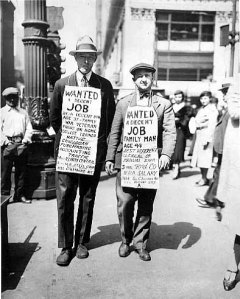
You can only watch a cash register so many times on the evening news before you realize how difficult it is to cover a complex, systemic issue like economics. Economic upheaval — and the resulting unemployment, hunger, and human suffering — is first visible (or invisible) in very “unsexy” computer bytes and programming code that record everything from credit default swaps to out-and-out Madoff-style thievery.
The other day someone in one of my classes remarked that, at least in the depression, there were countless visuals of suffering and a group of extraordinary photographers to record them. Those early 20th century images remain eloquent testimony of the suffering wrought by speculators and other assorted financial crooks.
Today, though, white-collar crime is more complex and more quiet. It is a stealth enterprise in which one corrupt accountant can press the send button on his or her computer, and send hundreds of phony profit statements reporting non-existent earnings to victims of the latest Ponzi scheme.
Well today it was all a little less baffling.
The PBS documentary series “Frontline” has produced an extraordinary 90 minute documentary that clearly explains how so many smart people lost so much money in Bernard Madoff’s scheme. The mechanics of the theft are fascinating.
But even more fascinating is the depiction of how people, happy with more and more profits, created a distorted picture of the world for themselves in which it was impossible to see even Madoff’s most ludicrous and bizarre behavior as anything unusual. Bernie was making them money , and it was oh so easy to imagine a world in which it all made sense. The documentary tells the stories of one shrewd person after another who, though capable of due diligence in every aspect of their lives, made room for Bernie’s peculiar practices simply because the money was good.
If Bernie the multibillion-dollar money manager happened to use one only one anonymous accountant whose office was in a strip mall, there had to be a reason. And who knew the reason? Bernie. Because Bernie was, after all, Bernie.
What an incredibly important lesson: At just the right moment, not two weeks or two months later when with hindsight everything becomes clear, we are capable of convincing ourselves of ridiculously implausible realities simply because the money is good.
I can’t recommend this documentary strongly enough. By the way, much of it is the reporting work of Frontline correspondent Martin Smith.
I am going to sound like a broken record soon, but there are sometimes when I simply can’t stop myself .
I thought my Chicago Tribune piece about maniacal cable news would make me feel better, calm me down a little, but it didn’t work.
Now it’s the shouters who often speak for me — my “loudmouths,” if you will — who are about to push me off the deep end.
Is there any chance, any chance at all, that hot air machines like Ed Schultz, Chrtis Matthews or Keith Olberman have any idea how deranged even their most persusave and courageous views can sound when they are shouted in a hyperventilating, salivating frenzy.
I wish I could think of a more nuanced way to put it, guys, but you have to switch to decaf. Your indignation, however justified, will emerge in the clarity and elegance of your argument and not with the accelerartion of your heart rate.
You look ridiculous. Bulging neck veins don’t make you more authoritative, they bring on heart attacks.
Here’s how sick of the nuttiness I am, how much I want the “debate by dynamite” to stop. I am going to quote from Richard Nixon’s first innaugural address. That’s right. Richard Nixon. Paragon of quiet, honest, reasoned argument.
I won’t suggest that Nixon followed his own advice, nor that he even wrote the following passage. But he did say it, and it keeps coming to mind as I watch the shoutocracy of cable news act as if they are mainlining Red Bull.
“To lower our voices would be a simple thing ….. We cannot learn from one another until we stop shouting at one another–until we speak quietly enough so that our words can be heard as well as our voices.”
Richard Nixon, January 20, 1969

Just when one photo becomes iconic — indeed, one of the most recognized images of the last several decades — some new ones of the same event surface.
This summer I am looking forward to teaching two classes.
At Hunter College, one summer session compresses a semester’s worth of work into eight weeks. One of those classes is Introduction to Media Studies, which I rarely teach. Every time I do, though, it is an opportunity to move out of the trees of specialization and get a good look at the whole forest.
To tell you the truth, I feel a little bit like the cowardly lion in the Wizard of Oz. Contemporary media and culture can be a scary forest. Social and technological change is taking place at breakneck speed. Media are pervasive and omnipresent. New technologies and social networks have so effectively penetrated social life that it is hard to find any remaining truly private spaces. Our TVs are computers and our computers are TVs.
And news is so instantaneous that, if some “god-forbid” catastrophic event happens to occur while I am teaching, it is possible that all of us in class with our various vibrating, digital gizmos will get a glimpse of the event on some tiny screen even before the first responders arrive on the scene of the actual event. We live in “real-time.”
(It’s actually quite a sight when, in one of my classes, a major news event takes place. Purses and pockets all across the room start to vibrate like a mini-earthquake!)
But one thing in particular worries me about this hyperventilating world: How — in the midst of all this noise, content, yelling, shouting, and reality programming – does someone who cares about an issue or an injustice make that issue heard and understood amidst the cacophony?
Some social problems, for a whole host of reasons, are not easily explained in this media environment. They may be complex, they may require nuanced thinking, or they may not have the kind of compelling visuals that get people’s pulse to quicken. Type 1 and Type 2 Diabetes, for example, are serious health problems. But if you are someone who wants to raise awareness or if you want to promote increased government funding, how do you get people all hot and bothered about something that might not affect them?
And so I wanted to share a passage from a wonderful New Yorker (May 18, 2009) article by Nick Paumgarten entitled “The Death of Kings: Notes from a Meltdown.” (Hunter students can access the article on Lexis-Nexis at the library database page.)
How, he asks, did such a massive financial collapse escape the attention of so many people? Why were people taken by surprise? His answer is one of the best comments on the role of media and the visual image that I have seen in a long time:
We are a visual species. In an economic crisis, in the early stages, at least (and we are likely still in the early stages, in spite of all the recent happy talk), the visible effects are subtle, if they are present at all. Maybe there are empty seats at the game. It is a mathematical predicament, an abstraction that expresses itself in dreary reports that don’t affect you, until they do. Deferred dreams aren’t news. Even the worst consequences-homelessness, hunger, untreated illness, everything short of civil unrest or outright revolution-aren’t spectacles. The history-making developments-the collapses of great or at least large institutions, the government’s deployments of sums beyond imagining, the exchange of gigantic liabilities for even more gigantic ones in the future, the effects these things have on geopolitics-are difficult to picture. People grasp at anecdotal observation: store closures, idle spouses, a rash of attacks by a mugger (a mugger!) with a pipe. The immigrants are going home.
How often do you wait for the compelling visual to get concerned?
And how often is that too late?
Normally I simply laugh off most of the shouting and screaming on 24 hour cable television news.
But yesterday I lost it, and the results are in today’s issue of the Chicago Tribune.
So now Judge Sotomayor’s “testy side” will be a talking point in the effort to derail her nomination.
Testy, huh?
What a pathetic strategy! Justice Scalia acts with astounding immaturity in public , at one point making an obscene gesture at a reporter, and it is largely laughed off.
Yet now, when a woman is reported to be possibly testy, all the big boys are running home to mommy because she might be mean to them.
If you have a problems with one of Judge Sotomayor’s opinions, speak up. Put her feet to the fire.
But to bring up issues like testiness and demeanor, after decades in which the “boys will be boys” rule basically excused any nonsense a man wanted to pull, beytrays the deep insecurity of men who still are terrified by the thought of an angry woman.
Yesterday, two students asked about two old columns of mine, one for the Washington Post and one for the International Herald Tribune. What’s strange about these being the ones they discovered is that there actually is one way they do belong together:
One was was as fun to write as anything I have ever done and the other was gut wrenching.
Here they are, as promised.
Psychologist Daniel Gilbert has a brilliant short piece in today’s Times about the fear that is engendered by uncertainty. He cites some fascinating studies in which subjects, to avoid or escape uncertainty, are willing to choose undesirable, yet clear and immediate, outcomes. The horror you know seems to trump an unknown future in which things might actually turn out to not be so bad.
How true! Our inability (and I do mean our ) to deal with uncertainty leads us into hole after hole. I was thinking of one of those holes in particular:
How many self-promoting, pseudo-experts — especially those who fill the bottomless news hole of 24 hour cable news — get airtime solely because, in times of uncertainty and ambiguity, they promise clarity? Of course, they never really deliver it. But how often do we seize their cockamamie “clarity” solely because we can’t live without immediate answers?
So many social problems defy easy explanations. Yet we still seem to go bonkers when, in a hyper-ventilating, instantaneous information environment, reporters and public officials fail to deliver quick answers that will sufficiently reduce our anxiety.
Do we know with any certainty the ultimate severity and trajectory of the H1N1 virus? Do we know why individuals erupt in senseless acts of mass violence? Do we really know why relationships fall apart? Or why hunger persists in a supposedly “developed” country?
In fact, we know a little bit about each of these vexing questions. In some cases we know a lot.
But certainty? Not a chance. Serious inquiry can reduce uncertainty and help us approach explanations for complex social phenomena. But it doesn’t provide certainty.
In fact, only one thing seems completely certain to me: There will never be a social crisis or problem that doesn’t spawn a crowd of “snake-oil ” hucksters who are all too happy to fill an uncertain void with pet theories, easy remedies, and ads for the products that will bring us the clarity we seek.
It’s a paradox, but it just might be that one of the most admirable qualities of an informed citizen in a complex world will be the ability to admit ignorance. Isn’t self-aware ignorance infinitely more honest than the bluster of phony certainty?
Some of the best excerpts from Saturday night.
One of the most brilliant and hilarious comedians on the planet, Wanda Sykes, will be hosting tonight’s White House Correspondent’s Association dinner. Watch it at 8 PM EDT live on C-Span.
I still can’t believe that the selection committee watched any of her videos. Or, if they did, I can’t believe that Wanda will somehow be able to resist, well, being Wanda.
Wanda Sykes. Face to face with President Barack Obama.
Now, if you’ll excuse me, I have to go make sure that my defibrilator has fresh batteries.
Have you ever been mesmerized by a film, haunted for days and even months, and been astonished at the length of time it takes for the emotional hangover to wear off?
Well get this:
For over 25 years I have been haunted by a film and, through all those years, I have never lost the uneasiness, the melancholy that came over me the day I first saw it.
I give up.
No I don’t have the flu.
But I have been laid up with a cold and – strangely enough – have found myself deliriously musing about all sorts of completely strange and random topics.
Of course, I have been thinking a lot about the pandemic, but before I say anything about H1N1, I have been trying to watch it unfold and think of some things to say that might actually be useful. This is a time when we can hear from too many voices, many well-intentioned, which speak with scandalously inadequate information. Some of you know I was very peripherally involved in pandemic planning, but I’ll get to that in a day or two.
For good or bad, these are some of the places my twisted mind has been visiting over the last couple days as I almost certainly try to subconsciously think about things other than a potential pandemic.

Now it is back to a movie so trashy, so juvenile, and so relentlessly idiotic that no one will ever, ever get me to reveal the title. Not even waterboarding would get me to admit it. Just thinking about the fact that I am watching is embarrassing.
Well, not really my moral core.
But yesterday I was mortified to find myself actually responding to a text message in the middle of class. And while I normally feel no great compulsion to give public confessions, this is different. Because just a week before, I had gently admonished a student who did the same thing.
I was showing a brief video excerpt to the class. The room was dark. Suddenly, I felt the vibrations from my new Blackberry storm in my shirt pocket. When I looked down, I saw the name of the sender who — whatever they were sending — could not have conceivably been the source of an emergency message. In other words, I could’ve waited. Easily.
Except that it wasn’t easy.
I couldn’t wait, and I actually hid the Blackberry from the class’es view and checked the message. Not only could it have waited, but I easily could have deleted it without opening it.
Aside from the fact that my Blackberry will now be turned off during class, it is probably a media professor’s occupational hazard that I can’t stop thinking about it. Why in the world did I feel a temporary, almost irresistible, compulsion to open that message? What information or psychic benefit did I imagine I would be missing if I waited twenty minutes until the end of class? Why was I unable to even think twice before I lost the kind of digital patience that I expect from students during class?
The answer isn’t that profound. We live in a society, and are immersed in a culture, in which the definition of connectedness keeps changing. We are sold devices that promise permanent connectedness. Our digital commercial culture regularly reminds us that even one moment out of the loop might be the precise moment in which we miss that once-in-a-lifetime message. We come to imagine that the costs of disconnectedness are too great to even imagine.
My brief moment of surreptitious texting also reminded me that, only a year or two ago, even a compulsive guy like me could wait several hours to read my e-mail. Yet yesterday I found myself easily slipping into a series of imagined, implausible scenarios in which failing to open one stupid e-mail could have all sorts of catastrophic consequences.
Is this crazy or what? Of course it is. And I can’t avoid thinking that there may even be some embarrassing amount of grandiosity in imagining that there was some urgent reason that I in particular had to open that particular message. Who do I think I am?
Of course I don’t want to do it again. But I am too aware of my own fears and insecurities to say that it won’t be a struggle. Even as I write this, I feel a small twinge of anxiety just contemplating an hour or two of disconnectedness.
And I don’t like the feeling.
Twenty nations gather to solve nothing less than an international calamity. The world watches with high hopes. Our futures hang in the balance.
So listen to what the impossibly irrelevant Oscar de la Renta has to say about it all. A real statesman, huh?
This is not the first time I have wondered whether someone gave Jack Shafer, Slate’s media critic, a hard time on the playground when he was a kid. For whatever reason, Shafer seems unable to resist occasionally punctuating his thoughtful criticism with the most bizarre, mean-spirited personal vitriole. Whenever he loses control, I feel like calling him and assuring him that he no longer has to worry about the kid who kicked him in the shins in 1962.
Well, Shafer has hit a new low.
Unless he is being tongue-in-cheek, or celebrating April Fool’s Day with a satrical impersonation of cruelty, I may never had read anything quite like “Are Times Publishers Born Stupid?” In the piece, Shafer takes a look at past and present New York Times publishers and asks whether they may represent a line of inherently stupid people.
Jack: Question the management decisions made by Times publishers. Question whether their views are adequately nuanced and informed. Question whether they have adapted to the challenge of new media or remained stuck in a defunct economic model. And feel free to characterize any statement or action of any past or present New York Times publisher as flat-out and astoundingly stupid.
But for you to write a piece about whether someone was “born stupid” only begs the obvious question:
Were you born cruel?
By the way, I would still read any column Shafer writes about who has made what mistakes at the New York Times, about who has said or done stupid things.
But Tuesday’s column was beyond cruel. It was peculiar. It was crazed.

A 4800 calorie hamburger the size of your head.
This calls for a TV special, an NPR feature, and a New York Times story.
Oh, right. The NY Times did a story.
How many of you have taken that widely circulated quiz to determine your “real” age? You know, the one that gives you a “health” age as opposed to your chronological age?
It turns that the “quiz” is a veiled attempt to extract health-related information from you that all sorts of marketers can use.
As the superb story in today’s Times points out, people reveal information in the course of doing the quiz that they almost certainly would not routinely disclose.
So if you do the quiz and then get an email about Boniva three weeks later, you’ll know why.
I am naturally skeptical of anything billed as “new” or “improved.” Chalk that up to a childhood when a “new” and “improved” Tide detergent came out every month or so.
Sharon Begley’s piece in the February 21st issue of Newsweek, Anatomy of a Scare, is a must read.
I am not sure I have ever seen a more complete and authoritative analysis of how one controversy over a medical issue played out in the mass media.
 MEDIA AND MAYHEM