A Giant Chorizo With Tires: Welcome to the Weinermobile!

Courtesy of my friend Dominic, an absolutely loony blog about the goings-on inside the Oscar Mayer Weinermobile as it travels the country — really imaginative marketing using new media tools.

I bring it to your attention for several reasons. 1) I find it stunning that the Weinermobile, an icon of 1950s hot-dog branding,  is still alive and kicking. 2)  It summons memories of one of the single greatest days of my life, the day in in 1960 when the Weinermobile visited Grovecenter School in Covina, California.

3) It reminds me of an incident three years ago out in the Jersey burbs. At the time, there was an immigrant family from Northern Mexico in the neighborhood whose 7 year-old son would come over and play with my daughter. One day, he was over when I heard that the Weinermobile was going to be visiting the nearby train station that morning.  I had to go and I had to take the kids.

But first I had to call his Mom, who spoke no English,  for permission.

And that phone call was the unforgettable memory:  In one five-minute phone conversation,  I learned that there is no amount of non-native fluency, no number of years of study and immersion, no amount of  Mexican music and literature to which you can be exposed that prepares you to even approach explaining a Weinermobile in Spanish.  All I remember is saying something about some guy who thought it would be cute to put wheels on a giant chorizo.

I do, though, remember her perfect reaction, which she sort of mumbled across the room to her husband and which she didnt seem to intend for me to hear:

For this we went through years of legal immigration procedures? A giant  chorizo with tires?

Waiting to See Which Media Outlet, If Any, Will Eternally Shame Themselves By Paying White House Party Crashers for Interview

Actually,  I hope none of you are even wasting 5 seconds of time thinking about the fame-starved loony-tunes who crashed the White House State Dinner this past week.  I certainly would not have been were it not for this AP story reporting that Mr. and Mrs. “Even a Tux and Gown Can’t Hide Our Essential Stupidity” are now trying to sell the rights to an interview.

No shock, of course.  “Cashing-in” after having done something stupid, and having media outlets willing to pay,  is a great American tradition that includes all sorts of  noble behavior. In fact,  I think  Michaele and Tareq Salahi have earned themselves a place of honor right up there with people who dump medical waste on beaches,  laugh at people when they trip and fall, or bring  whoopee cushions with them to church.

We are talking major-league idiocy.

But their stupidity might, I repeat might, be about to be quickly surpassed.  Because any media outlet with even a pretense of seriousness that actually does pay the Salahis for an interview, or that in any way enriches these pathetic jokers, will immediately knock them out of first place on the National Registry of Shameless  Stupidity.

The world will always  have jerks.  Many of us, myself included, will on occasion be those jerks. And the world will always have people willing to reward jerks.

But there is no reason that the rest of us  have to stand back and be silently complicit.

This is the precise moment when we should be watching,  and watching closely, for any evidence that the Salahis have been paid for an interview.  If this happens, the name of the offending media outlet should be blogged and tweeted and printed and sung and shouted until the whole world knows who decided that this was valuable news.

Then, only one task will remain: Each of us will have to ask ourselves  how and why we might have been complicit members of an audience that, again and again, has proven itself willing to watch these paid interviews with people like Mr. and Mrs. “Even a Tux and Gown Can’t Hide Our Essential Stupidity.’


A Special Comment on the Tragic Stabbing Death of Dwight Johnson

Moments ago I received the comment above about my last post. I have a response:

Cassandra: If I am interpreting your comment correctly, and you are Dwight’s cousin,  I want you and your family to know how very sad I am about what happened.  I cannot even begin to imagine the pain that all of you are feeling. I am thinking a lot  today about the fragility of life and the speed with which it can be tragically and cruelly ended.

Only the photographer can speak about the photographs themselves  and the decision to take them when she did. I reported the story that appeared  in the New York Times to students of mine who I thought might learn something valuable.

But I have a confession and an apology:  I am not happy with my initial reaction. I did think the incident and the photographs taken were vivid and interesting evidence of the speed and confusion with which these tragic events unfold.

But the minute I saw your email, I realized something else: My first reaction as a news consumer reading about the tragedy should have been concern for Dwight and all of you who today are living with this unbearable pain. My knee-jerk reaction was all too typical:  I  let the details of the incident obscure the single most important fact, i.e., that a precious human life was lost.

I once wrote an article about this very issue and you can read it here.  I wish I had remembered what I wrote. We all have to struggle to remember the foundation of grief and raw emotion that is always right there beneath the daily flood of events.

My only thought about the actions of the photographer  comes from work I have done studying how sudden traumatic events unfold and how they are covered in the media.  Explaining why people act  in certain ways under such extraordinary circumstances is almost impossible.  What seems logical moments later — and even days and weeks later —  often was not as obvious in the moment. Many of us, myself included, look back with regret to incidents in which we acted one way and not another. Our decision may have had tragic consequences. And sometimes we should have known better.

Much of the time, though, what we should have or could have done only becomes clear after the fact, and we have to be very careful not to judge ourselves too harshly. It is so important to remember just how fragile and human we are.

But what matters today is Dwight. I am thinking about you and your family.

All best wishes and deepest sympathy,

Steve Gorelick

A Subway, A Young Photographer, and a Stabbing

What a story.

Take a look at the kind of photographs that were taken by a young photographer  in the midst of  a frenzy of sudden violence on a subway.  This will occur more and more in an  era when most of us carry around some sort of camera device.

These spontaneous pictures, with all the frenzy and fear they depict, are an unusual window into the precise, confused  moment when panic strikes in a public place.

Things You Might Check Before Reporting Your Car Stolen

Directly from the pages of my local New Jersey community newspaper, local  journalism at its best:

Tuesday, November 17, a resident of

________Road reported that a motor

vehicle that he had borrowed from

his son-in-law was stolen from his driveway,

where he had parked it and left it

unlocked. According to police, the vehicle

was later located in a neighbor’s

driveway, where it had apparently rolled

after being left in neutral.

Bill Sparkman: Suicide, Not Murder.

This is a very sad post.

And despite some of the research areas in which I work, I am not a big fan of sadness. I don’t like it at all.

Students and colleagues sometimes laugh when I tell them I love joy and music and gut-splitting laughter. Because there isn’t too much of that in studies of media and violence and catastrophe.  I mean, it is only rational for someone to open our college catalogue,  see a grad seminar entitled Disease and Disaster in Media and Culture — and wonder if the instructor is rowing with all oars in the water. (Actually,  all his oars aren’t always in the water, but that’s another story).

I can only say that my fascination and curiosity  about violence was born of an intense curiosity about the effects of crime and violence on society and social institutions, everything from families to nations.  I won’t bore you again with childhood experience that planted this seed.

The sad story I want to share is about a murder that turned out not to be a murder.

On September 13, 2009, a US Census Bureau employee named Bill Sparkman was found hanged in an isolated location in rural Kentucky with the word “Fed” scrawled on his chest. This was at a time when anti-federal rage was on fire across the country in the form of  health reform town meetings being mobbed by people who find any government involvement ion health care to be a mortal sin.  (These , by the way, are overwhelmingly people WITH health insurance.)

The immediate assumption was that Bill Sparkman had been murdered.

It is easy to see why the media jumped on the murder narrative. All of us need to come up with some story that makes something horrible even slightly comprehensible. The murder of a “Fed” was as plausible as any other theory, and the fact that it took place in Kentucky summoned distant memories of the feds who came looking for illegal moonshine during prohibition. The story received enormous coverage.

The problem is that Bill Sparkman was not murdered. The official report just released details an elaborate suicide plan in which Mr. Sparkman would fake  his own murder so his son could collect his life insurance.

This is, of course, achingly sad for both Mr. Sparkman and his family. But I raise the story in Media and Mayhem to make an important point. There are times when everything about an incident points to one explanation. But this is precisely the point when a skilled journalist or media consumer or plain old citizen will ask what at the time seems like a dumb question: Yes, it looks like a murder, or yes it looks like a stranger abduction, but what is every other even slightly plausible explanations that has to be ruled out? Why might this NOT be what it looks like?

Supposed stranger abductions, for example, are only very rarely actual stranger abductions.

Very few people did that in this case. And it is a lesson to be learned and mulled over again and again.  The obvious and the plausible are often wrong. Sometimes that is because someone wanted to create a false impression to hide their culpability and sometimes no one is at fault. The guiltiest “looking” person can be innocent. And the most innocent looking person can be guilty. The point is that society gets in deep trouble when it jumps to conclusions based on looks and other stereotypes.  The single most horrifying story I have ever seen of a  “guilty” man who turned out to be completely innocent is detailed in the riveting HBO documentary The Trials of Darryl Hunt.

The trick of responsible citizenship, the kind of citizenship in which we place a high premium on truth, is to  never accept the obvious narrative immediately and to always  await the inevitably complex and nuanced details that are really what  make us human.

Finally, responsible citizenship requires our compassion. Oh,  we can be angry at a man whose deception scared a lot of good people . But we also might at least consider feeling compassion, even grief,  for a human being in such personal pain that this kind of scheme seemed the only way out.

The Family Stories That Surround You: National Day of Listening

Don’t ever forget that they very family that may surround you with all sorts of contradictory feelings — everything from love to anger; from dysfunction to support — is also a source of oral hsitory and audio narrative that  might someday mean a lot to you, either as a tool for self-exploration or as a way of sharing your family history with generations to come.

Learn audio. Record. Collect. Don’t wait.

Serious Reading: Sixty Hours of Terror: Ten Gunmen, Ten Minutes by Jason Motlagh

The November 16th issue Virginia Quarterly Review  has an incredible 4 part series by journalist Jason Motlagh on the events in Mumbai.

Highly recommended.

Sundry Recommendations

I have some miscellaneous and  enthusiastic recommendations.  They may not be everyone’s cup of java but they sure grabbed me, each wonderful examples of the reach of compelling content being extended by digital tools.

1) The first is outright embarrassing: Because, for a guy who at least tries to convince himself that he is wired,  it turns out that this “new”  discovery from American Public Media has been around since  2001.

Many of you farther along on the “wired” continuum already know about Krista Tippet’s Speaking of Faith, an American Public Media production billed as “public radio’s national conversation about belief, meaning, ethics, and ideas.” Well, I had no idea. And I simply want to pass on that, if you are someone who at least contemplates matters of the spirit, God, holiness, and compassion, you must give Krista’s broadcast a listen.  It moves back and forth between many of the world’s religions and, rather than working the typical extremes of the age of fundamentalism,  most of the discussions take place in the messy, complex middle where most of us actually live.

One broadcast worth downloading is a panel discussion with Krista, David Brookes and EJ Dionne discussing the theologian Reinhold Niebuhr..

Another program on German theologian Dietrich Bonhoeffer is riveting.

2) I also recommend a new on-line version of a class entitled “Justice: What is the Right Thing to DO?” at Harvard taught by Michael Sandel that has long been one of the University’s most popular courses.  The entire course, filmed elegantly with multiple cameras capturing student reactions and questions, can be seen here.

3)  A great guide to all of the podcasts and courses and provocative discussion freely available for download can be found at http://www.openculture.com/.

4) Finally, and I will understand if you are a little skeptical,  is the incredibly rich and fun Oxford Dictionary of National Biography. Each week they will send you a podcast of one of the biographical entries read aloud. I can only tell you that they are amazingly absorbing, incredibly entertaining.  Yes, I used the word “fun.” One week it is the famed, hard-living UK footballer George Best. And then comes poet Phillip Larkin. These are not standard reference entries. They are brilliantly written short takes on lives,  they have a point of view and — sometimes if the subject calls for it — they are hillarious.

Their podcast of the biography of spy Anthony Blunt is a great place to start.

5) Finally, to hear some extraordinary true-life story-telling from an organization doing all it can to keep the spoken, performed story alive, check out the podcasts from The Moth.  Real people. Real Stories. Performed live. And a lot of laughter, pain, and everything in between.

Fun stuff.

Google Puts Supreme Court Decisions On-Line

These decisions are widely available, but the move by Google will really make them easy to find.

My Ten Favorite Films: A Revised List

Every time I talk about top 10 lists,  I always start with the  disclaimer that I know  how pointless they are.

And then I ask myself:  OK, if they are  so pointless, why do I have so much fun reading them and doing  them and sharing them?

No good answer, In fact, making lists is far from the only pointless thing I do.

Today, I am adding some new films and slightly changing the order.   It is not a 10 best list.  It is a list of my ten favorites. A  list of 10 best films  would be beyond nervy given how many films have a legitimate claim to inclusion.

But it seems perfectly fair to make a list of ten favorites since they are, in fact,  only my favorites.

My favorites have stayed the same for over a year.  But for the last few months I have been mulling over “No Country for Old Men”  and “The Lives of Others.” (Now I can really hear you saying: This guy need a life! Who has time to mull anything over?)

Seriously, I want to make some changes to my list.  But according to ground rules that some friends of mine and I set up many years ago in a UCLA dorm room, I have to remove one film for each one I add.  I posted my last 10 favorite about a year ago. Here is my new one along with a list of contenders.

Comments welcome. Lists welcome. Ridicule welcome.

My Ten Favorite Films as of November 15, 2009

1. Dekalog

2. Godfather 1/Godfather 2

3.  Salesman

4. The Lives of Others

5. Amarcord

6.  Goodfellas

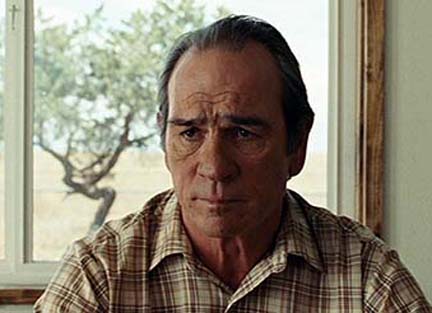
7  No Country for Old Men

8  Fargo

9. Rear Window

10 Night and Fog

__________________________________

Other Contenders (not in order)

Midnight Cowboy

Mr. Smith Goes to Washington

Au Revoir les Enfants

Shop on Main Street  (1965)

It’s a Wonderful Life

Jeux interdits

Come and See

Smile

Atlantic City

Three Kings

Das Boot

The General

Paris, Texas

Shoah

Invaders from Mars

Strangers on a Train

The Graduate

The French Connection

Double Indemnity

Les Enfants du Paradis

Les Diaboliques

Psycho

Le Salaire de la peur

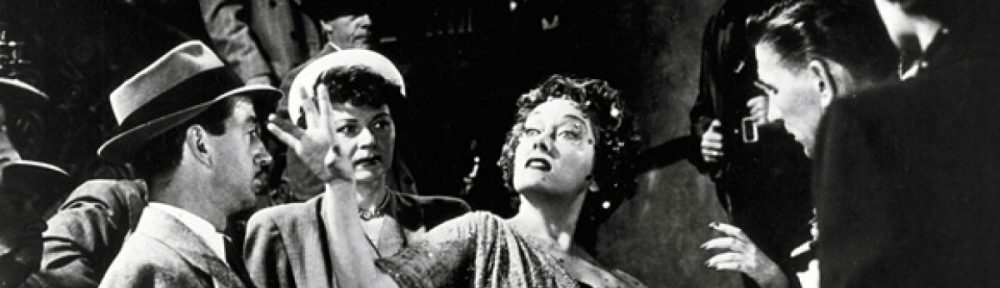
Sunset Boulevard

The Exiles

The Last Laugh

Hotel Terminus

Happiness

The Third Man

M

The Marriage of Maria Braun

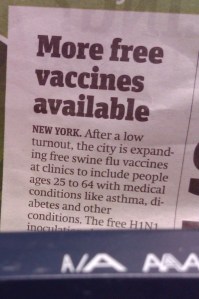
Large Supplies of H1N1 Vaccine Arriving. Apparently This Isn’t As Exciting a News Story As The Previous Shortage.

h1n1 news

I am not unaware that there are wide geographical differences in the distribution of the H1N1 vaccine. Some places need more vaccine and others have a surplus. No system of logistics is ever that flawless. But the story this week from multiple sources is that large supplies of the vaccine are reaching the public.

It’s just that vaccine arriving apparently isn’t as compelling a news story as a vaccine shortage.

I took the photo above from the page of one of the free newspapers that are handed out in the NYC Subway system. The story goes on to say that the supply of H1N1 vaccine is now so extensive in NYC that they are offering it to age cohorts that had previously been excluded because of  the urgent need to get the vaccine to kids at highest risk.

But in what is a typical pattern of press coverage, the early vaccine shortage got the  sensational coverage while the current successful broad distribution of the vaccine has gone relatively unnoticed. The only news story we would be less likely to hear about would be a  group of “keep the government out of health care” ideologues now announcing their gratitude because, without the government, many of their children would not have been vaccinated.

To tell you the truth, though, I no longer pay much attention to “get the government out of people’s lives”  crowd. Normally it would be a point of view that would deserve fair discussion and debate, and serious libertarians — however misguided — are at least consistent enough to be mildly interesting to speak with — but the hypocrisy of so many of those who complain about government  is simply too blatant. 

It turns out that  a more accurate statement of their  philosophy is “keep the government out of our lives” except in all the cases in which we DO want the  government in your lives.

PS. I am going to go to Google Earth right now, choosing a random US location with my eyes closed, and then checkng  the government web site to see if vaccine is available there. In fact, I’ll do two locations. My question is: At each of the two locations, is there vaccine available and how easy would it be to obtain?

Results:

1. My first random stop was an absolutely gorgeous piece of farmland in Greenville, Kentucky. On checking, every school child in Muhlenberg  has been offered a free H1N1 vaccination.

2. Stop #2  was  also a beautiful rural location, Hitchcock, Oklahoma. Located in Blaine County,  the population of Hitchcock doesn’t quite crack 200. Every Tueday and Thursday in Blaine County, an H1N1 clinic is being offered in Watonga.

It’s not that this problem is fully solved.

It’s the foolishness of those who loathe the thought of the government in health care but who couldn’ t get in line for the vaccine fast enough, the people who griped about a shortage but who will be unwilling to acknowledge the now successful effort that is making it possible for their kids to be protected.

Remembering Ulrich Mühe on the 20th Anniversary of the Fall of the Berlin Wall

muheuniform

Some of the facts that show up in my blog statistics are real mysteries. And this week there is one that has me fascinated.

All of a sudden my post about Ulrich Mühe —  Friedrich Hans Ulrich Mühe: An Actor Who Needed Only One Tear —   had an unexpected  increase in hits. I’d love to hear from anyone who knows why. (And right at the moment I write this,  I realize that — at the 20th Anniversary of the fall of the Berlin Wall — it makes perfect sensed that people would think about him.)

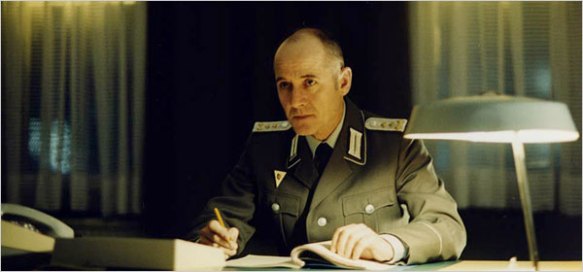
His performance in 2006 as an East German Stasi agent  in Florian Henckel von Donnersmarck’s Das Leben der Anderen ( The Lives of Others)  is so  emotionally shattering  that, as I sit here playing it over in my head scene by scene,  I find it hard to even discuss.  Mühe died in 2007 and lived a life inextricably tied to the separation and later reunification of Germany. He should be remembered and his work honored. Much of his early work took place on the stage in East Germany before unification.

Actually I do have one more thing to say: Sometime Media and Mayhem commenter Dominic, my friend from high school and a talented filmmaker and animation artist, once told me something about the film that mortified me so much that I never even mentioned it to him again.  Ever since I have been silently trying convince myself that he really didn’t  say it.

But I still have to ask: There isn’ t going to be a Hollywood re-make, is there?

Say it ain’t so.

Hulu: Graveyard of Astoundingly Bad Feature Films

Have you ever perused the feature films available for viewing on Hulu? I understand the economics that precludes quality product from showing up as freebies. But the available films look like someone was given the specific assignment of finding the worst films possible.

In fact, it is such a perfectly putrid list of films that only an expert with exquisite taste could compile it. You would have to be so knowledgeable that you could authoritatively and instantly reject any film with even a few seconds of redeeming quality.

I only mention this because I saw a rumor in the trades that ad-supported Hulu was contemplating a pay-wall.  I can hear all of you pulling out your credit cards.

But I say let a thousand flowers bloom.  If you succeed, guys, I’m buying the rights to Ishtar and Waterworld  for national theatrical release.


Mr. Speaker, I Ask That You Grant The Opponents of Health Care Unanimous Consent to Revise and Extend Their Selfishness

True Story:

An hour ago — with full sincerity — I chided my 12 year-old daughter for a comment she made as we were watching the House debate on the health care.  She had heard a comment by an opponent of the health care bill and crossed what I have struggled to teach her about the  “civility” line.  So I found myself  coming up with words that —  while sappy and saccharine —  I think I still believe.

“It’s true, I said, I don’t agree with what he said either. But this doesn’t mean he is a bad person.  In our country we can disagree and still be kind to each other.”

Part of me was gagging with guilt as I said it. I remembered all the distinctly uncivil rage she has seen me express.  I knew that she knew that I don’t always live those words.  But I still believe that quaint qualities like kindness and decency and civility are anything but quaint.

Then I turned on the television and began to watch the health care debate. And wouldn’t you know that here I am struggling with the civility thing again.

Why is it that, among all the speakers opposing the health care bill, not one representative — not one — started with anything close to the following:

“We rise in opposition to the health care bill. But before we make clear why this is a bad bill, we want to clearly state for the record that we are not blind to the pain of the uninsured and  unemployed, we are not blind to the thousands of uninsured children who were taken to emergency rooms today with life-threatening  illnesses, we are not blind to productive, employed  people who — in a flash — find themselves unemployed and uninsured, we are not blind to the struggles of those in pain. We don’t disagree about compassion, we disagree on how to be compassionate.”

I did not, and have not, heard one opponent say anything close to this.  I have not heard one opponent, before launching into his or her argument, give even a tip of the hat to the fact that somebody, somewhere is hurting. Apparently, this wasn’t on the list of approved talking points.

I  really do want to hear your argument.

But don’t say anything — NOT ONE THING — before at least one of you  makes a simple statement of concern (2 -3 words would count) for all the people who can’t take the time to think about politics when they are busy deciding which of their three kids will get treated first and who will get which medication.

C’mon guys:  Say you feel bad. Say you know hurt when you see it.  Acknowledge the existence of people who have done everything right but who find themselves uninsured for a whole host of reasons.  Then you can dump on the bill to your heart’s content. I’ll even try to listen quietly.

But if you want me or any other supporter of the bill to take your objections seriously,  we are waiting to see any sign — OK, I’ll settle for body language or even a wink of the eye —  that signals any compassion underlying your obsession with government control.

So far,  all I hear about  is   socialism,  the end of free choice, and Nancy “Beelzebub” Pelosi. You think you are right and I think you are wrong.  That’s  our system.  I respect your right to express your views. If you were sitting here now I would listen respectfully.

But I insist on an answer to this question:  Why has there not been one opponent today who has  who preceded his or her argument  with an affirmation of  plain, old-fashioned compassion? Couldn’t  you have at least lied and pretended that compassion is a fundamental value?

I am still trying to hang in there with civility, but can’t you see how loudly your silence speaks?  You have not given us one reason to think your script goes anywhere beyond government control, socialism, and dumping on Nancy Pelosi.

C’mon, compassion isnt controversial, it’s not some rhetorical trick. It is Sunday school stuff and , while I wasn’t always listening during the bible passage, I apparently was awake during the part about sharing and giving and sacrifice.

Your silence  speaks volumes.  And yes,  I grant unanimous consent for you to revise and extend your selfishness.


Covering the Ft. Hood Incident

There are two great short essays in the Columbia Journalism Review that explain perfectly why the instant cable coverage of sudden catastrophes is often so astoundingly misinformed and incompetent.

To watch talking heads, lacking much if any authoritative information, coming to instant, facile conclusions about suspects, motives, and details is not to watch journalism. It is the equivalent of attending a seance  or meeting with a psychic. Armed with little knowledge and even less common sense, these hyper-ventilating bloviators fill the air with conjecture that is so uninformed, so embarrassingly foolish, that the only thing clarified is their incompetence. They will dispense psychiatric diagnoses, forensic theories, and all sorts of  other expert opinions when the only thing they lack is — whoops — expertise.

I am going to start to cite specific examples so I can then provide names.  All I know is that, if there was ever a time when 24 hour cable news performers showed any journalistic restraint  and  skepticism,  that is now history.

One laughable example is a CNN reporter who not only freely offers his strange guesses about what might be going on and compares one incident with another he may have covered a few years back. He also asks questions of witnesses  in which he coaxes them, not to inform, but  to guess, to imagine, to hypothesize. After what I saw during the Ft. Hood coverage, I am now on a mission to bring you specific examples of just how speculative  a talking head can be when hyperventilation rather than reporting is the goal.

I Have Heard From One of the “Soldiers of the Selfish Revolution”©

I just received this comment and wanted to share it and my response with you.  Someone was trying to be amusing, and even if it is clear that comedy isn’t in his future,  he does reveal the carricature of the lazy uninsured that the “soldiers of the selfish revolution”© are trying to promote.

Comment: “I agree, I smoke and over eat, I am way overweight and I just found out I have diabetes. It’s only fair rich healthy people should pay for my health care. I have the freedom to abuse myself thats being a good american. I should nit be punished with higher insurance cost just becouse I love life.”

My Response: You’ re hilarious. And with a little work on spelling and grammar you could be a real comedian.

For now I can only say that your silliness is actually very useful.

Because I have never read a more perfect description of the stereotype of the uninsured that the soldiers of the selfish revolution© would like you to believe. The picture of the uninsured that they promote is full of fat, lazy, self-destructive gluttons who want us “good people” to fund their debauchery. What pathetic nonsense. Do you really buy this?

Come to New York City and I’ll take you to some children’s health clinics and introduce you to some of these creeps. Together we’ll look for the slobs, the drunks, and the smokers. Just don’t say I didn’t warn you about your inevitable disappointment when all we find are uninsured children choking from asthma, unisured parents unable to afford life-saving medications, and kids who go to emergency rooms for an infection of some sort but who are then diagnosed with malnutrition. Really lazy creeps, huh?

By the way, you are sort of right about one thing. Our premiums are higher because of the unhealthy lifestyles people embrace. But you are looking in the wrong place: If you really want to find the overeating, drinking, and smoking, come out to the burbs and I’ll take you on a trip you’ll never forget. We’ve got eaters and drinkers and smokers by the bushel. But I warn you: They virtually all have great health insurance and big houses and big appetites and, yes, your premium is higher to partially subsidize their irresponsibility.

I’d Laugh If I Wasn’t Screaming: The Revolt of “The Soldiers of The Selfish Revolution”©

Absolutely and mind-bogglingly astounding.

Today, in a compelling demonstration of just how compassionate and altruistic some people can be, thousands of people with health insurance gathered on Capitol Hill to protest a bill that would provide some coverage for those who are not covered.

What happened to the grand American tradition of at least being a little ashamed and even secretive about your selfishness? Now, apparently, you can boldly and even proudly trumpet your belief that your good fortune should not be extended to others.

I can’t believe that some of these soldiers of the selfish revolution © didn’t at least wear masks.

Yes I’m angry. But I learned a long time ago to always look for the sadness underneath my occasional ranting and raving. And this time it wasn’t hard to find: I share a country with at least some people whose social conscience ends right at the place where the needs, sometimes the desperate needs, of others have to be considered.

Listen to the wisdom of one of these anti-government  misanthropes:

“It’s time to make a stand,” he said. “We want to see limited government, not more taxes put in our face. We don’t believe our health care system entirely broken. We need to slow down, stop and start over with this legislation.”

Mr. Scevola said that he had health insurance through his employer. “Kaiser Permanente,” he said proudly. “They are the best on the West Coast.”

I’m so thrilled he is happy with his coverage.

Helvetica

spinal

I am the last person who expected to find a documentary about a typeface to be riveting. Yet for two years, Gary Hustwit’s documentary Helvetica has stuck with me, a brilliant examination of how typefaces worm their way into the very nature of how we perceive the world.

One result of great documentary is to reveal the significance of something that, in its very pervasiveness, was completely missed and taken for granted.   Antonio Gramsci pointed out as well as anyone how much implicit ideology we miss when we take reality for granted, when we avoid looking closely at assumptions and words and symbols — and, yes, typefaces — that seem self-evident.

This is the accomplishment of Helvetica.  A must for students of media, culture, design, digital culture.

Another Brilliant Coup for Pro Publica: Abuses at University of Phoenix

Whether the non-profit model for investigative journalism ultimately catches fire, the best of the current non-profit organizations doing in-depth reporting is Pro-Publica.   I previously called your attention to Pro Publica’s  incredible cooperative reporting effort with the New York Times, written and reported by Sheri Fink, detailing the struggle for survival inside Memorial Hospital during Hurricane Katrina.

And now another: Pro-Publica reporter Sharona Coutts has written a detailed and compelling report about abuses at the University of Phoenix, the nation’s largest for-profit university that relies heavily on on-line instruction.  The report details mind-boggling recruiting and financial aid abuses.

One reason I get excited about the Pro-Publica model, even though it may be short-lived, is that  it is almost impossible to imagine a major media outlet covering a story like this with substantial human and financial resources. Yet it is a story that must see the light of day  in an  economy in which countless prospective students are desperately seeking the training they need to keep their head above water.

Pro Publica deserves a real pat on the back.

My 12 Year-Old Daughter Gets an H1N1 Vaccination: With Gratitude to the Much Loathed Public Option

H1N1

Every so often, “Media and Mayhem” focuses on the “Mayhem” part of the blog title.

For many years I have been studying how society — media, government, all institutions — operate during times of  social stress. What happens when normal social norms and media practices confront catastrophe or danger? How does an atmosphere of fear  affect our behavior and our attitudes? How do all the new and old media of communication respond?

A pandemic is an interesting case. It is not an event in which illness and death occur in one mass conflagration, but a series of events — millions in fact — that occur outside the lens of collective public scrutiny.  In other words, you don’t see the whole thing at once.

On any given day and at any given moment, most people are feeling fine. They very well might not have seen anyone sick.  Pandemic damage unfolds slowly,  the  cumulative effect of all these infections and deaths.  The mass media will cover the worst (and all too real) atrocity tales of young children dying quickly  and unexpectedly, but the massive and speedy infection of millions of people will occur quietly.  No buildings explode. No  planes crash. No bridges collapse.  The infection spreads.

And the solutions are not the kind of visible dramatic actions that are unleashed after other kinds of catastrophes: There are no beaches to storm with troops, no fire trucks to dispatch.

There are vaccinations. Hand washing. And if symptoms occur, there is a very effective drug called Tamiflu.

So this weekend I took my 12 year-old daughter for a vaccination. I am almost  embarrassed at the amount of expert opinion I sought before doing this. But after I was absolutely convinced that it was important,  and after reading the most recent statistics about who was at risk (I actually am a regular reader of an outstanding government publication with the appetizing title “Mortality and Morbidity”) , we got in the car and drove to a county health department here in New Jersey.

And I still can’t believe what I encountered.

The county staff could not have been more efficient and welcoming. This was public health at its best. Long lines of children most likely to suffer serious complications from an infection were getting the vaccine.  The line was moving. And I saw many seriously disabled kids whose disabilities, I was told, made them especially vulnerable to complications if they got the flu.

And wouldn’t  you know that here and there people in line were using the time to rail against health care reform, to moan about the disaster that is inevitable when the government gets involved in health care. I was incredulous. Here they were,  potentially protecting the lives of their children courtesy of an efficient government effort to deliver vaccine, and their response was to complain.

But this post is not about what health  care reform should look like or how much government-delivered care there should be.  It’s not even that much about the complaining I heard.  Scared people look for scapegoats,  and while I might think they are horribly misguided,  I learned long ago that people concerned  about a threat to their children (me too) will babble all manner of  legends,  folk-theories,  and political propaganda.

What I did learn was the way that fear can blind people to painfully obvious facts. Who did these people think had gotten them the vaccine?  Pharmaceutical companies produced it.  And then thousands of much-maligned bureaucrats at federal and state agencies, schools, health departments, law enforcement agencies, and other institutions worked to get it to my daughter on October 31, 2009 at 3:00PM on a rainy Saturday.

I will not romanticize the functioning of any large institution. Logistics and organization can be messy, confusing, and occasionally negligent. It is all part of how institutions  function.

But could there  be anything more misguided and loony than to get angry at the involvement of government in health care at the very moment that government has delivered a dose of vaccine to your child?

To the some of the moms and dads I met Saturday : It’s natural to be afraid. It’s even natural to lash out after seeing a news report about children dying. It’s natural to channel your fear into blame. But just because its natural doesnt mean it isn’t dumb.  It was one of those bureaucrats  doing their job — and doing it well — that got you the vaccine.

And before you so quickly buy into the dishonest reactionary demonization of  any government involvement in health care, remember the public health nurse who calmed your little one down before the vaccination.

You know which one.  The nurse to the right.  The smiling one. The one from the government.